
In commercial buildings, industrial plants, clean room HVAC systems and large combined air conditioning units (AHU), bag filters (also called bag filters) are widely used medium-efficiency air filtration equipment.
Compared with traditional plate filters, bag filters adopt a multi-bag structure to increase the effective filtration area and improve ventilation processing capabilities. They have the following advantages:
Large dust holding capacity
Long service life
Low replacement frequency
Suitable for large air volume HVAC systems
However, in the actual project procurement process, many customers will encounter these questions:
How to choose F5, F6, F7, F8, F9 grade bag filters?
The more filter bags, the better the filtration performance?
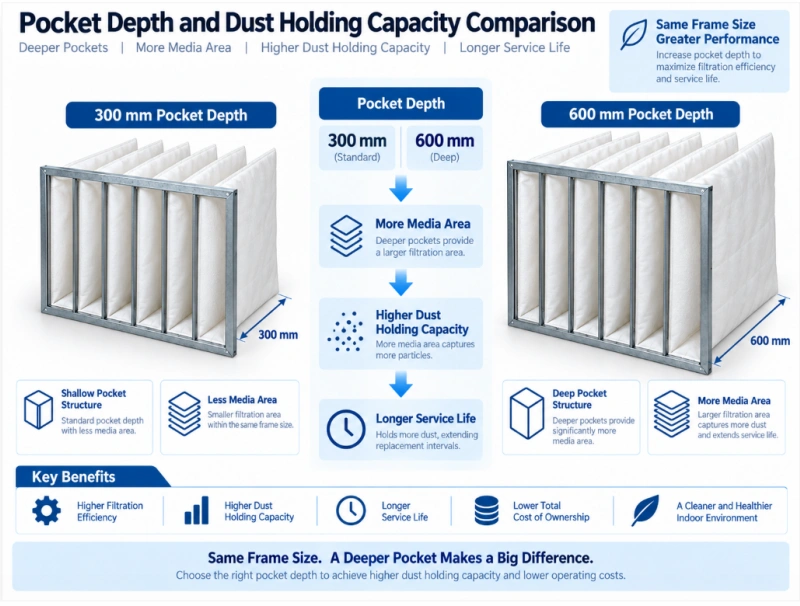
What is the difference between a filter with a bag depth of 300mm and a bag depth of 600mm?
Why are bag filters with the same appearance and size different in air volume and resistance?
How to choose bag filters for combined air conditioning units (AHU)?
In fact, bag filter selection cannot only look at filtration efficiency. Engineers also need to comprehensively consider: filtration efficiency, number of filter bags, filter bag depth, rated air volume, initial resistance, final resistance, installation space and long-term operating costs.
A properly selected bag filter can not only meet air quality requirements, but also reduce the energy consumption of the HVAC system and improve the operational stability of the filtration system.
1. What problems does bag filter solve?
Bag filters are generally installed in the medium-efficiency filtration section of air conditioning systems and are widely used in:
Combined air conditioning unit (AHU)
Fresh air unit
Industrial ventilation system
Clean room HVAC system
Commercial HVAC system
Its main function: before the air enters the end high-efficiency filter, it further intercepts particles in the air and reduces the particle load of the rear-end high-efficiency filter.
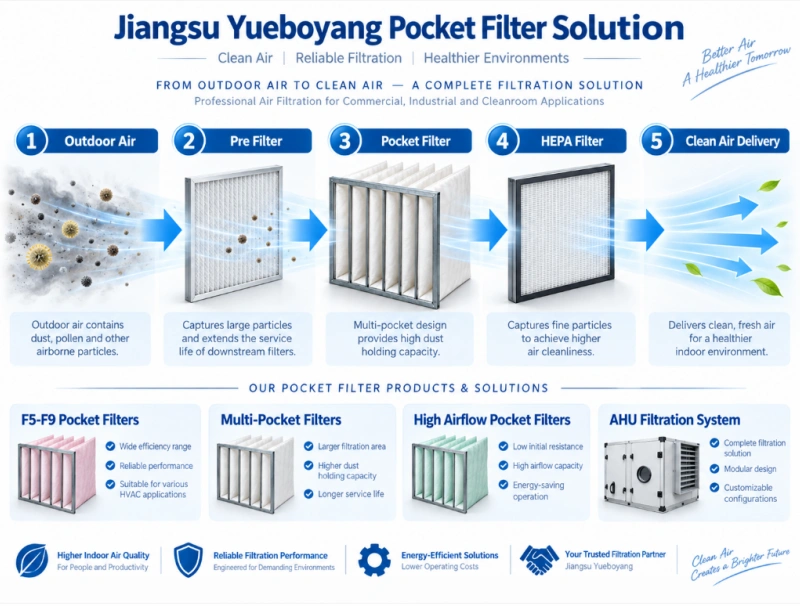
Typical air filtration process: new style ↓ primary filter ↓ bag filter ↓ high efficiency filter ↓ Clean air supply
Primary filter: intercepts large particles of dust and fiber impurities. Bag filter: captures finer particles and protects the rear-end high-efficiency filter. High-efficiency filter: Complete terminal advanced air purification.
It can be seen that the bag filter cannot replace the high-efficiency filter. It plays an important intermediate filtration function in the entire air filtration system.
2. How to choose the efficiency grade of F5‑F9 bag filter
Bag filters are divided into the following grades according to the filtration efficiency:
Table
| Filter level | Typical application scenarios | Features |
|---|---|---|
| F5 | General HVAC system | Basic particle filtration |
| F6 | Commercial buildings | Filtering effect further improved |
| F7 | ||
| F9 | High cleanliness conditions | Advanced pre-filtration |
In actual projects, the higher the efficiency level, the better.
Commercial HVAC: Generally, F6‑F7 is used to meet the needs for improving indoor air quality. Industrial plants: In working conditions with high dust concentration, continuous operation of equipment, and high cleanliness requirements, F7‑F8 bag filters are usually used. Clean room HVAC system: In order to protect the high-efficiency filter, F8‑F9 bag filter is commonly used as pre-filtration.
Selecting the filter grade requires comprehensive consideration: back-end filtration equipment requirements, fan residual pressure head, energy consumption indicators, and on-site operating conditions.
3. Why do the number of filter bags and depth of filter bags affect filtration performance?
The core advantage of bag filters comes from the increase in filtration area. The filtration area increases → the wind speed on the filter material surface decreases → the resistance decreases → the dust holding capacity increases → the service life is extended.
Common filter bag depths: 300mm, 380mm, 500mm, 600mm, 750mm, 900mm Common number of filter bags: 3 bags, 5 bags, 6 bags, 8 bags, 10 bags
Example: Under the same conditions, 600mm bag depth compared to 300mm bag depth filter:
Larger filtration area
Stronger dust holding capacity
Longer replacement cycle
However, the deeper the filter bag, the more suitable it is. The selection also needs to take into account: internal installation space of the air conditioning unit, air volume requirements, inspection and maintenance space, and system resistance.
4. How do air volume and resistance affect bag filter selection?
Many customers only write: "592×592×600mm bag filter" when purchasing. However, products with the same dimensions may have huge differences in performance. Influencing factors include: number of filter bags, filter material structure, filter material material performance, and filter bag depth design.
Key technical parameter description:
Table
| Parameter | Description |
|---|---|
| Rated air volume | Filter rated air handling capacity |
| Initial resistance | New filter operating resistance |
| Final resistance | Recommended resistance threshold for filter replacement |
| Dust holding capacity | The ability of the filter to store dust |
| Filter area | Effective filter area |
Example: Product A: air volume 3400m³/h, initial resistance 80Pa Product B: air volume 4500m³/h, initial resistance 120Pa
The two have the same appearance and size, but the energy consumption, replacement cycle, and operating costs are completely different. So purchasing can’t just compare size and price.
5. Bag filter selection options under different scenarios
Key considerations for commercial building HVAC systems: indoor air quality, operating energy consumption, replacement cycle Recommended: F6‑F7 bag filter
Key considerations for industrial plants: dust load, continuous operation, service life Recommended: F7‑F8 bag filter
Key considerations for clean room HVAC systems: protection of high-efficiency filters, stable filtration performance Recommended: F8‑F9 bag filter
6. What parameters need to be provided when purchasing bag filters?
If you want to get an accurate quotation and select the right product, you need to provide the following information to the supplier:
Form
| Item | Required Information |
|---|---|
| Efficiency Level | F5‑F9 |
| Outline Dimensions | Width × Height × Frame thickness |
| Filter bag depth | 300‑900mm |
| Number of filter bags | 3/5/6/8/10 Bag |
| Air volume | m³/h |
| Initial resistance | Pa |
| Final resistance | Pa |
| Filter material | Synthetic fiber / Fiberglass |
| Usage conditions | Combined air conditioning unit AHU / HVAC system / Clean room |
The more complete the parameters provided, the easier it is for the supplier to output an adapted solution.
7. Purchasing Frequently Asked Questions FAQ
Q1: The more filter bags, the better the filtration performance? uncertain. Having more filter bags can increase the filtration area, but the selection must also take into account the installation space, air volume requirements, and purchase costs.
Q2: Is F9 definitely better than F7? no. Higher efficiency often comes with higher resistance. If the system working conditions do not require F9, choosing high-grade products will increase the energy consumption of the equipment.
Q3: How often should the bag filter be replaced? The replacement cycle is not fixed and depends on the operating resistance, intake air quality, equipment operation time, and on-site dust concentration.
Q4: Can bag filters from different manufacturers be directly interchanged if they have the same size? Direct replacement is not recommended. It is necessary to check the number of filter bags, depth of filter bags, rated air volume, resistance parameters, and filter material material.
8. Jiangsu Yueboyang bag filter overall solution
For air filtration scenarios of commercial buildings, industrial plants, clean rooms, HVAC, and air conditioning units, Jiangsu Yueboyang can provide professional bag filter solutions.
Product series includes:
F5‑F9 Bag filter
Medium-efficiency bag filter
Multi-bag filter
Large air volume bag filter
Customized filtration solution for air conditioning unit
Jiangsu Yueboyang provides a complete set of filtration system matching according to project conditions: Primary effect filter ↓ Bag filter ↓ High-efficiency filter ↓ Clean air supply
By optimizing filtration efficiency, number of filter bags, filter bag depth, air volume, and resistance, we help customers achieve:
Reduce HVAC operation energy consumption
Prolong the service life of the back-end high-efficiency filter
Improve the stability of the entire air filtration system
For engineering procurement personnel, bag filter selection is not to blindly choose the highest efficiency level, but to achieve the optimal balance between filtration performance, system resistance, service life and operating costs.


