
In clean workshops, electronics manufacturing, pharmaceutical production, biological laboratories, and advanced air purification systems, high-efficiency air filters (HEPA) are key equipment to control the concentration of particulate matter in the air. Among them, High-efficiency filter with partitions has the characteristics of high filtration efficiency, stable structure, and can be adapted to large air volume operations. It is widely used in clean room terminal air supply systems, air conditioning unit filtration sections and various industrial purification projects.
For engineering designers and purchasers, the core concern is not "what is a high-efficiency filter with partitions", but a series of practical issues: How to choose between H13 and H14 grades? Does the filter size fit into the installation space? How to balance air volume and resistance? Why are there huge price differences between products from different manufacturers?
The reasonable selection of high-efficiency filters requires a comprehensive evaluation of filtration efficiency, rated air volume, initial resistance, final resistance, filter material structure, sealing method, installation size and long-term operating costs. An adapted set of high-efficiency filter solutions with partitions can not only meet the cleanliness level requirements, but also reduce system energy consumption and improve equipment operation stability.
1. Why choose high-efficiency filters with partitions for clean room projects?
High-efficiency filters are generally installed at the end of the air purification process.
Typical air filtration process: fresh air → primary efficiency filter → medium efficiency filter → high efficiency filter with partition → clean room
Primary and medium efficiency filters intercept large particle pollutants and reduce the load of the high efficiency filter; high efficiency filter with partition captures fine particles in the air to achieve final cleanliness control.
Compared with ordinary filters, high-efficiency filters with partitions have the following advantages: high filtration efficiency, uniform air flow distribution, large effective filtration area, long service life, and are suitable for continuous operation conditions.
It is an essential terminal filtration device for scenes that require a stable and clean environment. Applicable scenarios include: semiconductor manufacturing workshops, pharmaceutical plants that comply with GMP specifications, biological laboratories, hospital operating rooms, and precision manufacturing areas.
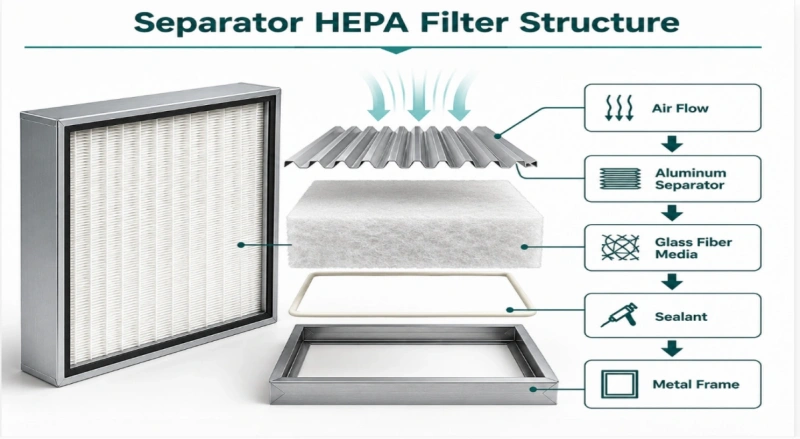
2. Core structure and working principle of high-efficiency filter with partitions
The iconic feature of high-efficiency filters with partitions is the use of aluminum partitions to ensure uniform pleat pitch of the filter material.
Main components and their functions:
Table
| Parts | Main functions |
|---|---|
| Glass fiber filter media | Capture fine particles to achieve high filtration efficiency |
| Aluminum partitions | Maintain the gap between the filter media pleats to maximize the ventilation area< /td> |
| Sealant | Prevents air bypass and leakage |
| Metal frame | Provides mechanical structural strength |
Aluminum partitions can prevent the pleats of the filter material from sticking to each other, ensuring that the airflow passes through the filter material evenly, while increasing the filtration area and dust holding capacity. This sturdy structural design is very important for high air volume purification systems, where the filter needs to withstand continuous air flow pressure during long-term operation.
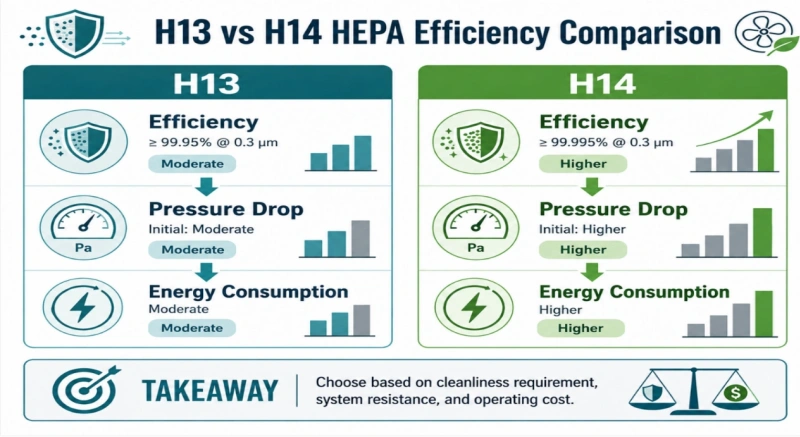
3. How to choose H13 and H14 high-efficiency filters with partitions
H13 and H14 are the two most common grades in procurement, defined according to the EN1822 standard.
Table
| Filter level | Test standard | Typical efficiency | Common application scenarios |
|---|---|---|---|
| H13 | EN1822 | Pair MPPS (most penetrating particle size) particles ≥99.95% | Clean rooms, pharmaceutical plants, laboratories |
| H14 | EN1822 | Yes MPPS (most penetrating particle size) particles ≥99.995% | High-level clean room, electronics, biological industry |
Many purchasing personnel have misunderstandings: the higher the efficiency, the better. This is not the case. Higher efficiency levels generally mean: denser filter material, higher air resistance, and greater fan energy consumption.
Therefore the filter level should be determined by the actual cleanliness level requirements. H13 is sufficient for ordinary clean production areas; H14 is required for high-demand environments such as semiconductor production and biosafety facilities.
Selection principle: Just meet the specified cleanliness requirements, do not blindly pursue the highest efficiency level.
IV. Key technical parameters for selecting high-efficiency filters with partitions
Many engineering purchase orders simply indicate: "High-efficiency filter, 610×610×292mm". Relying on this information alone is not enough to make a correct selection.
Key parameters and their actual impact:
Table
| Parameters | Actual impact |
|---|---|
| Filtration efficiency | Determines the achievable clean room level |
| Rated air volume | Represents the filter's ability to handle air |
| Initial resistance | Determines the system System basic energy consumption level |
| Final resistance | Set the trigger threshold for filter replacement |
| Filter size | Guarantee Management and installation adaptability |
| Sealing form | Prevent air bypass leakage |
Air volume and resistance are often ignored. If the actual operating air volume exceeds the rated air volume, it will cause: increased surface wind speed, increased initial resistance, shortened filter service life, and insufficient system air supply volume.
Filter selection cannot only look at the appearance size.
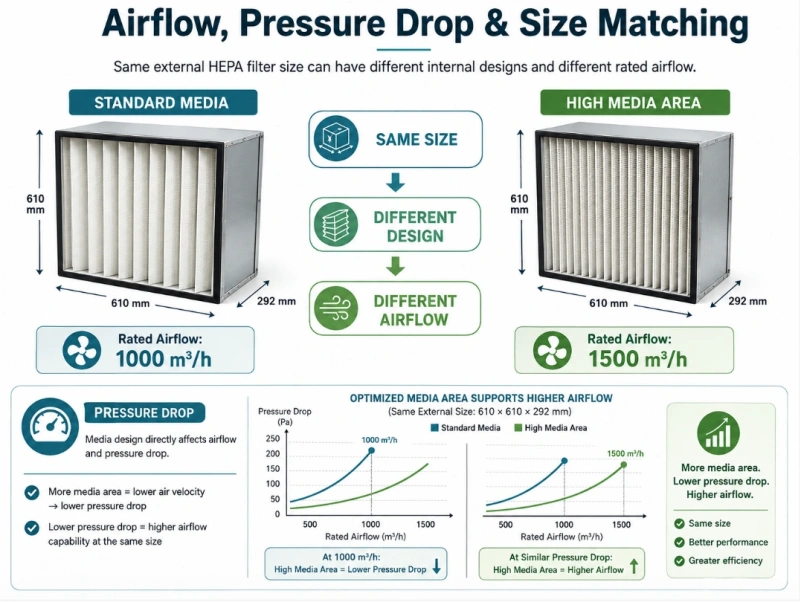
5. With the same appearance and size, why are there differences in filter performance?
In actual procurement, two filters with the same external dimensions (for example, 610×610×292mm) may have different rated air volumes: Product A has a rated air volume of 1000m³/h, and Product B can reach 1500m³/h.
The fundamental reasons for the differences: different total areas of filter media, different pleat design, different partition structures, different design values of face wind speed, and different resistance characteristics.
Therefore, in addition to providing dimensions when enquiring, you also need to specify: design air volume, allowable initial resistance, filter efficiency level, and operating environmental conditions.
6. Main application scenarios of high-efficiency filters with partitions
Table
| Industry | Application area | Core focus |
|---|---|---|
| Electronic manufacturing industry | Clean production line | Low resistance, stable and consistent performance |
| Pharmaceutical industry | GMP Clean area | Reliable sealing, filter integrity |
| Hospital | Operating room | Safe control of air hazards |
| Laboratory | Biological protection environment | Fine particle isolation and protection |
7. Information required for purchasing high-efficiency filters with partitions
To avoid procurement errors, please provide the following complete parameters to the manufacturer:
Table
| Category | Information required |
|---|---|
| Basic specifications | H13/H14 Grade, size, quantity |
| Air volume parameters | Design air volume, rated air volume requirements |
| Resistance requirements | Initial resistance, allowable final resistance |
| Installation requirements | Installation method, sealing configuration |
| Environmental conditions | Temperature and humidity, anti-corrosion requirements |
| Compliance standards | GMP, ISO Clean room standards and whether a test report is required |
Complete parameter specifications allow suppliers to provide highly matched purification solutions.
8. Purchasing Frequently Asked Questions FAQ
Q: Is H14 definitely better than H13? A: Not necessarily. If the project cleanliness requirement is H13, choosing H14 will only bring higher resistance and increase long-term operation energy consumption.
Q: How long is the service life of a high-efficiency filter with partitions? A: There is no fixed replacement cycle. The service life is determined by the resistance difference, environmental dust content, actual air volume, and cumulative operating time.
Q: Can filters from different manufacturers be directly interchanged if they have the same size? A: Direct replacement is not recommended. Before replacement, you need to check the filtration efficiency, rated air volume, resistance curve, filter material material and sealing structure.
9. Jiangsu Yueboyang Purification - high-efficiency filter solution with partitions
For clean workshops, industrial air conditioning units and advanced purification engineering projects, Jiangsu Yueboyang Purification can provide professional and customized high-efficiency filter solutions with partitions based on the project cleanliness level, system air volume, installation space and operating restrictions.
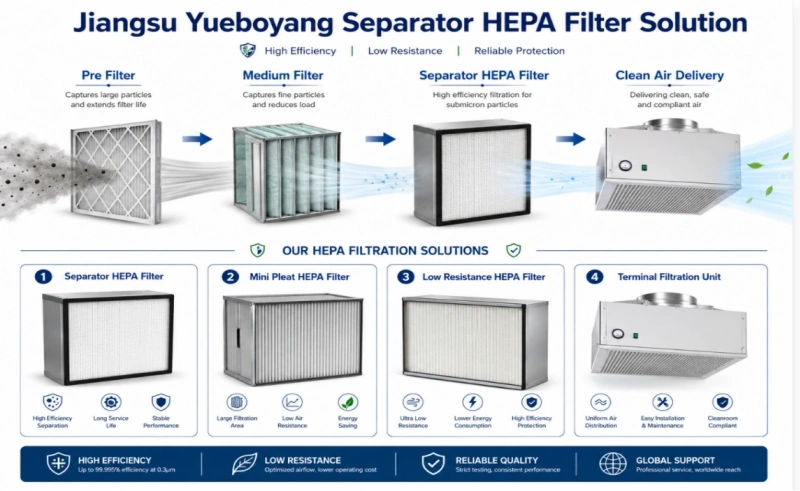
The product series includes: high-efficiency filters with partitions, H13/H14 high-efficiency filters, high-efficiency filters without partitions, ultra-low resistance high-efficiency filters, air-conditioning terminal filter equipment, and clean air supply system components.
In actual engineering projects, Jiangsu Yueboyang Purification not only supplies parts, but also pays attention to the matching of the entire air filtration system. Complete solution chain: primary-efficiency filtration → medium-efficiency filtration → high-efficiency filtration → clean air supply.


