
In HVAC air-conditioning boxes, fresh air units, clean rooms and industrial air treatment systems, filters are not "the higher the efficiency, the better". If the combination of primary-efficiency, medium-efficiency and high-efficiency filters is unreasonable, it may cause the system pressure difference to be too high, the air volume to decrease, the energy consumption to increase, and the service life of the high-efficiency filter to be shortened.
For engineers and buyers, the more important question is: How should different filter levels be combined? What role should each level of filter play? How to select based on air volume, pressure difference and cleanliness requirements?
1. Engineering issues: Why is multi-level filtering needed?
Particles of different sizes often coexist in outdoor air and return air.
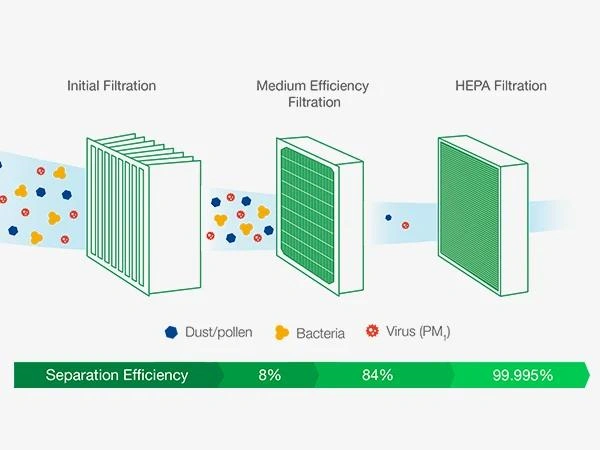
If a high-efficiency filter is used directly to handle all particulate matter, large particles of dust will quickly increase the load on the HEPA filter, causing the pressure difference to continue to increase.
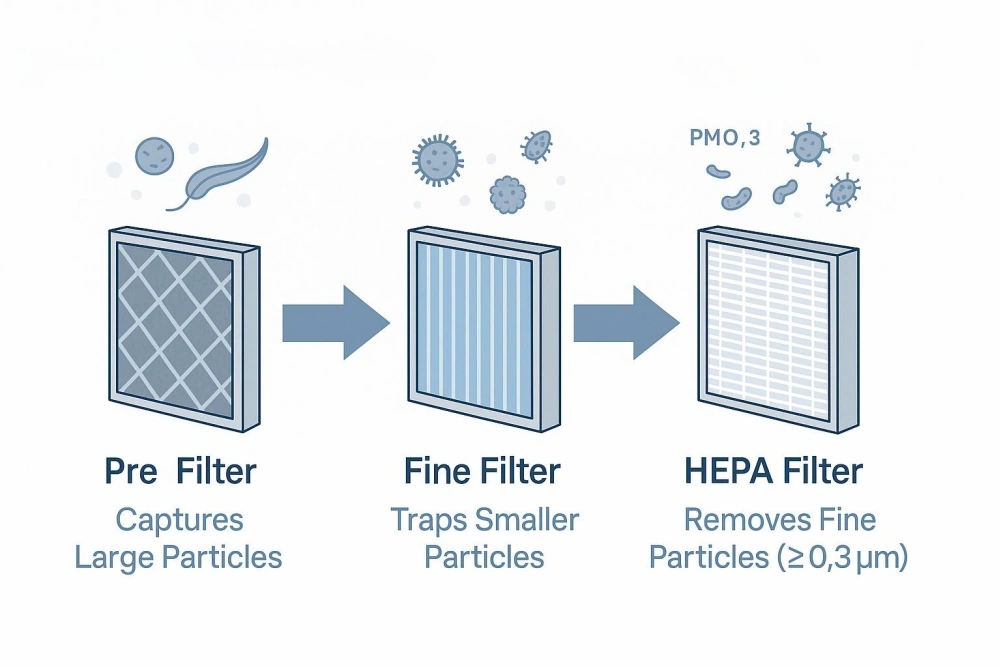
Therefore, engineering systems usually use hierarchical filtration, allowing different filters to undertake different tasks:
Primary effect filter → intercept larger particles and protect back-end equipment
Medium effect filter → further filter fine particles and reduce the load of high-efficiency filter
High-efficiency filter → perform high-efficiency filtration of the final air to meet the requirements of clean areas
A typical system can use:
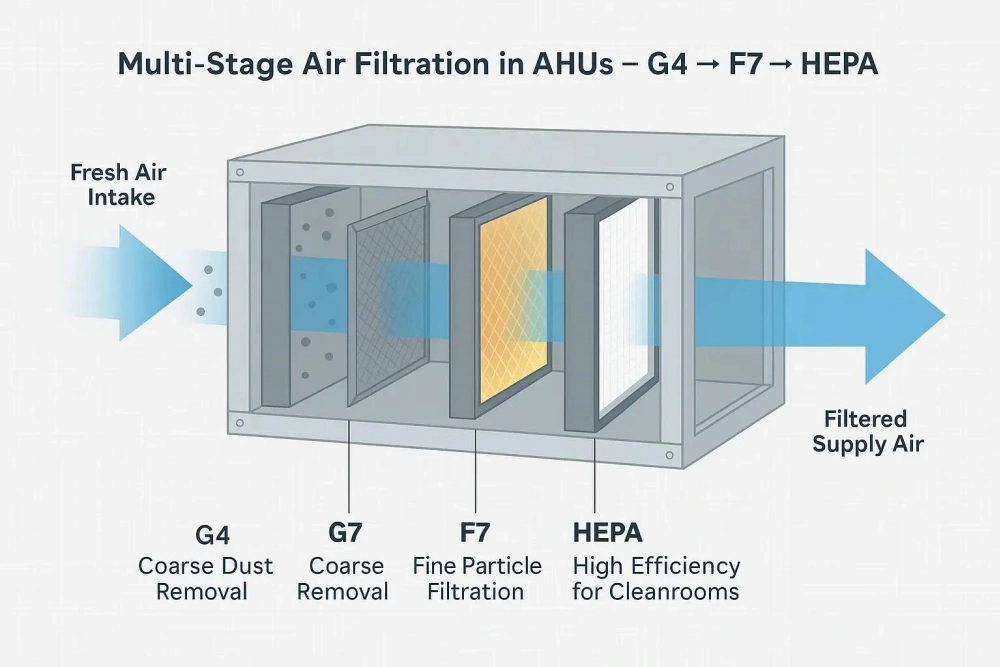
Outdoor air → Primary effect → Medium efficiency → surface cooling/heating → high efficiency filtration → clean area
Not all HVAC systems require three levels of filtration. The number of filtration stages should be determined based on final cleanliness, pollutant concentration, air volume, system pressure difference and operating costs.
2. Technical parameters: Don’t just look at G4, F7 or H13 when choosing a filter
Many engineering procurement inquiries only provide: G4, F7, H13, but it is impossible to judge whether the filter is suitable for the actual system based on the filtering level alone.
Project selection requires at least the following parameters to be confirmed:
| Parameters | Engineering significance |
|---|---|
| Airflow | Determine the actual processing capacity of the filter |
| Filter Efficiency | Judge particulate matter filtration capacity |
| Initial Pressure Drop | Judge the operating resistance of the new filter |
| Final Pressure Drop | Judge the replacement cycle |
| Filter Size | Confirm installation compatibility |
| Filter Media | Affects efficiency, life and pressure difference |
| Frame Material | Affects mechanical strength and environmental resistance |
| Filter Depth | Affects the filter material area and dust holding capacity |
| Operating Temperature | Determine whether the use environment is suitable |
| Sealing/Gasket | Reduce the risk of bypass leakage |
For general ventilation filters, you also need to pay attention to ISO 16890 and other filter testing and classification standards.
For HEPA filters, you cannot simply use the grade concept of ordinary HVAC filters to make judgments. You should also confirm the corresponding efficiency, test methods, rated air volume and leak detection requirements.
3. How to combine primary-efficiency, medium-efficiency and high-efficiency filters?
1. Initial effect + medium effect
This is a common combination in ordinary HVAC and fresh air systems.
Basic structure:
Primary filter → Medium filter → Air conditioning treatment equipment → Indoor
The primary effect is responsible for reducing large particle pollutants entering the system, and the medium effect further reduces fine particles.
This solution is suitable for:
Office buildings
Commercial buildings
Hotels
General industrial plants
General fresh air system
General AHU system
If the project does not have strict cleanliness requirements, there is no need to blindly add HEPA filters.
2. Primary effect + medium effect + HEPA
For scenes with high air cleanliness requirements such as clean rooms, pharmaceuticals, hospitals, and electronic manufacturing, three-level filtration can be used:
Primary effect → Medium effect → HEPA
The core of this combination is not to simply add a first-level filter, but to use the front-end filter to reduce the particle load entering HEPA.
Typical system:
Outdoor air → primary effect → medium effect → AHU → HEPA → clean room
HEPA can be installed at the back end of the air treatment equipment or at the end of the clean room according to project requirements.
3. Primary effect + medium effect + HEPA terminal filtration
For projects with higher requirements on cleanliness and particle control, a combination of centralized pre-filtration and terminal high-efficiency filtration can be used.
For example:
Fresh air → Initial effect → Medium effect → AHU → Clean room air supply system → HEPA end filter
This solution is common in:
Pharmaceutical production area
Medical clean area
Laboratory
Electronic manufacturing
Semiconductor-related production areas
New energy and lithium battery production areas
The specific configuration needs to be determined based on the cleanliness level, number of air changes, air volume and project design specifications.
4. Selection factors: filtration efficiency is not the only indicator
1. Selection based on air volume
Filters must be selected based on actual air volume.
For example, the nominal efficiency of a filter meets the requirements, but if the actual passing air volume exceeds the design value, the face wind speed of the filter increases and the pressure loss may also increase.
Therefore, it is recommended to provide:
Airflow + Filter Size + Filter Efficiency
instead of only providing the filtering level.
2. Selection based on initial resistance
Initial resistance is an important parameter for evaluating filter operating performance.
Under the same filtration efficiency and air volume conditions, if the initial resistance of a certain filter is significantly higher, it may increase the fan load and long-term operating energy consumption.
Therefore, it is recommended to ask the supplier to provide:
Initial Pressure Drop @ Rated Airflow
That is, the initial pressure difference under rated air flow.
3. Set the replacement cycle according to the final resistance
After the filter is used for a period of time, the filter material will gradually accumulate dust, and the pressure difference will continue to increase.
If you continue to use a severely clogged filter, it may cause:
Air volume decreases
Fan load increases
System energy consumption increases
Clean room pressure difference is abnormal
HVAC system operation is unstable
Therefore, engineering projects should establish a filter maintenance and replacement strategy based on pressure difference.
4. Select according to the installation space
Different AHUs and clean room systems have different installation spaces.
If the internal space of the device is limited, important considerations need to be made:
Filter thickness
Frame size
Installation direction
Sealing method
Replacement space
Maintenance method
For bag filters, V-type filters and HEPA filters, the specific installation structure also needs to be confirmed.
5. Engineering application: What solutions should be used for different projects?
Commercial buildings
Ordinary office buildings, shopping malls, hotels and other projects mainly focus on indoor air quality, air volume and operating energy consumption.
Usually based on outdoor air quality and system requirements:
Initial effect + medium effect
Key optimization:
Filtration efficiency + pressure difference + replacement cost
Hospital
The air control requirements for different functional areas of the hospital vary greatly.
Normal areas and high-cleanliness areas cannot use exactly the same filtering configuration.
For areas that require higher air cleanliness, you can use:
Primary effect + medium effect + HEPA
At the same time, filter sealing, installation methods and maintenance conditions need to be considered.
Pharmaceutical factory
Pharmaceutical production environment needs to control particulate matter and cross-contamination risks.
Typical solutions can be adopted:
Initial effect → Medium effect → HEPA
For key clean areas, further consideration needs to be given to the installation, leak detection and replacement of HEPA filters.
Electronic and semiconductor factories
Electronic manufacturing generally has high requirements for the control of particulates in the air.
The system can adopt:
Fresh air pre-filtration → medium efficiency → AHU → HEPA/ULPA terminal filtration
In addition to focusing on filtration efficiency, engineering design should also pay attention to:
Particle control
Pressure drop
Airflow
Filter leakage
Installation sealing
Maintenance
New energy and lithium battery factories
The air treatment plan for new energy factories needs to be determined based on the production process.
Different production areas may be:
Particles
Temperature
Humidity
Fresh air volume
Cleanliness
Have different requirements.
Therefore, the fixed "initial effect + medium effect + high efficiency" scheme cannot be directly applied, but should be configured according to the specific production process and HVAC system parameters.
6. Frequently Asked Questions
Do you have to use all primary, medium and high-efficiency filters?
Not necessarily.
Ordinary HVAC systems may only require primary and medium-efficiency filtration.
Only when the project has higher requirements for final air cleanliness, it is necessary to further adopt HEPA or other high-efficiency filtration solutions.
Is the higher the filter efficiency, the better?
Not necessarily.
Higher filtration efficiency usually means higher filtration resistance and higher procurement costs, so the selection must be combined with project requirements.
The correct principle is:
Meet cleanliness requirements while controlling pressure difference and life cycle costs.
Why do we need to install a pre-filter in front of HEPA?
The pre-filter can intercept larger particles in advance and reduce the particle load borne by the HEPA filter.
For environments with high particle concentrations, reasonable pre-filtration and medium-efficiency filtration can help extend the service life of HEPA filters.
Can I use only one HEPA filter?
Technically some systems can be designed this way, but whether it is economically justified depends on the air pollution load and final cleanliness requirements.
If the concentration of particulate matter in the air is high, using HEPA directly may cause it to accumulate dust faster.
Therefore, for many engineering systems, multi-stage filtration is more reasonable than using high-efficiency filters alone.
7. Procurement suggestions: What parameters should B2B provide when purchasing filters?
If you are an HVAC engineering company, clean room engineering company, equipment OEM or industrial project purchaser, it is recommended to provide the following information to the filter supplier:
1. Airflow
For example:
5,000 m³/h
2. Filter Size
For example:
592 × 592 × 600 mm
3. Filter Efficiency
For example:
ISO ePM1 / HEPA H13 / H14
4. Initial Pressure Drop
Require the supplier to provide the initial pressure difference under rated air volume.
5. Final Pressure Drop
Used to establish filter replacement and maintenance cycles.
6. Filter Media
For example:
Synthetic
Fiberglass
PP
PTFE
7. Frame Material
For example:
Galvanized Steel
Aluminum
Stainless Steel
Plastic
8. Application
Need to tell the supplier that the filter should ultimately be applied to:
HVAC
AHU
Cleanroom
Hospital
Pharmaceutical
Electronics
Semiconductor
Battery Factory
This way suppliers can provide more accurate filter solutions based on actual working conditions.
8. Yue Boyang multi-stage air filtration solution
Jiangsu Yueboyang Purification Equipment Co., Ltd. specializes in air filters and clean room air treatment products, and can provide multi-stage air filtration solutions based on customers' air volume, filtration efficiency, size, pressure difference, installation method and usage environment.
Product solutions can cover:
Primary filter
Used to intercept larger particles and pre-protect back-end HVAC equipment and filters.
Medium-efficiency filter
is used to further reduce the load of fine particles and can be used in AHU, fresh air units and industrial air treatment systems.
High-efficiency filter / HEPA
Used for high-efficiency filtration of final air, suitable for high-cleanliness applications such as clean rooms, hospitals, pharmaceuticals, and electronic manufacturing.
According to project requirements, it can be combined:
Primary effect + medium effect
Or:
Primary effect + medium effect + HEPA
For clean rooms and high-cleanliness industrial projects, the overall solution design can also be combined with AHU pre-filtration and terminal HEPA filtration.
In B2B projects, Yueboyang can perform product selection and technical confirmation based on the customer's:
Airflow + Filter Size + Efficiency + Pressure Drop + Application
to help engineering companies, OEM customers and purchasers reasonably control system pressure difference, maintenance costs and filter replacement costs while meeting air cleanliness requirements.
Conclusion
The combination of primary, medium and high-efficiency filters is not simply a superimposition of filters of different levels.
A reasonable engineering plan should also consider:
Filtration efficiency, air volume, initial resistance, final resistance, dust holding capacity, cleanliness requirements, equipment space and life cycle cost.
For ordinary HVAC systems, priority can be given to primary efficiency + medium efficiency; for clean rooms and high-cleanliness industrial applications, primary efficiency + medium efficiency + HEPA can be used according to project requirements.
For customers who are engaged in project design or procurement, the most important thing is not to ask "G4, F7 or H13" individually, but to provide the supplier with complete air volume, size, filtration efficiency, pressure difference and application environment, so as to obtain a filter solution that is truly suitable for the project.


