
The air supply and return methods of clean rooms directly affect indoor air flow organization, pollutant discharge efficiency, cleanliness stability, and HVAC system operating costs. Common methods in engineering design include top air supply, side air supply, top air supply and lower return air, top air supply and side lower return air, etc.
Therefore, the clean room air supply and return system is not simply selected based on the room area, but should be comprehensively determined based on the ISO cleanliness level, production process, pollutant generation location, room size, floor height, and building structural conditions.
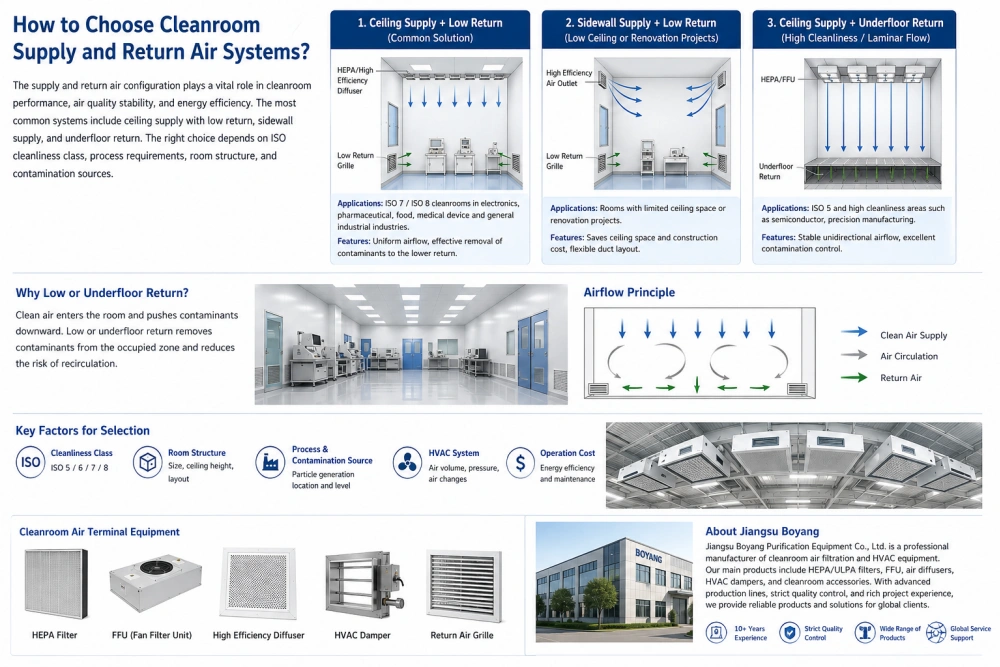
1. Why should clean rooms pay attention to the air supply and return method?
Whereas conventional air conditioners primarily address temperature and comfort issues, cleanroom HVAC systems also need to control airborne particles and minimize the circulation of contaminants in the work area.
Proper airflow organization should allow clean air processed by HEPA or other high-efficiency filters to reach key operating areas first, and then take pollutants away from the work area.
For non-unidirectional flow clean rooms, the air supply mainly relies on clean air to dilute the indoor air; for vertical one-way flow clean rooms, it is necessary to form a relatively stable downward airflow so that pollutants can be discharged downward with the airflow. ASHRAE's clean room design information also distinguishes ISO 7 non-unidirectional flow and ISO 5 unidirectional flow as typical different air flow organizations.
Therefore, when choosing the air supply and return method, you must first determine whether the clean room uses non-unidirectional flow or unidirectional flow.
2. Top air supply system: suitable for most conventional clean rooms
Top air supply is a very widely used form in clean rooms. After the clean air passes through the HEPA filter, high-efficiency air supply outlet or FFU, it enters the clean room from the top.
Common forms include:
Top delivery, side bottom return
Top delivery, double side bottom return
Top full of HEPA, bottom return air
Top FFU air supply, side wall bottom return air
For ISO 7. In common industrial clean rooms such as ISO 8, if there are no special local pollution control requirements, top-down transportation usually has good engineering adaptability.
The main advantage is that clean air can enter the work area from the upper part and take away pollutants through the lower return air outlet. Compared with sending it up to the upper level, sending it up to the next level is more conducive to controlling pollutants in the work area.
What projects is top air supply suitable for?
More suitable for:
Electronic product production workshop
Food clean workshop
Medical device production area
Pharmaceutical clean room
Laboratory
General industrial clean room
ISO 7, ISO 8 Such as non-unidirectional flow clean areas
If the room is wide, or the process equipment has obvious dust-generating points, you can consider bilateral lower return air to reduce local eddy currents and pollutant retention.
3. Side air supply system: suitable for limited floor height and renovation projects
Side air supply is to send filtered clean air from the side wall or a position close to the side wall into the work area, and then discharge it through the return air system on the other side or the same side.
Compared with top air supply, the biggest advantage of side air supply is not that the cleaning effect is necessarily better, but that the building adaptability is stronger.
For example, some old factory building renovation projects may not have enough suspended ceiling mezzanine space. If top air supply is forced, the air ducts, static pressure boxes and suspended ceiling structures need to be rearranged, resulting in higher construction costs.
In this case, side air supply can reduce overhead space and simplify some HVAC duct layout. Relevant clean room engineering information also points out that side air supply has certain advantages in the renovation of old factories and clean rooms with low floor heights.
What should we pay attention to when using side air supply?
Side air supply does not mean that the air supply vents can be installed at will.
If the air supply speed is too high, the wind speed in the work area may be too high; if the room is long, the concentration of pollutants may also gradually increase as the air flows from the air supply side to the return air side.
Therefore, side air supply needs to be considered:
The installation height of the air supply vent;
The air supply direction;
The location of the workbench and equipment;
The location of the return air vent;
Personnel activity area;
The location of the pollution source.
For areas with higher cleanliness requirements, the airflow organization should be verified through CFD simulation or on-site airflow testing, rather than based solely on the number of air supply outlets.
4. Why is the bottom return air so important in a clean room?
"Lower return air" is actually a key link in the air flow organization of many clean rooms.
When the clean air enters the work area from the top, it returns through the lower wall air return vent or the raised floor, allowing the pollutants to move downward with the air flow and leave the work area.
For non-unidirectional flow clean rooms, the common form is:
Top air supply → work area → return air at the bottom of the side wall
This method can continuously dilute indoor pollutants through clean air and bring some pollutants to the return air area. Return air vents should usually be placed at a reasonable location to prevent contaminants from re-entering the work area after passing through critical process areas.
For vertical one-way flow clean rooms, you can use:
Top high-efficiency filter air supply → vertical downward → raised floor/lower return air
This air flow organization is closer to the "plug flow" effect and is suitable for areas with higher pollution control requirements. ASHRAE's clean room design information also lists top HEPA/ULPA air supply and bottom return air as typical vertical unidirectional flow forms.
5. How to choose between top delivery and next post, side delivery and side response?
In actual projects, preliminary judgments can be made according to the following ideas:
| Project conditions | Recommended airflow organization |
|---|---|
| ISO 7/ISO 8 Conventional clean room | Push to the next level |
| The room is wider and there are more pollution sources | Push to the lower level on both sides |
| The floor height is higher Low | Side air supply or side air supply |
| Clean renovation of old factory buildings | Prioritize side air supply |
| ISO 5 High clean area | Vertical one-way flow, top feed and bottom return |
| Raised floor clean room | Top feed and bottom return |
| Partial high clean work station | FFU/HEPA Local air supply |
| There are obvious dust-producing equipment | Combined with local exhaust and lower return air |
| Tall clean workshop | Consider local purification according to the process, rather than simply high ventilation in the whole room |
It should be noted that this table can only be used as a preliminary plan, and the final design still needs to be calculated based on the actual cleanliness, equipment layout, number of personnel, and pollution sources.
6. Why is it not recommended to simply use "upload and return"?
The biggest problem with sending air up and back is that the supply air and return air are concentrated at the top. The air may form a short circulation path in the upper part, and the pollutants in the lower part of the work area cannot be effectively taken away.
For clean rooms, the location of the return air not only affects the air volume balance of the HVAC system, but also directly affects the migration path of pollutants.
Therefore, in general clean room design, if conditions permit, priority should usually be given to locating the return air outlet in the lower part of the work area, and arrange it reasonably according to the location of the pollution source.
Especially when dust, fibers or other particulate contaminants are present in the production process, it is important to avoid airflow short circuits that allow contaminants to circulate near the work area.
7. The same solution cannot be used for different cleanliness levels
Cleanliness level is an important basis for selecting airflow organization, but it is not the only basis.
For example, ISO 5 areas usually require more stringent pollution control, and vertical unidirectional flow can provide a more stable airflow direction and strong self-purification ability.
In non-unidirectional flow clean rooms such as ISO 7 and ISO 8, pollutants can be diluted and discharged through reasonable top delivery, side delivery and lower return air.
If there is a local high-cleaning process inside the clean room, it is not necessarily necessary to design the entire room into a high-level one-way flow. The use of FFU, HEPA high-efficiency air supply vents or local clean work areas can often reduce overall HVAC system investment and operating energy consumption while meeting process requirements.
8. How to match the supply and return air equipment in the clean room?
After the air flow organization is determined, filtration and air supply equipment need to be properly matched.
Jiangsu Yueboyang Purification Equipment Co., Ltd. can provide HEPA high-efficiency filters, FFU fan filter units, high-efficiency air supply outlets, HVAC dampers, air outlets and clean room supporting equipment according to clean room application requirements.
Among them, HEPA filters are used for terminal air filtration, FFU can be used for modular clean air supply, and high-efficiency air supply outlets are suitable for clean room terminal air supply systems; HVAC dampers can be used for air volume adjustment, area isolation, and air control between different clean areas.
For projects that require engineering selection, matching can be based on cleanliness level, room size, design air volume, filtration efficiency, initial resistance, final resistance and installation method, rather than purchasing solely based on product size.
9. Core principles of project selection
If you need to quickly determine which air supply and return method should be used in the clean room, you can consider it in the following order:
Step 1: Determine the cleanliness level
First determine the ISO Class 5. ISO Class 6, ISO Class 7 or ISO Class 8.
Step 2: Determine the air flow type
Determine whether to use unidirectional flow or non-unidirectional flow.
Step 3: Analyze pollution sources
Clear the locations of personnel, equipment, dust, particulate matter and process emissions.
Step 4: Analyze the building conditions
Focus on the room area, aspect ratio, floor height, suspended ceiling mezzanine, and whether it is a new construction or renovation project.
Step 5: Determine the location of supply and return air
Try to avoid air flow short circuits, eddies and pollutants circulating in the work area.
Step 6: Match terminal equipment
Select HEPA filters, FFU, high-efficiency air supply vents, diffusers, HVAC dampers and other equipment according to air volume and cleanliness requirements.
Conclusion
There is no "single standard answer" for top air supply, side air supply and bottom return air in clean rooms that applies to all projects. A truly reasonable solution should be comprehensively designed based on cleanliness requirements, process pollution characteristics, room structure and HVAC system economics.
For conventional ISO 7 and ISO 8 clean rooms, top-to-bottom flow is usually a more practical solution; for limited floor heights or old factory building renovation projects, side air supply has better adaptability; for high-cleanliness areas such as ISO 5, vertical one-way flow and top-to-bottom flow should be considered.
Jiangsu Yue Boyang Purification Equipment Co., Ltd. can provide HEPA high-efficiency filters, FFU, high-efficiency air supply outlets, dampers and clean room related products for engineering projects around clean room air filtration and HVAC systems, helping engineers and buyers select terminal equipment based on actual project needs.


