
Air pollutants in industrial production environments mainly include dust, oil mist, welding smoke, VOC, organic solvent vapors and acid and alkaline gases. Different pollutants have different particle sizes, concentrations, and physical and chemical properties. Therefore, industrial air filters cannot be selected solely based on filtration level, but should be comprehensively matched based on pollutant type, air volume, temperature and humidity, system resistance, and use environment.
1. How to choose a filter for dust environment?
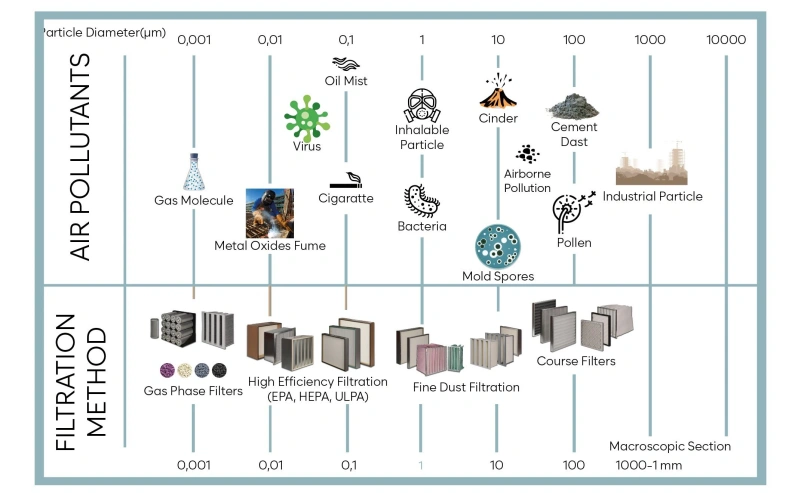
Dust is the most common pollutant in industrial HVAC systems, including metal dust, cement dust, wood chips, fibers and welding fumes.
For ordinary and large particle dust, primary effect plate filter or bag filter can be used for pre-filtration to reduce the load of subsequent filters. For pollutants such as fine particles and welding smoke, you need to choose medium-efficiency, V-type filters or high-efficiency filters with higher filtration efficiency.
If used in clean environments such as electronics, pharmaceuticals, and medical care, HEPA filters need to be configured according to the cleanliness level. When making actual selection, you cannot simply pursue high filtration efficiency, because the higher the filtration level, the higher the air resistance will usually be.
2. How to choose a filter for oil mist environment?
Oil mist is often generated during machining, CNC, grinding, stamping and automotive manufacturing processes. Compared with ordinary dry dust, oil mist is sticky and easily adheres to the surface of the filter material and causes the filter to quickly clog.
In oil mist environments, priority should be given to filter materials with oil resistance, and multi-stage filtration solutions should be adopted according to the oil mist concentration, such as:
Initial effect filtration → oil mist filtration → medium effect filtration → high efficiency filtration
For high-concentration oil mist, focus should be placed on the oil resistance of the filter material, dust holding capacity, initial resistance and pressure drop changes after operation. Ordinary HVAC filters are not necessarily suitable for long-term treatment of high concentrations of oil mist.
3. How to choose a filter for chemical pollutants?
VOCs, organic solvent vapors, acidic gases and alkaline gases are molecular pollutants that cannot be effectively removed by ordinary fiber filters.
This type of pollutant usually requires the use of an activated carbon filter or chemical adsorption filter. Activated carbon is mainly used to adsorb some VOCs, organic gases and odors; for specific acidic, alkaline or reactive gases, corresponding chemical adsorption materials need to be selected based on the nature of the pollutants.
When purchasing chemical filters, working conditions parameters such as pollutant name, concentration, air volume, temperature and humidity should be provided to determine the appropriate filter material and adsorption capacity.
IV. Multi-stage filtration is recommended for complex industrial environments
When dust, oil mist and chemical pollutants are present in the production environment, it is recommended to use a multi-stage filtration system to allow different filters to undertake different pollution control tasks.
For example:
Primary filter: intercepts larger particles of dust;
Medium-efficiency or high-efficiency filter: further removes fine particles and some oil mist;
Activated carbon or chemical filter: handles VOC, odor and specific chemical gases;
HEPA filter: used for high-efficiency particle filtration at the end of the clean room.
This approach can reduce the pollution load of high-grade filters and extend the overall service life of the system.
5. What parameters need to be confirmed when purchasing industrial air filters?
When B2B purchases industrial air filters, it is recommended to confirm the following key parameters:
Pollutant type and concentration;
Particle size;
System processing air volume;
Filtration efficiency level;
Initial resistance and final resistance;
Operating temperature and humidity;
Oil and chemical resistance of the filter material;
Filter size and sealing method;
Replacement cycle and maintenance requirements.
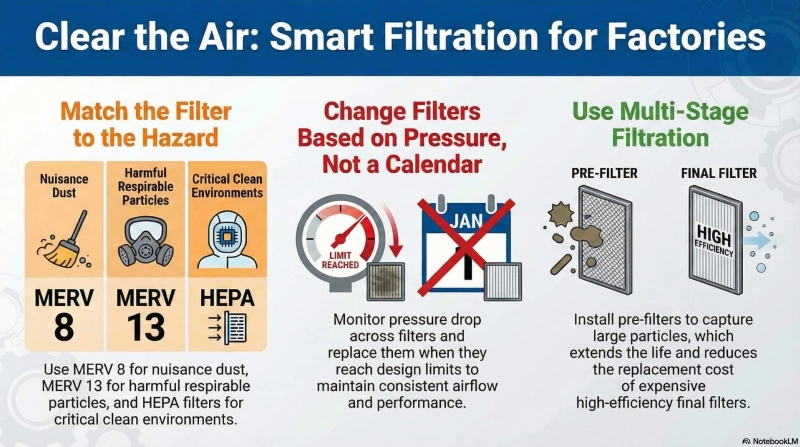
The correct selection of industrial air filters is not that the higher the filtration efficiency, the better, but that a balance needs to be struck between filtration efficiency, air resistance, service life and operating costs. For complex industrial projects, it is recommended that professional filter manufacturers make customized selections based on actual working conditions.
6. Professional industrial air filter selection and matching
The correct selection of industrial air filters does not mean that the higher the filtration efficiency, the better, but requires a balance between filtration efficiency, air resistance, service life and operating costs. For industrial projects where dust, oil mist or chemical pollutants are present at the same time, multi-stage filtration and combination configuration should be carried out according to actual working conditions.
Jiangsu Yueboyang Purification Equipment Co., Ltd. has the R&D, production and supporting capabilities of industrial air filters and air purification equipment. It can provide primary-efficiency plate filters, bag filters, medium-efficiency filters, V-type filters, HEPA high-efficiency filters, activated carbon filters and other products, and can be selected and customized according to the customer's air volume, filtration efficiency, installation size and actual pollutant working conditions.
For different application scenarios such as industrial plants, HVAC systems, clean rooms, electronic manufacturing, pharmaceuticals, and automobile manufacturing, we can provide combination solutions from pre-filtration, medium-efficiency filtration to high-efficiency and chemical filtration according to project needs, helping B2B customers build more stable and efficient air filtration systems.


