
During the operation of an HVAC system, it is not uncommon to experience increased fan noise, duct vibration, or louder airflow sounds after replacing the air filter. For factories, clean rooms, commercial buildings and industrial ventilation systems, the filter itself is not necessarily the source of noise, but the filter's resistance, installation status and matching relationship with the fan may affect the operating noise of the entire system.
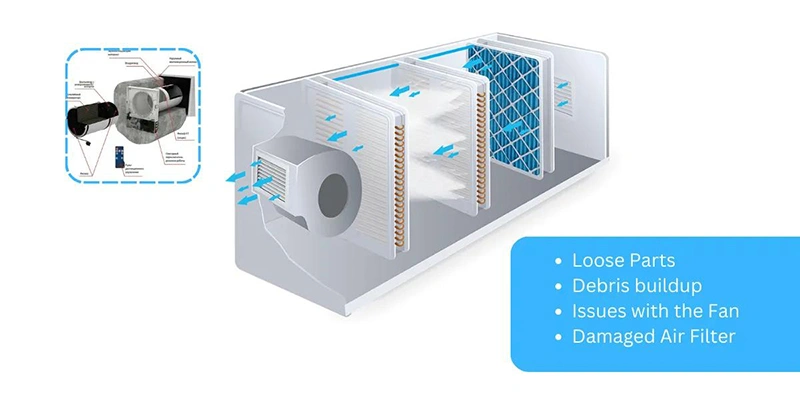
The filter resistance is too high, causing the fan load to increase
The noise increases after the filter is replaced. The initial resistance of the new filter should be checked first.
Different filter materials, filtration efficiencies, structural forms and filter areas will produce different air resistance. For example, under the same rated air volume, a filter with higher filtration efficiency but insufficient filtration area may have a higher initial resistance.
As filter resistance increases, the fan needs to provide higher static pressure. If the fan operating point changes, it may cause changes in speed, load and airflow conditions, resulting in more significant fan noise.
Therefore, when purchasing filters, you should not only focus on filtration efficiency, but also confirm parameters such as rated air volume, initial resistance, and final resistance.
Filter size or structure mismatch
If the size of the new filter does not exactly match the original filter, it may cause a gap between the filter and the mounting frame.
When air passes through a poorly sealed location at high speed, it is easy to produce obvious air flow noise. At the same time, bypass airflow may also reduce filtration efficiency.
For bag filter, V-type filter and HEPA filter, you should especially check whether the filter length, width, thickness, number of filter bags and installation direction meet the equipment requirements.
Vibration caused by weak filter installation
After the filter is replaced, if the pressing device, mounting frame or sealing structure is not fixed in place, the filter may vibrate slightly under the action of high-speed airflow.
This vibration will be transmitted through the box or air duct, causing obvious mechanical noise.
After replacing the filter, check the pressing mechanism, filter frame and sealing strip to ensure that the filter is installed smoothly and fixed reliably.
Fan operating point changes
There is a direct pressure and air volume relationship between the fan and filter in the HVAC system.
When the resistance of the new filter is different from the original filter, the total resistance of the system will also change, and the actual operating point of the fan may change accordingly. If the fan enters an unstable operating area, air flow pulsation, fan surge or abnormal noise may occur.
For HVAC systems that use variable frequency control, you also need to check whether the fan frequency automatically increases after replacing the filter.
The air flow speed of the air valve and air outlet is too high
After the filter is replaced, if the system control logic increases the fan speed to maintain the set air volume, the air speed of some air ducts, air valves and air supply outlets may increase.
When the wind speed exceeds the reasonable design range of relevant components, obvious airflow noise is likely to occur.
Therefore, when troubleshooting noise, you should not only check the filter, but also check the opening of the air valve, the wind speed of the air outlet and the local resistance of the air duct.
How to reduce HVAC noise after filter replacement?
It is recommended to check in the following order:
Measure the initial pressure difference of the new filter;
Compare the rated air volume and resistance parameters of the new and old filters;
Check the filter size and installation direction;
Check the fan operating frequency, static pressure and working point;
Check the damper, air outlet and abnormal air flow in the air duct;
Re-test the air volume and system static pressure if necessary.
For B2B HVAC projects, when selecting air filters, filtration efficiency, rated air volume, initial resistance, filtration area, service life and installation size should be comprehensively considered, rather than pursuing higher filtration levels alone. For places with high air quality requirements such as clean rooms, pharmaceuticals, and electronic manufacturing, the resistance change of the HEPA filter and the matching of the terminal air supply system should also be considered.
Properly matching the filter with the fan, damper, air duct and air supply end can reduce abnormal noise after filter replacement and help the HVAC system maintain stable and efficient operation.


