
The configuration of the clean room air filtration system needs to be comprehensively determined based on the target cleanliness level, room volume, number of personnel, equipment dust production, process requirements and air flow organization method. ISO 5, ISO 7 and ISO 8 are common cleanliness levels in industries such as industrial manufacturing, pharmaceuticals, medical equipment, electronics and food. However, there are obvious differences between the three in terms of terminal filtration, air supply method and air circulation volume.
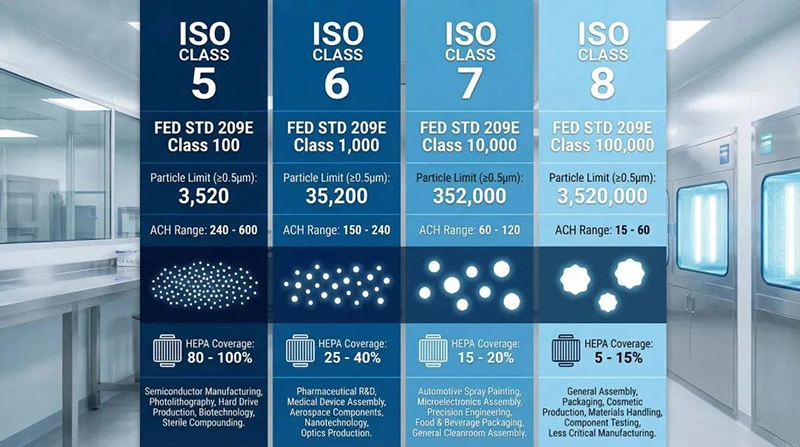
ISO 5 clean room: with high-efficiency terminal filtration and unidirectional airflow as the core
ISO 5 has significantly higher requirements for the control of particulate matter in the air than ISO 7 and ISO 8. At a particle size of ≥0.5 μm, the maximum particle concentration allowed by ISO 5 is 3,520 particles/m³.
For ISO 5 clean areas, HEPA or higher terminal filtration is usually used, combined with unidirectional flow or partial unidirectional flow design. Common configurations include:
The fresh air section is equipped with a primary filter;
A medium-efficiency filter is installed in the air conditioning box;
H13/H14 HEPA filter is used at the end;
Key areas can be usedFFU fan filter unit;
High-coverage HEPA air supply end is used in high-clean areas;
With a reasonable return air system, it can reduce the accumulation of pollutants in the work area.
ISO 5 usually requires a higher air circulation volume. The common reference range in engineering design is about 240-360 times/hour, but the actual value should be determined based on the process load and cleanliness verification results, and cannot be designed solely based on the number of air changes.
ISO 7 clean room: HEPA terminal filtration and mixed airflow
ISO 7 allows a maximum particle concentration of 352,000 particles/m³ at a particle size of ≥0.5 μm. The cleanliness requirements are lower than ISO 5, but stable air filtration and airflow organization are still required.
A typical ISO 7 air filtration system can use:
Primary effect filter → Medium effect bag filter → HEPA terminal filter → Clean room
Depending on the project size and layout, HEPA filters can be installed in clean air supply vents, HEPA filter boxes or FFUs. ISO 7 typically uses non-unidirectional mixed airflow to reduce indoor particle concentrations by continuously delivering HEPA-filtered clean air.
The common reference number of air changes in engineering projects is about 30-60 times/hour, but the final air volume should be calculated based on the number of personnel, the amount of dust generated by the equipment, the heat load and the target cleanliness.
ISO 8 cleanroom: focus on economical multi-stage filtration
ISO 8 allows a maximum particle concentration of 3,520,000 particles/m³ at ≥0.5 μm particle size, so the filtration system generally does not require high-density terminal filtration like ISO 5.
Common configurations are:
Primary efficiency filter → Medium efficiency filter → HEPA filter → Clean room
For some ISO 8 applications, HEPA terminal filtration can be used according to actual cleanliness requirements and HVAC system design, or a stable clean environment can be achieved through reasonable air supply and return organization.
The common air circulation volume in ISO 8 projects is about 10–25 times/hour, but this range is only suitable as a design reference.
How to choose ISO 5, ISO 7 and ISO 8 filtration systems?
| Cleanliness level | Typical air flow method | Common filtration configuration | Typical application |
|---|---|---|---|
| ISO 5 | One-way flow/partial one-way flow | Initial effect + medium effect + HEPA/H14 | Aseptic process, precision electronics, key production area |
| ISO 7 | Non-unidirectional mixed flow | Initial effect + medium effect + HEPA | Pharmaceutical, medical equipment, electronic manufacturing |
| ISO 8 | Non-unidirectional mixed flow | Primary effect + medium effect + HEPA or configuration according to project requirements | Packaging, auxiliary production, clean storage |
It should be noted that ISO 14644-1 stipulates the air cleanliness level, and does not stipulate that all ISO 5, ISO 7 or ISO 8 clean rooms must use a fixed number of air changes. Therefore, the number of filters, air volume, filtration efficiency and terminal filtration coverage should be designed and verified based on specific projects.
For B2B clean room projects, the air filtration system should also consider filter size, rated air volume, initial resistance, final resistance, sealing structure, filter material type and later replacement and maintenance methods. For high cleanliness and critical process areas, HEPA filter leak testing and installation sealing are also very important.
By properly configuring primary-efficiency, medium-efficiency, HEPA filters, as well as FFU, clean air supply outlets and return air systems, a hierarchical air purification scheme from ISO 8 to ISO 5 can be established according to different production processes, and a balance between cleanliness, energy consumption and operating costs can be achieved.


