
H13 and H14 are both commonly used HEPA high-efficiency air filters, which are widely used in clean rooms, pharmaceuticals, hospitals, electronic manufacturing, semiconductors, and food processing. Although both are HEPA filters, there are certain differences in filtration efficiency, particle penetration rate, and applicable scenarios. Understanding the differences between H13 and H14 will help you choose the appropriate HEPA filter based on actual cleaning requirements.
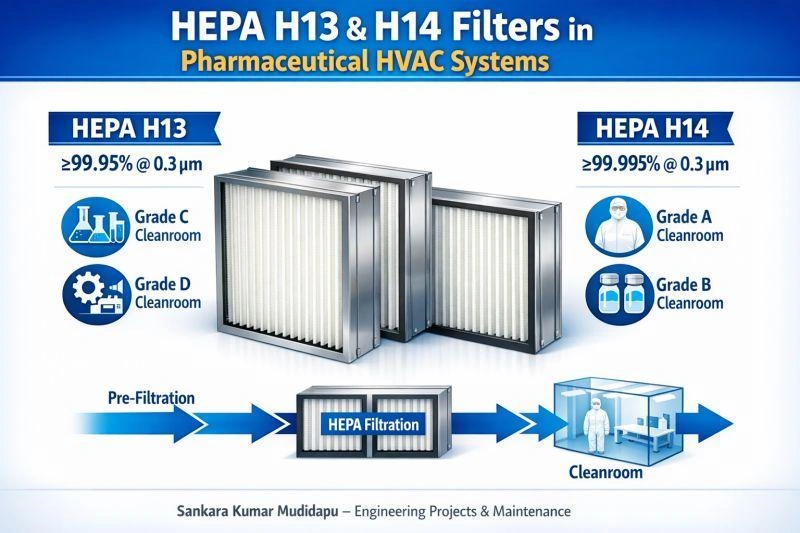
The main difference between H13 and H14
According to the EN 1822 standard, both H13 and H14 are HEPA filters, and their filtration efficiency is mainly based on MPPS (most penetrating particle size).
| Parameters | H13 | H14 |
|---|---|---|
| Filter level | H13 | H14 |
| Overall filtration efficiency | ≥99.95% | ≥99.995% |
| Overall penetration rate | ≤0.05% | ≤0.005% |
| Local filtration efficiency | ≥99.75% | ≥99.975% |
The overall filtration efficiency of H14 is higher than that of H13, and the proportion of particles allowed to penetrate is about one-tenth that of H13. Therefore, H14 can provide a higher level of air filtration performance for clean environments with higher requirements for particle pollution control.
What is MPPS?
MPPS is the abbreviation of Most Penetrating Particle Size, which is the "most penetrating particle size". The filtration efficiency of HEPA filters for particles of different particle sizes is not exactly the same, so EN 1822 uses MPPS as an important test basis.
When purchasing H13 or H14 HEPA filters, it is not recommended to compare only single parameters such as "99.97%@0.3μm". You should also confirm the filtration grade, MPPS filtration efficiency, initial resistance, rated air volume and filter test report.
What scenarios are H13 and H14 suitable for?
H13 is usually suitable for air filtration systems with higher cleanliness requirements, such as hospital clean areas, food processing areas, general pharmaceutical workshops, electronic manufacturing workshops, and some ISO 7 and ISO 8 clean rooms.
H14 has higher filtration efficiency and is more suitable for applications that require strict control of particle contamination, such as sterile pharmaceutical production areas, semiconductor manufacturing, high-demand medical environments, high-precision laboratories, and other critical clean areas.
The actual selection should be based on clean room design standards, production processes and project technical specifications, rather than simply pursuing a higher HEPA level.
How to choose between H13 and H14?
If the project technical specifications allow H13, and the cleanliness requirements, system air volume and operating costs can meet the design requirements, H13 can be selected. For critical areas with higher requirements for air cleanliness and particle control, H14 may be considered.
At the same time, you also need to pay attention to the initial resistance of the filter and the system fan capacity. HEPA filter selection should not only focus on filtration efficiency, but also comprehensively consider rated air volume, resistance, size, filter material, frame and sealing method to ensure that the filter matches the HVAC system.
What parameters need to be confirmed when purchasing HEPA filters?
When purchasing H13 or H14 HEPA filters, it is recommended to confirm:
HEPA grade: H13 or H14;
Testing standards: EN 1822, ISO 29463 or project specified standards;
MPPS filtration efficiency;
Rated air volume and initial resistance;
Filter size and frame material;
Filter material and sealing method;
Scanning leak detection and single unit test report.
For critical applications such as pharmaceuticals, medical, and semiconductors, it is recommended to require suppliers to provide complete filtration efficiency, resistance, and leak detection test data.
Jiangsu Yueboyang HEPA filter product supporting capabilities
Jiangsu Yueboyang Purification Equipment Co., Ltd. can provide H13, H14, etc. according to different cleanliness levels and application requirementsHEPA high-efficiency filter, and product selection and matching can be carried out based on the customer's clean room design, installation size, rated air volume and filtration efficiency requirements.
In addition to HEPA high-efficiency filters, the company can also provide air filtration products such as primary-efficiency filters, medium-efficiency filters, bag filters, V-type filters, and FFU fan filter units, which can meet the multi-stage air filtration needs of clean rooms, HVAC systems, and pharmaceutical, medical, electronics, semiconductor, food and other industries.
For H13 or H14 HEPA filter procurement projects, it is recommended to confirm the filtration level, efficiency, air volume, resistance, size and testing requirements before placing an order to ensure that the filter meets the project cleanliness requirements and matches well with the air purification system.


