
F5, F6, F7 and F8 are common medium efficiency filtration grades in the traditional European air filter classification system, and are widely used in HVAC air conditioning systems, fresh air systems, industrial ventilation and some clean environments. Different grades have differences in filtration performance, air resistance and applicable scenarios. For foreign trade procurement and engineering projects, understanding these differences can help to make a reasonable selection of air filters.
1. What are F5, F6, F7 and F8?
F5 to F8 belong to the medium-efficiency filtration grades in the traditional EN 779 standard system. With the development of air filtration standards, ISO 16890 is increasingly used in the international market to evaluate filter performance.
Therefore, when purchasing F5, F6, F7 or F8, it is not recommended to compare only the grade names. You should also confirm parameters such as test standards, filtration efficiency, rated air volume and pressure loss.
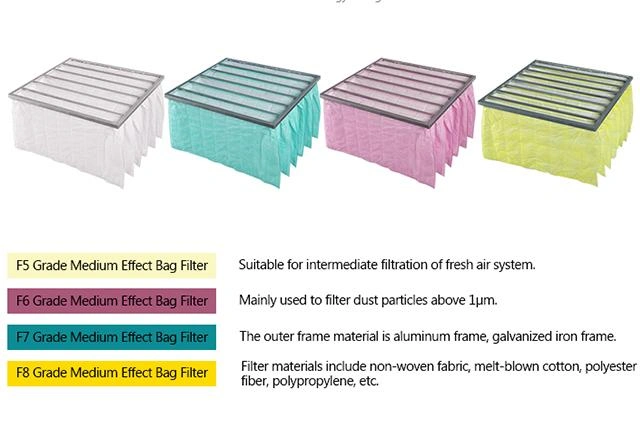
2. What is the difference between F5-F8 air filters?
In general, the filtration performance from F5 to F8 gradually improves, but the filter resistance usually also increases.
F5 air filter
F5 is a basic medium-efficiency filtration grade, suitable for general HVAC, fresh air and industrial ventilation systems, and can be used to reduce the load of particulate matter in the air.
F6 air filter
F6 has higher filtration performance than F5 and can be used in office buildings, general areas of hospitals, industrial plants and air handling units, etc., where air quality requirements are higher.
F7 air filter
F7 is widely used in hospitals, food processing, pharmaceuticals, electronics manufacturing and clean room front-end filtration. In the HEPA system, F7 can also be used as a pre-filter to reduce the particle load of HEPA.
F8 air filter
F8 has higher traditional F-level filtration performance and is suitable for HVAC, medical, pharmaceutical, electronic manufacturing and clean room air treatment systems that require higher air cleanliness.
3. How to choose F5-F8?
Filter selection should not only look at the filtration level, but should also consider comprehensively:
Cleanliness requirements: determine the required filtration performance;
Design air volume: ensure that the filter meets the actual air handling capacity;
Initial resistance: affects fan energy consumption ;
Filter area: affects resistance and service life;
Fan residual pressure: avoids insufficient air volume after replacing high-grade filters;
Operating cost: comprehensive consideration of filter life and energy consumption.
The reasonable selection logic is:
Cleanliness requirements → Filtration level → Air volume → Filtration area → Resistance → Fan residual pressure
4. How do F5-F8 and HEPA filters cooperate?
In high cleanliness systems, F5-F8 are usually used as pre-filtration of HEPA filters rather than replacing HEPA.
Typical structure is:
Primary effect filtration → F5-F8 medium effect filtration → HEPA high-efficiency filtration → clean air supply
Multi-stage filtration can reduce the load of particulate matter entering the HEPA filter and help extend the service life of the high-efficiency filter.
5. Precautions for purchasing F5-F8 filters
When purchasing, it is not recommended to only indicate "F7 Air Filter". You should also confirm:
Filter Class;
Test Standard;
Rated Airflow;
Filter Dimensions;
Initial Pressure Drop;
Filter Media;
Frame Material;
Dust Holding Capacity;
Testing Documents.
It is particularly important to note that EN 779 has been gradually replaced by the ISO 16890 system. Therefore, suppliers should be required to clarify test standards and provide corresponding performance data when purchasing.
6. Jiangsu Yueboyang medium-efficiency filtration product supporting capabilities
Jiangsu Yueboyang Purification Equipment Co., Ltd. can provide F5, F6, F7, F8 medium-efficiency air filters, as well as primary-efficiency filters, bag filters, HEPA high-efficiency filters and FFU fan filter units.
The company can select and customize products based on filtration level, design air volume, installation size, resistance requirements and actual use environment, and provides air filtration product matching for HVAC, hospitals, food, pharmaceuticals, electronic manufacturing and clean room projects.
7. Summary
The main differences between F5, F6, F7 and F8 are filtration performance and air resistance. Generally, the higher the filtration level, the stronger the filtration capacity, but system resistance and operating energy consumption also need to be considered simultaneously.
Actual projects should conduct comprehensive selection based on cleanliness requirements, air volume, fan residual pressure and operating costs, and pay attention to the differences between EN 779 and ISO 16890 standards to ensure that the performance of purchased filters meets project requirements.


