
Clean room HEPA filter is an important terminal component of the air purification system. Its selection is directly related to cleanliness, air supply volume, system resistance and operating cost. For clean room projects, you should not just indicate "purchasing HEPA filters" when purchasing, but should formulate complete technical specifications to clarify filtration efficiency, air volume, size, resistance, sealing method and testing requirements to avoid inconsistent product parameters affecting project acceptance.
1. First clarify the use environment and cleanliness level
Develop HEPA filter Before purchasing specifications, you should first clarify:
Clean room purpose and production process;
Target cleanliness level;
Installation location;
Design air supply volume;
Use temperature and humidity range;
HVAC system operating conditions.
Different applications have different requirements for filters. For example, the design conditions of electronics manufacturing, pharmaceutical, food and hospital cleanrooms are not exactly the same and therefore cannot simply adopt uniform specifications.
2. Clarify HEPA filtration efficiency
Filtration efficiency is one of the core parameters in the procurement specification.
The specification should clearly define the efficiency level of the filter and the corresponding test method, and avoid just writing "99.99% high efficiency filter" without test conditions.
At the same time, the applicable particle testing range, efficiency level and related testing standards for filters should be clarified so that suppliers can produce and test according to unified technical requirements.
3. Clarify the rated air volume and size
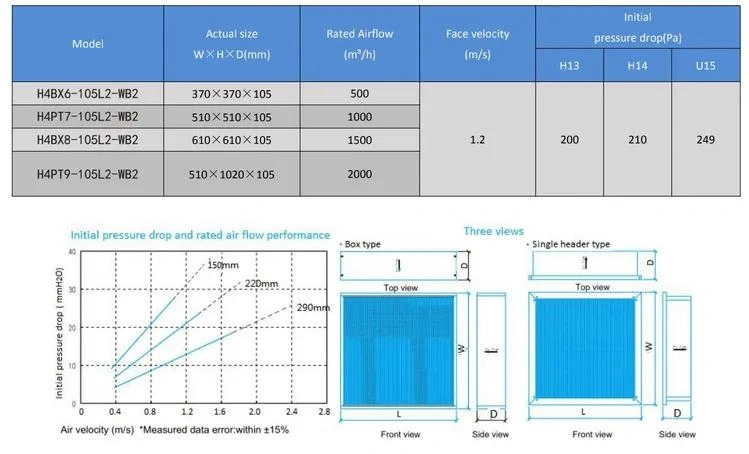
The size of the HEPA filter must match the end equipment of the clean room.
The procurement specifications clearly suggest:
Length × width × thickness;
Rated air volume;
Allowable air volume range;
Installation method;
Flange or frame size;
Sealed structure.
If the filter is used for FFU or high-efficiency air supply vents, the corresponding equipment model and installation interface should also be provided to avoid size mismatch problems after arrival.
4. Clarify the initial resistance and final resistance
The filter resistance will directly affect the fan energy consumption, so you cannot only focus on the filtration efficiency when purchasing.
The technical specification should require the supplier to provide the initial resistance under the specified air volume, and clarify the final resistance or replacement judgment conditions.
On the basis of meeting the cleanliness requirements, reasonable control of filter resistance can help reduce the long-term operating costs of the HVAC system.
5. Clarify the filter material and frame material
The procurement specification should clarify the filter material requirements based on the actual application, for example:
Filter material type;
Separation material or structure without partitions;
Frame material;
Sealing material;
Moisture-proof performance;
Structural strength.
For clean environments such as food, pharmaceuticals and hospitals, the material’s moisture resistance, cleaning and maintenance requirements, and long-term operational stability should also be considered based on specific usage conditions.
6. Focus on sealing and leak detection requirements
The HEPA filter itself has a high filtration efficiency, which does not mean that the system will definitely be leak-free after installation.
The procurement specification should specify the sealing method between the filter and the frame, and specify the leak detection requirements for the finished filter.
For high-cleanliness projects, the supplier can be asked to provide a single filter test report, and after installation is completed, an on-site leak test will be conducted in accordance with the project requirements to confirm that there are no abnormal leaks in the filter material, frame and sealing structure.
7. Clear test reports and quality documents
When purchasing HEPA filters, it is recommended to require suppliers to provide complete quality documents, including:
Product specifications and technical parameters;
Filtration efficiency test report;
Initial resistance test data;
Product qualification certificate;
Batch or product number;
Dimensional and appearance inspection records;
Relevant performance testing data.
For large clean room projects, suppliers can also be required to provide sample confirmation, production process quality control and factory inspection data.
8. Establish a complete procurement technical specification table
During actual procurement, the core parameters can be organized into a table:
| Technical Parameter | Procurement Requirement |
|---|---|
| Product Name | HEPA High Efficiency Air Filter |
| Filter Type | HEPA Filter with Separator / Mini-Pleat HEPA Filter |
| Filtration Efficiency | To be specified according to the cleanroom classification and project requirements |
| Test Standard | In accordance with the project-specified or mutually agreed test standard |
| Rated Airflow | To be determined according to the cleanroom design airflow |
| Overall Dimensions | Length × Width × Height, according to the installation requirements |
| Initial Pressure Drop | Shall meet the specified value at rated airflow |
| Final Pressure Drop | Final resistance value for filter maintenance or replacement shall be specified |
| Filter Media | Fine glass fiber or other filter media specified for the project |
| Separator Material | Hot-melt adhesive, aluminum separator, or other specified structure |
| Frame Material | Aluminum alloy, galvanized steel, or other specified material |
| Sealing Method | Gasket seal, gel seal, or other specified sealing structure |
| Sealant | Suitable for cleanroom applications |
| Operating Temperature | To be specified according to the actual project environment |
| Operating Humidity | To be specified according to the actual project environment |
| Leakage Testing | Factory or on-site leakage testing according to project requirements |
| Installation Method | Compatible with FFU, HEPA terminal housing, or filter mounting frame |
| Product Identification | Each filter shall have an individual serial number or batch number |
| Appearance | Filter media, frame and sealing structure shall be free from visible damage, deformation or contamination |
| Quality Documents | Certificate of conformity, performance test report and relevant quality documents |
| Packaging | Moisture-proof, dust-proof and impact-resistant packaging |
| Warranty | In accordance with the purchase contract and mutually agreed warranty terms |
| Remarks | Final technical parameters shall be based on the approved project specification and mutually confirmed version |
9. Jiangsu Yueboyang HEPA filtration product supporting capabilities
Jiangsu Yueboyang Purification Equipment Co., Ltd. focuses on the field of clean air and purification equipment, and can provide products such as HEPA high-efficiency filters, ultra-high-efficiency filters, primary and medium-efficiency filters, FFU fan filter units and high-efficiency air supply outlets.
For clean room projects, the company can select and customize products based on cleanliness level, design air volume, filtration efficiency, installation size, resistance requirements and usage environment, and provide relevant product testing data to provide air filtration product support for electronic manufacturing, semiconductor, food, pharmaceutical and medical clean projects.


