
HEPA filters are widely used in clean rooms, hospitals, pharmaceuticals, electronics manufacturing, and food processing. For B-end project procurement, if you only confirm the product size and filtration level, it is easy to cause problems such as inability to install, insufficient air volume, excessive resistance, or poor sealing. Therefore, the size, performance, material and installation method of the filter should be fully confirmed before purchasing.
1. Clear usage scenarios
Before purchasing, first confirm the application environment of HEPA filter, including clean room grade, target cleanliness, installation location, design air volume and major pollutants in the air.
Different application scenarios have different requirements for filtration efficiency, materials, sealing performance and tolerance. Therefore, the selection should be based on the actual working conditions and cannot be purchased based on the name "HEPA filter".
2. Confirm the size and installation method
Size mismatch is the most common problem in procurement. In addition to length, width, and height, you should also confirm:
Actual installation dimensions of the filter
Thickness and flange size
Connection method
Installation direction
Sealing strip position
Liquid tank sealing or gasket sealing method
When replacing the original filter, it is recommended to provide the original product model, on-site photos, equipment drawings or actual installation dimensions to avoid placing orders based solely on verbal data.
3. Confirm filtration level and test standards
HEPA filters have different filtration levels, such as H13, H14, etc. The filtration level, filtration efficiency and corresponding test standards should be clearly specified when purchasing.
Different standards may have differences in testing methods and test particle sizes, so you cannot just compare the "filtration efficiency percentage" in product promotions. For hospital, pharmaceutical and high-grade clean room projects, testing and acceptance requirements should also be clearly defined.
4. Confirm air volume and resistance
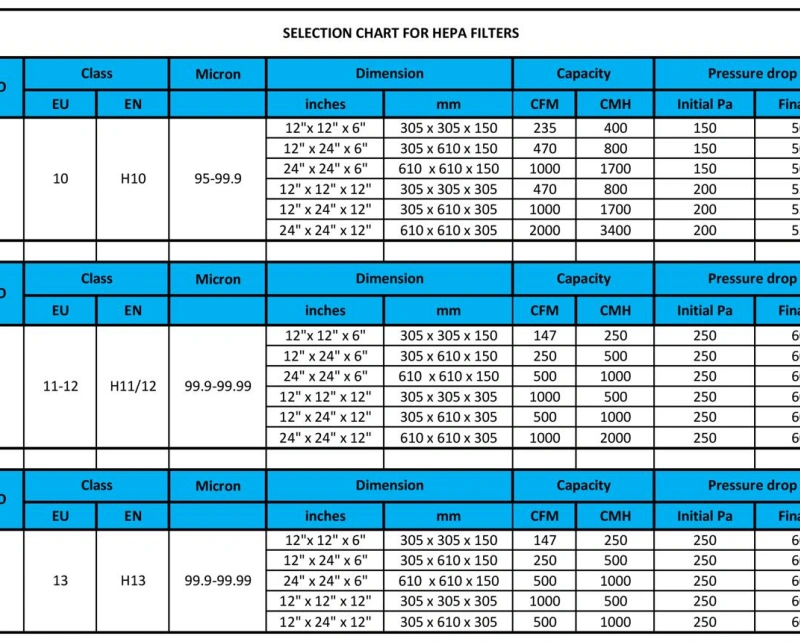
Filtration efficiency is not the only performance parameter. The rated air volume and initial resistance will directly affect the operation of the HVAC system.
If the filter resistance is too high, it may cause a drop in air volume, an abnormal indoor pressure difference, and an increase in fan energy consumption. Therefore, when purchasing, you should also confirm:
Rated air volume, initial resistance, final resistance and system fan residual pressure.
Ensure that the filter has a reasonable resistance level at the design air volume.
5. Confirm the filter material, frame and sealing materials
Purchasing specifications should specify parameters such as filter material type, frame material, separation material, sealant and sealing strip.
For environments with high humidity, high temperature or the presence of corrosive gases, the temperature resistance, moisture resistance and corrosion resistance of the product should also be confirmed. For food, pharmaceutical, medical and other projects, appropriate materials should be selected based on specific cleanliness requirements.
6. Confirm leak detection and test reports
HEPA filters not only need to meet filtration efficiency requirements, but also pay attention to overall integrity and leakage performance.
When purchasing, it should be clear whether to scan and detect leaks one by one, and the supplier should be required to provide a factory test report. For key clean areas, leak detection methods and on-site acceptance standards should also be confirmed in advance.
7. Establish a procurement technical specification table
It is recommended to establish a complete technical specification table in the purchase order, including at least:
Size, filtration level, rated air volume, initial resistance, final resistance, filter material, frame, sealing method, test standards, leak detection requirements and test reports.
For non-standard products, drawings or samples should be confirmed before mass production to avoid discovering mismatch in specifications after the product arrives.
Conclusion
Specification mismatch in HEPA filter procurement is often not a single size problem, but rather a lack of systematic confirmation of size, air volume, resistance, filtration efficiency, sealing method and installation structure. Standardizing the procurement process can effectively reduce the risks of returns, on-site modifications, and substandard system operation.
For projects that require customized or bulk purchase of HEPA filters, Jiangsu Yueboyang Purification Equipment Co., Ltd. can assist in product specification matching and technical confirmation based on the equipment parameters, installation dimensions, design air volume and usage environment provided by the customer, and provide HEPA filters of different sizes, filtration levels, frame materials and sealing structures. At the same time, the company can also provide primary-efficiency, medium-efficiency, high-efficiency filters, FFU fan filter units, high-efficiency air supply vents and other ancillary products to provide overall supporting support for clean rooms and HVAC air purification systems.


