
Commercial buildings, such as shopping malls, office buildings, hotels, shopping malls and complexes, etc., have high personnel density and long running hours of central air-conditioning systems. Air filters not only affect indoor air quality, but also air volume, fan energy consumption and equipment maintenance costs. Therefore, a reasonable air filtration solution should be established based on the building's usage characteristics.
1. Analysis of air quality requirements for commercial buildings
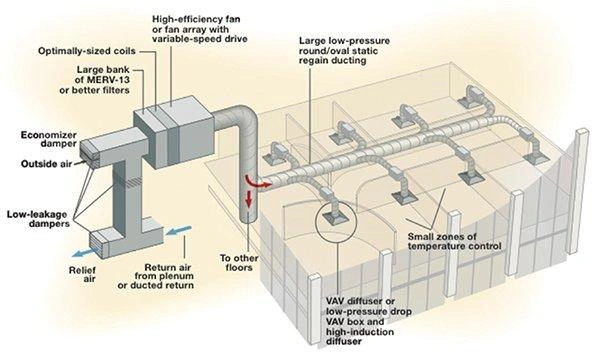
Commercial buildings mainly need to control dust, PM2.5, pollen and some particulate matter brought in by outdoor air. At the same time, they also need to pay attention to odors and gaseous pollutants generated in densely populated areas.
Before formulating a filtration plan, the air purification target should be determined based on the building area, population density, outdoor air quality, fresh air volume and central air conditioning system parameters to avoid blindly increasing the filtration level.
2. Reasonable configuration of multi-stage filtration
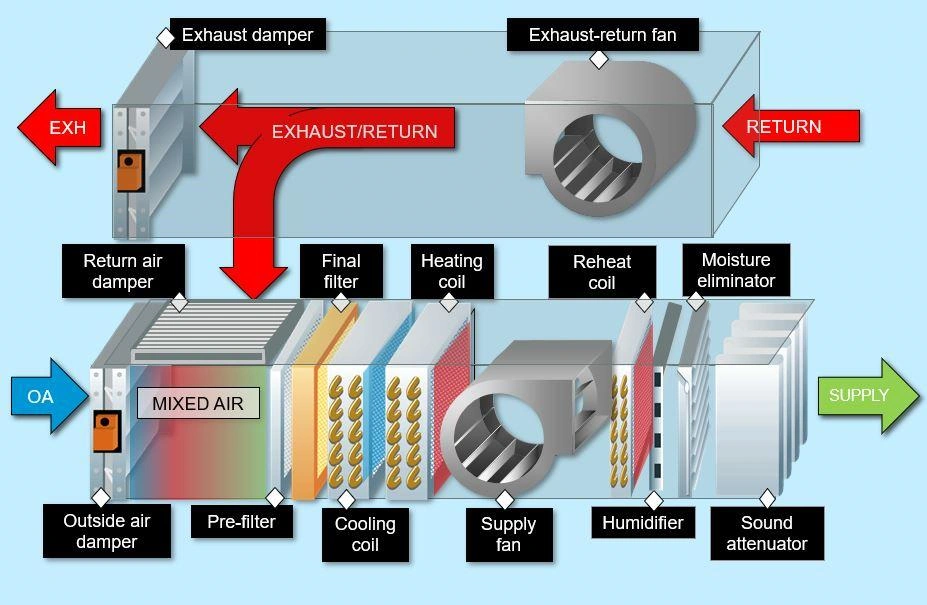
Central air conditioners in commercial buildings can usually use multi-stage filtration.
The primary-efficiency filter mainly intercepts larger particles and reduces dust from entering the air-conditioning box and rear-end filters; The medium-efficiency filter further filters smaller particles and improves the overall air purification effect.
For areas with higher air quality requirements or higher density of people, higher-grade filters can be added according to actual needs, but system resistance and fan energy consumption need to be evaluated at the same time.
3. Choose low-resistance filters
Commercial building central air conditioners run for a long time, and filter resistance has a greater impact on long-term energy consumption.
On the premise of meeting the design filtration efficiency, priority should be given to comparing the initial resistance, dust holding capacity and service life of different products. Filters with low resistance and high dust holding capacity can reduce the fan operating load and extend the filter replacement cycle.
Therefore, when purchasing, you should not only compare the unit price of the filter, but also consider the comprehensive cost of the entire life cycle.
4. Optimization for special areas
The air needs of different commercial areas are not exactly the same.
In densely populated areas such as shopping malls and supermarkets, emphasis should be placed on ensuring fresh air volume and particle filtration capabilities; hotels and catering areas may be polluted by odors and oil fumes, and appropriate filtering and adsorption materials need to be selected based on the characteristics of pollutants.
For special areas such as underground garages, targeted ventilation and air treatment solutions should be adopted based on the type of pollutants.
5. Strengthen fresh air and air valve control
Air filtration is only a part of air purification, and the normal operation of the fresh air system must also be ensured.
The status of fresh air outlets, filters, air valves and air ducts should be checked regularly, and the air volume balance in each area should be ensured through reasonable air valve adjustment.
For large commercial buildings, it can be combined with the building automation system to dynamically adjust the fresh air volume according to the density of people, indoor air quality and operating time, thus taking into account both air quality and energy consumption.
6. Establish filter pressure difference management
During use, the filter will gradually accumulate dust and the resistance will continue to increase. Long-term use of high-resistance filters may cause a decrease in system air volume and an increase in fan energy consumption.
It is recommended to record the operating status of the filter through pressure difference monitoring, and determine the maintenance and replacement cycle based on the actual resistance, rather than completely using fixed time replacement.
Through digital management, waste caused by premature replacement of filters can be avoided, and high energy consumption of the system caused by long-term non-replacement can also be avoided.
7. Comprehensive evaluation of operating costs
Commercial building air filtration solutions should be evaluated from the entire life cycle, including:
Filter purchase cost + fan energy consumption + replacement frequency + maintenance cost.
A filter with a higher purchase price but low initial resistance, large dust holding capacity, and long service life may have a lower long-term comprehensive cost than a low-priced product with fast resistance growth.
Conclusion
Commercial building central air conditioning air filtration solutions cannot only focus on filtration efficiency, but should comprehensively consider air quality, filtration level, system air volume, filter resistance, service life and operating energy consumption. Through reasonable multi-stage filtration, fresh air control, damper adjustment and pressure difference management, it is possible to improve indoor air quality while reducing the long-term operating costs of the HVAC system.
For projects that require the selection, optimization and bulk purchase of central air-conditioning filters for commercial buildings, Jiangsu Yueboyang Purification Equipment Co., Ltd. can match products based on building area, designed air volume, filtration level, equipment size and actual operating environment, and provide primary-efficiency, medium-efficiency, high-efficiency, HEPA and activated carbon filters and other products. At the same time, it can be equipped with HVAC dampers, FFU fan filter units, high-efficiency air supply vents and other air purification equipment, providing complete HVAC air purification product supporting support for shopping malls, office buildings, hotels and large commercial complexes.


