
During the food production process, dust, fibers, microorganisms and other particles in the air may enter food exposure areas, affecting product hygiene and quality. For ready-to-eat food, aseptic packaging and high-cleanliness production areas, the rational application of HEPA high-efficiency filters can further reduce the concentration of fine particles sent into the production area and establish a more stable clean air environment.
1. Why do food production workshops need HEPA filters?
The sources of air pollution in food production workshops include outdoor fresh air, personnel activities, raw and auxiliary materials, equipment operation, and packaging processes. Ordinary primary and medium-efficiency filters are mainly responsible for front-end particle filtration, while HEPA filters can further filter fine particles in the air.
It should be noted that HEPA filters are mainly used for air particle control and cannot replace cleaning and disinfection, personnel hygiene management and microbial control measures in the food production process.
2. Which food production areas are HEPA filters suitable for?
Not all food production areas require HEPA filters, and selection should be based on product risks and process requirements.
1. Ready-to-eat food production area
For areas where food has been heated or otherwise processed and then left open, HEPA terminal filtration can be used according to clean environment requirements to reduce the risk of air particles entering the product.
2. Food packaging area
In cooked food, beverages, dairy products and other food packaging areas, if the products have high requirements for environmental cleanliness, HEPA filters can be used in conjunction with clean air supply equipment for local air purification.
3. High-cleanliness production area
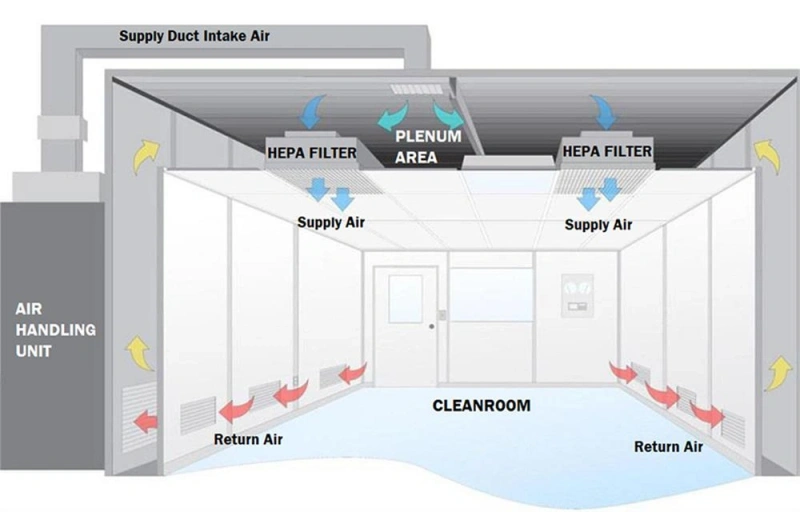
For production processes that require high air cleanliness, HEPA filters, FFU and clean air supply vents can be used to form a local clean environment.
3. Basic structure of HEPA filtration system
Typical systems can use:
Fresh air → Primary effect filtration → Medium effect/bag filter → Air conditioning treatment → HEPA filtration → Clean air supply → Food production area → Return air/exhaust air
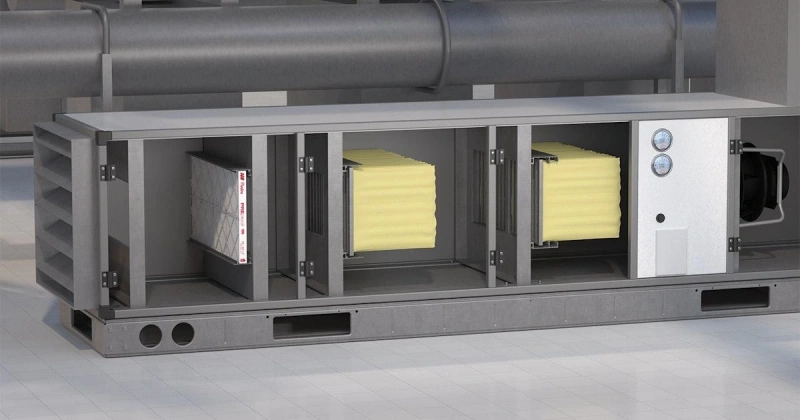
The primary and medium-efficiency filters are responsible for intercepting larger particles and reducing the pollution load of the HEPA filter; the air conditioning system is responsible for temperature and humidity treatment; the HEPA filter serves as the final high-efficiency filtration link.
This multi-stage filtration structure can reasonably distribute the filtration load of different filters and help extend the service life of HEPA filters.
4. How to select HEPA filters for food production?
1. Select filtration efficiency according to cleanliness requirements
Filter efficiency should be determined based on the production process, product type and target cleanliness. It is not that the higher the filtration efficiency, the better. System air volume, resistance and operating costs also need to be considered comprehensively.
2. Select the size according to the air volume
The rated air volume of the HEPA filter should meet the actual air supply demand. Insufficient filtration area may lead to increased resistance, so the size and number of filters should be reasonably selected based on the air volume.
3. Pay attention to the initial resistance
Long-term operation of the HEPA filter will increase the fan load. Choosing a filter with reasonable resistance and combining it with front-end pre-filtration can reduce system operating energy consumption.
4. Pay attention to sealing performance
After the HEPA filter is installed, if there is leakage between the filter and the frame, even if the filter material has high filtration efficiency, it may affect the actual purification effect. Therefore, a reliable sealing structure should be selected and installation inspection should be done.
5. How to choose a high-humidity food environment?
In the food production process, there may be cleaning, cooking, cooling and other processes, and the air humidity is high. In high-humidity environments, attention should be paid to the moisture resistance of the filter material and the frame protection capabilities.
At the same time, the air conditioning dehumidification system should be designed reasonably to prevent the filter from being in an inappropriate humidity environment for a long time. For areas where there is a risk of condensation, comprehensive control is also required from aspects such as air dew point and equipment surface temperature.
6. How to maintain HEPA filter?
During the operation of the HEPA filter, particulate matter will gradually accumulate and the resistance will continue to increase. It is recommended to judge the operating status of the filter through pressure difference monitoring, and perform maintenance based on the actual air volume and cleanliness test results.
Daily management should focus on checking:
The pressure difference before and after the filter;
The appearance of the filter and the condition of the filter material;
The sealing condition of the filter and the frame;
Whether the air supply volume meets the design requirements;
The level of particulate matter in the clean area.
After reaching the specified maintenance conditions, it should be replaced according to the specifications, and the installation inspection after replacement should be done.
7. Jiangsu Yueboyang Food Clean Air Product Supporting Capabilities
Jiangsu Yueboyang Purification Equipment Co., Ltd. focuses on the field of clean air and purification equipment, and can provide products such as primary, medium, high-efficiency and ultra-high-efficiency filters, bag filters, FFU fan filter units and high-efficiency air supply outlets.
For food processing, food packaging and high-cleanliness production areas, the company can select and customize HEPA filters and related purification products based on the cleanliness level, design air volume, installation size and actual working conditions, and provide product supporting support for the air filtration system in food production workshops.
8. Summary
The application of HEPA filters in food production workshops should be comprehensively designed based on product type, production process, cleanliness requirements, air volume and environmental conditions.
Through primary-efficiency, medium-efficiency and HEPA multi-stage filtration, combined with reasonable clean air supply, air flow organization, temperature and humidity control and pressure difference monitoring, the risk of air particle pollution in the production area can be reduced and a more stable clean air environment can be provided for food production.


