
During food processing, dust, fibers, microorganisms and other particles in the air may enter the food production environment, affecting product hygiene and quality. Properly designing the clean workshop air filtration system can reduce the risk of air pollutants entering the production area and maintain stable air cleanliness, temperature, humidity, and air flow organization.
1. Why does a food clean workshop need air filtration?
During food processing, raw materials, personnel, equipment and packaging materials may produce or carry particulate matter. If air filtration capacity is insufficient, contaminants may enter food exposure areas, increasing the risk of product contamination.
Therefore, food clean workshops should establish a reasonable air filtration system based on product type, production process and hygienic requirements, and conduct a comprehensive design with fresh air, air conditioning, pressure difference and air flow organization.
2. Composition of air filtration system in food clean workshop
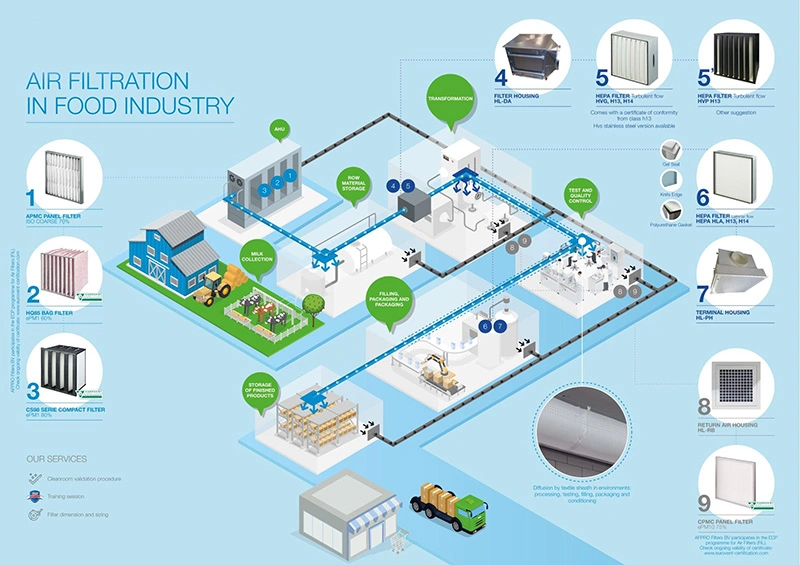
A typical air treatment system can use:
Fresh air → Primary effect filtration → Medium effect/bag filter → Air conditioning treatment → HEPA high efficiency filtration (on demand) → Clean air supply → Production area → Return air/exhaust air
Primary-efficiency filters mainly filter larger dust, fibers and particles, reducing the load on subsequent filters; medium-efficiency or bag filters further reduce the concentration of particulate matter in the air; for areas where food is directly exposed and require higher air cleanliness, HEPA high-efficiency filters can be added according to actual needs.
3. Filtration solutions for different food production areas
1. Raw material processing area
A lot of dust is usually generated during raw material processing, so the dust holding capacity and maintenance cycle of the filter should be considered. Primary effect + medium effect or bag filter structure can be used to reduce a large amount of particulate matter from entering the air conditioning system.
2. Food processing area
For processing areas where food is directly exposed, the cleanliness of the air supply should be improved and the airflow should be reasonably organized to reduce external pollutants from entering the production area.
3. Packaging area
Ready-to-eat food, cooked food and open packaging areas usually have higher environmental cleanliness requirements. Higher-level terminal filtration can be configured according to product risks and process requirements, and regional pressure can be reasonably controlled.
4. High cleanliness areas
For areas with higher requirements for particle and microbial control, HEPA filters, FFU or clean air supply equipment can be used to form a local high-clean environment.
4. What parameters should be paid attention to when selecting a filter?
Food clean workshop filters should not only look at filtration efficiency, but should also consider comprehensively:
Rated air volume: meets the system design air volume;
Filtration efficiency: determined according to the requirements of the production area;
Initial resistance and final resistance: affect the system energy consumption;
Dust holding capacity: adapts to the actual pollution load;
Filter material performance: meets the usage conditions of food production environment;
Moisture resistance: suitable for high-humidity production areas;
Dimensions and specifications: matches AHU, FFU or air supply outlet;
Sealing performance: reduces bypass leakage after filter installation.
For food production environments with high humidity, special attention should be paid to the possible performance changes of filter materials after they become damp.
5. Air flow organization and pressure control
The air filtration system needs to be co-designed with the air flow organization of the clean workshop. The filtered clean air should flow in a predetermined direction to avoid unreasonable air flow between areas with different hygiene levels.
For areas where food is directly exposed, a reasonable pressure relationship can be established based on the production process and hygienic requirements, so that the air flows from relatively clean areas to areas with higher pollution risks, reducing the possibility of external contaminated air entering.
At the same time, the air supply vents and return air vents should be reasonably set up to reduce air flow short circuits and local blind spots.
6. How to reduce the operating cost of the filtration system?
Food clean workshops usually require continuous operation of HVAC systems, so filter resistance will directly affect fan energy consumption.
It is recommended to adopt a reasonable multi-stage filtration structure to allow the primary and medium-efficiency filters to bear the main particulate matter load and protect the back-end high-efficiency filter. At the same time, the degree of filter clogging is determined through pressure difference monitoring instead of simply replacing it at a fixed time.
For food factories with large air volumes, the use of bag filters with larger filtration areas can improve dust holding capacity and extend maintenance cycles under reasonable working conditions.
7. Jiangsu Yueboyang Food Clean Air Product Supporting Capabilities
Jiangsu Yueboyang Purification Equipment Co., Ltd. focuses on the field of clean air and purification equipment, and can provide products such as primary, medium, high-efficiency and ultra-high-efficiency filters, bag filters, FFU fan filter units and high-efficiency air supply outlets.
For the clean workshops of food processing plants, the company can select and customize filters based on the cleanliness requirements of the production area, design air volume, installation dimensions and actual working conditions, and provide air filtration and terminal clean air supply products for food processing, packaging and other clean production areas.
8. Summary
The air filtration system in the clean workshop of a food processing plant should be comprehensively designed based on food type, production process, regional hygiene requirements, air volume, pollution load and temperature and humidity conditions.
By rationally configuring primary-efficiency, medium-efficiency, bag-type and HEPA filters, combined with airflow organization, pressure control and differential pressure monitoring, the stability of the air environment can be improved and a reasonable balance can be achieved between food hygiene, product quality, system reliability and operating costs.


