
Hospital operating rooms, ICUs, clean wards, negative pressure isolation wards and other areas have high requirements for air cleanliness and air environment stability. As an important part of the HVAC system, the operating status of the air filter will directly affect the air supply volume, air cleanliness and system energy consumption. Therefore, establishing a standardized filter maintenance and management system is an important measure to ensure the stable operation of medical clean areas.
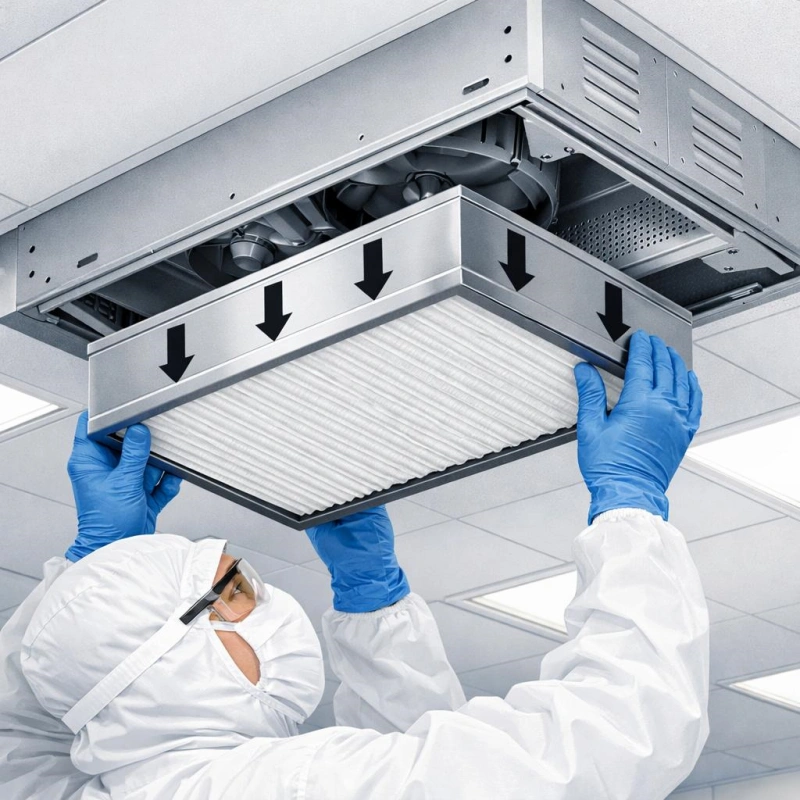
1. Why do we need to maintain the air filter regularly?
Air filters will continuously trap dust, fibers and particles during long-term operation. As pollutants accumulate, filter resistance gradually increases, which may lead to a decrease in air volume, increase in fan energy consumption, and affect the pressure and air flow organization of the clean area.
If the filter is not replaced for a long time, it may also affect the service life of the terminal HEPA filter. Therefore, a hierarchical maintenance and replacement mechanism should be established based on the actual operating status of the filter.
2. Filter configuration in hospital clean areas
A typical medical clean air treatment system can use:
Fresh air → Primary filter → Medium efficiency filter → Air conditioning treatment → HEPA high efficiency filter → Clean air supply → Indoor
The primary filter mainly intercepts larger particles and protects subsequent filters; the medium-efficiency filter further reduces the load of particulate matter in the air; HEPA filters are usually used as high-efficiency filtration equipment at the end of clean areas.
The filtration configuration in different areas should be determined according to the cleanliness level, ventilation system and specific usage requirements.
3. Key points for daily filter maintenance
1. Monitor the filter pressure difference
The pressure difference is an important indicator for judging the degree of dust accumulation on the filter. It is recommended to install a pressure difference monitoring device before and after the filter to record operating data regularly.
If the pressure difference continues to rise, check whether the filter is clogged and determine whether it needs to be replaced based on the system air volume and cleanliness test results.
2. Check the filter seal
Just because the filter itself performs well does not mean that the system will have a good filtration effect after installation.
Maintenance personnel should regularly check the sealing status between the filter and the installation frame to confirm whether there is looseness, deformation or obvious air leakage, especially for HEPA filters.
3. Check the appearance of the filter
During the maintenance process, the filter material should be observed for damage, deformation, moisture or abnormal contamination. Filters that are obviously damaged should be replaced in time.
IV. Maintenance and management of filters of different levels
1. Primary filter
Primary filter usually bears a larger load of particulate matter and should be inspected and replaced regularly according to the actual dust situation. Maintenance cycles need to be shortened in highly polluted environments.
2. Medium-efficiency filter
The dust holding capacity of medium-efficiency or bag filters is usually higher than that of ordinary primary-efficiency filters, but the operating status still needs to be judged by pressure difference monitoring. When the resistance reaches the system setting range, replacement should be arranged in time.
3. HEPA high-efficiency filter
HEPA filters are usually located at the end of the clean area and require higher maintenance. In addition to monitoring the pressure difference and air volume, you should also pay attention to the sealing and installation status of the filter. After replacement, necessary leak detection and cleanliness testing should be carried out according to project requirements.
5. Establish a filter replacement management system
Hospitals should not simply replace all filters according to a "fixed time", but should establish a maintenance mechanism based on operating status.
It is recommended to create a filter file and record:
Filter model and specifications;
Installation location;
Filter efficiency;
Installation date;
Initial pressure difference;
Current operating pressure difference;
Replacement date;
Maintenance and inspection records.
Through long-term records, the service life of filters in different areas can be analyzed to provide data basis for subsequent procurement and maintenance.
VI. Precautions for filter replacement
When replacing the air filter, standard disassembly and assembly methods should be used according to the structure of the equipment to avoid secondary pollution during the disassembly process.
After replacing the HEPA filter, you should focus on checking the installation tightness, and conduct corresponding testing according to the hospital's clean area management requirements. For special areas such as negative pressure isolation wards, special filter replacement and waste disposal procedures should also be developed in conjunction with infection control requirements.
7. Jiangsu Yueboyang Medical Filtration Product Supporting Capabilities
Jiangsu Yueboyang Purification Equipment Co., Ltd. focuses on the field of clean air and purification equipment, and can provide primary-efficiency, medium-efficiency, high-efficiency and ultra-high-efficiency filters, FFU fan filter units, high-efficiency air supply outlets and other products.
For hospital operating rooms, ICUs, clean wards and other medical clean areas, the company can select and customize products based on filtration efficiency, design air volume, installation size and actual use environment, and provide supporting support for air filtration and terminal clean air supply products for hospital HVAC systems.
8. Summary
The maintenance of air filters in hospital clean areas should be transformed from simple "regular replacement" to a management model that combines pressure difference monitoring, appearance inspection, sealing inspection, cleanliness testing and operation records.
Scientific maintenance of primary-efficiency, medium-efficiency and HEPA high-efficiency filters can maintain stable air supply volume and air cleanliness, while reducing unnecessary filter replacement and HVAC operating costs, providing a more reliable air environment for clean areas in hospitals.


