
Laminar flow operating rooms have high requirements for air cleanliness and air flow organization. HEPA filter is an important part of the terminal air purification system. Reasonable selection of HEPA filters is not only related to the air cleaning effect of the operating room, but also affects the air supply volume, system resistance, operating energy consumption and maintenance costs. Therefore, filtration efficiency, air volume, resistance and installation tightness all need to be considered comprehensively.
1. Why do laminar flow operating rooms need HEPA filters?
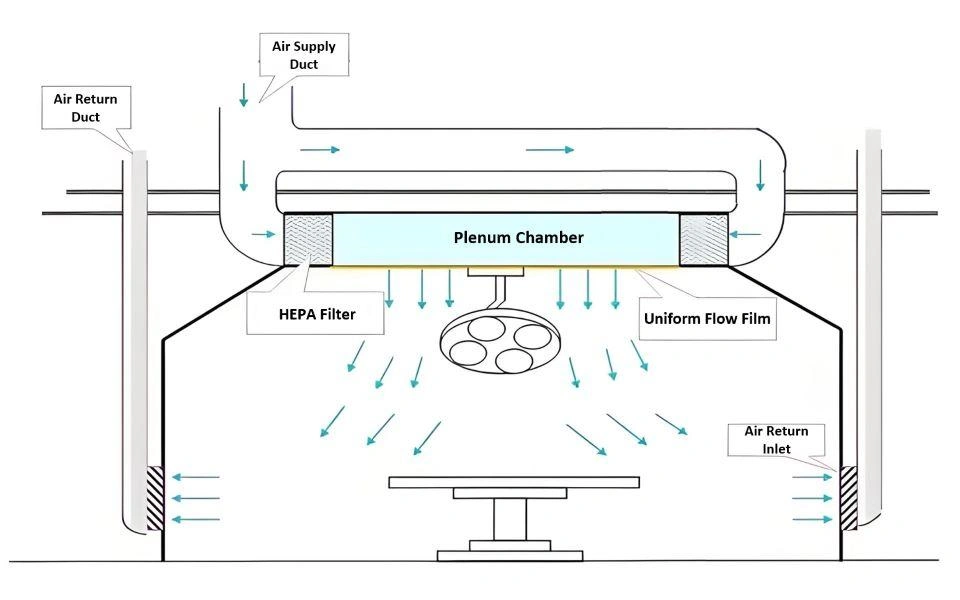
Laminar flow operating rooms reduce the concentration of particulate matter in the air in the surgical area by continuously supplying high-efficiency filtered clean air. HEPA filters are usually installed in clean air supply ceilings, laminar air supply devices or other terminal air supply equipment to perform final filtration of air that has been pretreated by the air conditioning system.
Compared with ordinary HVAC filters, HEPA filters have higher particle filtration capabilities and are suitable for medical environments that require higher air cleanliness.
II. The position of the HEPA filter in the laminar flow system
A typical laminar flow operating room air treatment process is:
Fresh air → Primary-efficiency filtration → Medium-efficiency filtration → Air-conditioning treatment → High-efficiency filtration → Laminar air supply → Operating area → Return air/exhaust air
Primary-efficiency and medium-efficiency filters are mainly responsible for front-end filtration tasks, which can reduce the load of particulate matter entering the HEPA filter, thus extending the service life of the high-efficiency filter.
As the final filtration link, the HEPA filter should be installed as close to the clean air supply end as possible to reduce the filtered air from being polluted again.
3. How to choose a HEPA filter?
1. Selection based on cleanliness level
Different operating rooms have different cleanliness requirements. The efficiency level of the HEPA filter should be determined based on the design requirements of the hospital's clean operating department and specific projects.
It is not recommended to blindly select the highest filtration efficiency in all projects, but to conduct a comprehensive design based on the target cleanliness, system air volume and equipment capacity.
2. Selection based on air volume
The rated air volume of the filter must match the laminar air supply system. If the actual air volume exceeds the filter design range, it may cause increased resistance and decreased operational stability.
Therefore, when selecting, you need to confirm the filter size, rated air volume and the design air volume of the terminal equipment at the same time.
3. Pay attention to the initial resistance
The higher the filtration efficiency of the HEPA filter, it does not mean that the system must be more energy-saving. Filter resistance will directly affect the fan operating load.
On the premise of meeting the cleanliness requirements, products with reasonable resistance and sufficient filtration area should be selected to reduce long-term operating energy consumption.
4. The sealing performance of HEPA filters is equally important
When using HEPA filters in laminar flow operating rooms, you cannot just focus on the filtration efficiency of the filter material itself.
If there is a gap between the filter and the mounting frame, air may bypass the filter material and directly enter the surgical area, causing a bypass leak. Therefore, the high-efficiency filter should be used in conjunction with a special installation frame and sealing structure, and should be installed and leak-detected as required.
For clean operating rooms, filter performance + installation sealing jointly determine the terminal air purification effect.
5. Application in laminar air supply system
HEPA filters are usually used in conjunction with clean air supply ceilings, laminar air supply devices or FFU and other equipment.
A reasonable air supply method can enable HEPA-filtered clean air to cover the main surgical area and take away polluted air through the return air system. Problems such as air supply short circuit and local air flow turbulence should also be avoided during the design process.
Therefore, HEPA filter selection cannot be separated from the entire HVAC system and should be comprehensively determined based on the air supply area, air volume, air flow organization and equipment structure.
6. HEPA filter maintenance and replacement
After the HEPA filter has been running for a period of time, as particulate matter continues to accumulate, the resistance will gradually increase. Filter maintenance cannot simply be replaced according to a fixed time, but should be judged based on the pressure difference, air volume and cleanliness test results.
Daily management suggestions:
Regularly check the filter pressure difference;
Monitor the level of particulate matter in the clean room;
Check the sealing condition of the filter and frame;
Troubleshoot any abnormal resistance in a timely manner;
Carry out necessary leak detection and cleanliness testing after replacement. FFU fan filter unit, high-efficiency air supply vents and other products.
For medical clean environments such as hospital clean operating rooms and laminar flow operating rooms, the company can select and customize filters based on the cleanliness level, design air volume, installation size and terminal air supply equipment requirements, and provide supporting support for high-efficiency filtration and terminal air supply products for clean air-conditioning systems.


