
The operating room laminar air supply ceiling is an important terminal equipment of the clean operating room HVAC system. It mainly performs terminal filtration of the processed air through high-efficiency filters and sends clean air evenly into the operating area.
For engineers and buyers, when choosing a laminar air supply ceiling, they cannot just focus on the appearance size, but need to make a comprehensive configuration based on the operating room area, cleanliness level, design air volume, HEPA filtration efficiency, air supply method, installation conditions and maintenance requirements.
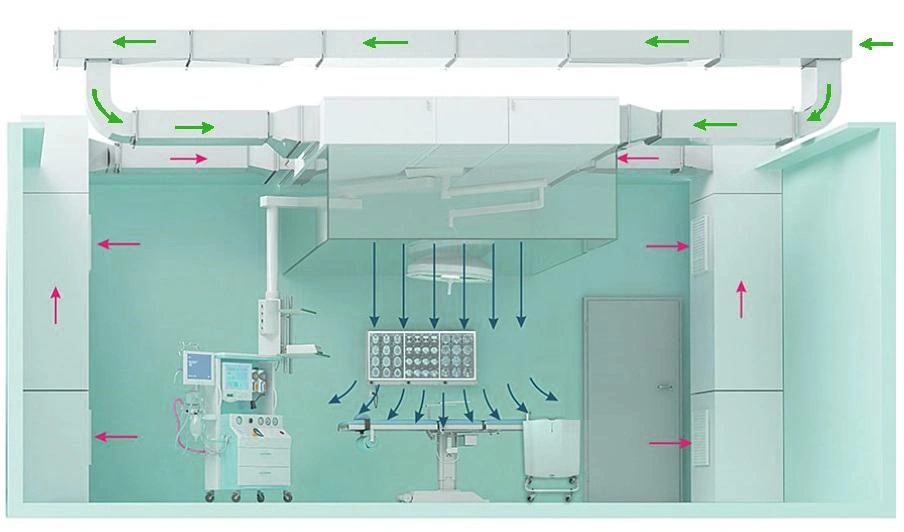
1. System configuration of operating room laminar air supply ceiling
A complete clean operating room air treatment system usually includes:
Fresh air → Primary effect filtration → Medium effect filtration → Air conditioning treatment → Air duct → High efficiency filtration → Laminar air supply ceiling → Operating area → Return air system
Laminar air supply ceiling is usually installed above the operating table as a terminal air supply device for clean air.
During engineering design, it is necessary to ensure that the AHU, air duct, HEPA filter and terminal air supply ceiling match each other. If the front-end air volume is insufficient, even if a high-efficiency HEPA filter is used, the expected air cleaning effect cannot be achieved.
Therefore, when purchasing a laminar air supply ceiling, the design air volume, filter resistance and system static pressure should be confirmed at the same time, and cannot be purchased based on the size of the ceiling alone.
2. How to determine the size of the laminar air supply ceiling?
The size of the laminar air supply ceiling should be determined based on the area of the operating room, the size of the operating table and the coverage of the clean area.
Usually important considerations are:
Operating room length and width
Operating table size and location
Ceiling height
Laminar flow coverage area
Air supply area
Air volume and ventilation requirements
Return air position
For surgical areas that require key protection, it should be ensured that the laminar air supply area can cover the operating table and main operating space to avoid clean dead corners due to too small air supply areas.
Therefore, it is not recommended to purchase directly only according to "standard size" in engineering projects, but should be confirmed based on the actual installation space.
3. How to choose a HEPA filter?
HEPA filter is the core component of laminar air supply ceiling to achieve terminal high-efficiency filtration.
It is recommended to confirm the following parameters when purchasing:
Filtration efficiency, rated air volume, initial resistance, final resistance, filter material type, filter element size and sealing method.
For clean operating rooms, it is usually necessary to determine the HEPA filtration level based on the project cleanliness level and local medical cleanliness standards.
At the same time, pay attention to whether the actual air volume of the filter matches the design air volume of the air supply ceiling.
If the filter resistance is too high, it may lead to:
Insufficient air volume
Increased fan energy consumption
Increased system static pressure
Unstable air supply speed
Therefore, we cannot only compare HEPA filtration efficiency, but also need to consider efficiency comprehensively + Air volume + Resistance + Service life.
4. What engineering parameters need to be paid attention to for laminar air supply ceiling?
When making technical selection, engineers are advised to confirm the following parameters:
| Parameters | Key points in selection |
|---|---|
| Ceiling size | Match the operating room and ceiling space |
| Air supply area | Cover the main Clean operating area |
| Design air volume | Match with AHU and air duct system |
| HEPA level | Determine based on cleanliness level and project standards |
| Initial resistance | Influence system System static pressure and energy consumption |
| Air supply uniformity | Avoid local air flow instability |
| Box material | Commonly used sprayed steel plate or stainless steel |
| Sealing performance | Reduce filter bypass leakage Risks |
| Filter replacement method | Facilitates later maintenance |
| Installation method | Matches the on-site ceiling structure |
These parameters are more important than simply comparing product prices.
5. What is the difference between a laminar air supply ceiling and an ordinary clean air supply outlet?
Ordinary clean air supply vents are usually suitable for local clean areas or general clean spaces, while laminar air supply ceilings are mainly used in scenarios that require continuous clean air protection for specific areas.
For operating room projects, laminar air supply ceilings usually have a larger air supply coverage area and can be integrated with HEPA filters.
If the project has high requirements for air cleanliness and airflow organization in the surgical area, engineers should give priority to evaluating laminar air supply solutions instead of simply using ordinary diffusers.
6. What information is required before purchasing a laminar flow air supply ceiling?
When buyers inquire from manufacturers, it is recommended to provide at least the following project parameters:
Operating room length, width and height
Operating table size and installation location
Design cleanliness level
Planned air supply volume
HEPA filter level
Suspended ceiling structure and installation space
Return air method and return air location
Relevant standards of the country or region where the project is located
Required quantity and delivery requirements
If these parameters are incomplete, it will be difficult for manufacturers to accurately judge product specifications, and it will also easily cause problems with later installation size, air volume or filter matching.
7. Why is it recommended to customize according to the project?
The building structure, ceiling size, air volume requirements and HEPA configuration of different hospitals and clean operating rooms are not exactly the same.
Therefore, laminar air supply ceilings can be customized according to project requirements, for example:
Ceiling size customization
Air supply area customization
HEPA filter specification configuration
Air volume and wind resistance matching
Cabinet material selection
Flange and interface dimensions
Filter installation method
Maintenance and replacement structure
For hospital new construction, renovation and clean room projects, it is recommended to submit architectural drawings and HVAC parameters to the manufacturer for technical confirmation before purchasing.
8. Boyang laminar air supply ceiling project supporting capabilities
Jiangsu Yueboyang Purification Equipment Co., Ltd. can provide laminar air supply ceilings and supporting air filtration products according to project requirements for clean operating rooms and other clean environments.
We can carry out product selection and size configuration based on the operating room size, design air volume, cleanliness level, installation conditions and HVAC system parameters provided by the customer, and provide supporting solutions for HEPA filters, clean air supply equipment and related air purification products.
For OEM, engineering projects and bulk purchases, we can also provide customized products and technical support according to project requirements to help engineers and buyers achieve a reasonable balance between filtration efficiency, air volume, installation size, maintenance methods and overall system matching.


