
The ICU ward is an important area for intensive treatment and care of critically ill patients in the hospital. It has high requirements for air cleanliness, air flow organization, temperature, humidity and pressure control. Proper air filtration and purification systems can reduce the concentration of particulate matter and pollutants in the air, providing a more stable indoor environment for patient treatment and medical staff's work.
1. Why does ICU need air filtration?
ICU patients usually need to receive treatment and care for a long time, and personnel, equipment and external air may become sources of indoor air pollution. If air filtration capacity is insufficient, particulate matter in the air may increase the risk of cross-contamination.
Therefore, the ICU air purification system should be designed as a whole by combining fresh air, return air, filtration, exhaust and pressure control, rather than relying solely on a single filter to improve air cleanliness.
2. Basic structure of ICU air purification system
Typical systems can use:
Fresh air → Primary-efficiency filtration → Medium-efficiency filtration → Air conditioning treatment → High-efficiency filtration → Clean air supply → ICU ward → Return air/exhaust air
Primary filter mainly intercepts larger dust, fibers and particles and reduces the load of subsequent filters; medium-efficiency or bag filters further filter particles in the air; for areas with higher cleanliness requirements, HEPA high-efficiency filters can be configured at the end.
The actual system should determine the filtration level and air treatment method based on the hospital building conditions, ward type and relevant design requirements.
3. Application of HEPA filters
HEPA filters are usually used as terminal filtration equipment in high-cleanliness areas, which can further reduce the concentration of fine particles in the air.
In ICU applications, in addition to focusing on filtration efficiency, rated air volume, initial resistance, final resistance, filter size and sealing performance should also be considered.
If the filter is not installed tightly, air may bypass through the gaps in the frame, affecting the actual purification effect. Therefore, high-efficiency filters should be used in conjunction with reliable mounting frames and sealing structures.
IV. ICU airflow organization design
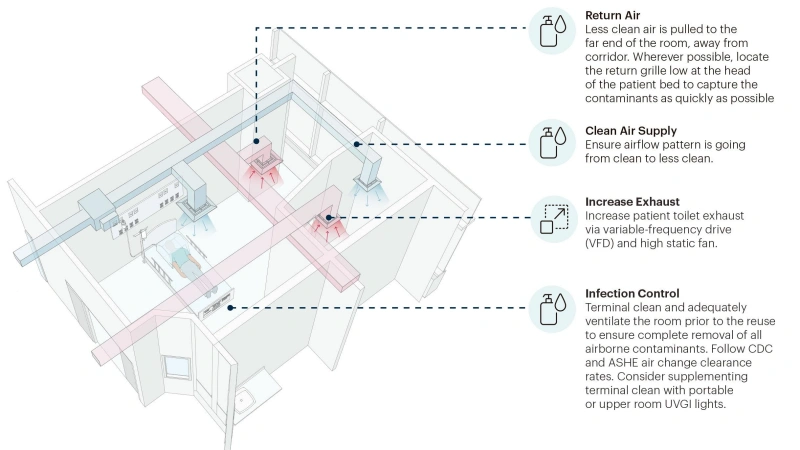
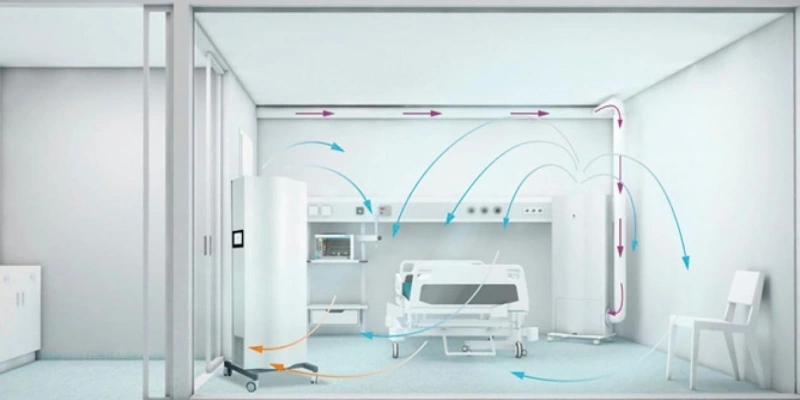
Air filtration and airflow organization require collaborative design. After clean air enters the ward, it should flow according to the designed air flow path and take away contaminated air through a reasonable return air or exhaust system.
The positions of the air supply and return vents should be reasonably designed based on the bed layout, personnel activity areas and equipment locations to reduce air flow short circuits, local dead corners and the backflow of polluted air.
For different types of ICU wards, reasonable pressure relationships and ventilation methods need to be set according to actual infection control needs.
5. Temperature, humidity and pressure control
The ICU air environment must not only control particulate matter, but also maintain appropriate temperature and humidity.
The air conditioning system should be designed according to the number of personnel, equipment heat dissipation, fresh air volume and outdoor climate conditions, and maintain a stable indoor environment through an automatic control system.
A reasonable pressure relationship should be established between different functional areas according to hospital design requirements. For example, for areas that need to prevent external contamination from entering, corresponding positive pressure control can be used; for areas that need to limit the outward spread of pollutants, negative pressure or other ventilation measures should be designed according to specific infection control requirements.
6. Key points for ICU filter selection
Filter selection recommendations focus on:
Filtration efficiency: determined according to ward cleanliness and infection control requirements;
Rated air volume: meets the system design air supply volume;
Initial resistance: affects the energy consumption of fan operation;
Dust holding capacity: related to the service life of the filter;
Sealing performance: reduces the risk of bypass leakage;
Dimensions and specifications: matched with AHU, FFU or terminal air supply equipment;
Maintenance convenience: convenient for daily inspection and replacement.
During the operation of the filter, the pressure difference and air quality should be checked regularly, and maintained or replaced in time according to the actual operating status.
7. Jiangsu Yueboyang medical purification product supporting capabilities
Jiangsu Yueboyang Purification Equipment Co., Ltd. focuses on the field of clean air and purification equipment. It can provide primary, medium, high and ultra-high efficiency filters, FFU fan filter units, high-efficiency air outlets and other products for medical clean environments such as hospital ICUs, clean wards, and operating rooms.
The company can select and customize products based on the design air volume, cleanliness level, installation size and actual use requirements of the hospital's clean area, and provide supporting support for filtration and terminal clean air supply products for the hospital's air purification system.
8. Summary
Air purification in ICU wards requires the combination of multi-stage filtration, clean air supply, air flow organization, temperature and humidity control, pressure control and operation and maintenance.
By rationally configuring primary-efficiency, medium-efficiency and HEPA high-efficiency filters, and designing corresponding air supply, return air and exhaust modes according to different ward functions, the stability of the air environment can be improved and reliable air environment support can be provided for the treatment of ICU patients and the work of medical staff.


