
The negative pressure isolation ward controls the flow of air to prevent potentially contaminated air from spreading to corridors, front rooms and other areas. For HVAC engineers and project contractors, the design focus is not just to achieve "negative pressure", but to simultaneously ensure stable pressure difference, sufficient air exchange, controllable air flow direction, reliable exhaust, effective filtration, and continuous pressure monitoring.
For purchasers, equipment selection also requires comprehensive judgment based on the design air volume, static pressure, filtration efficiency, filter resistance, airtightness and subsequent maintenance requirements.
This article introduces the main design parameters and equipment selection points of the HVAC system in negative pressure isolation wards from the perspectives of engineering design and equipment procurement.
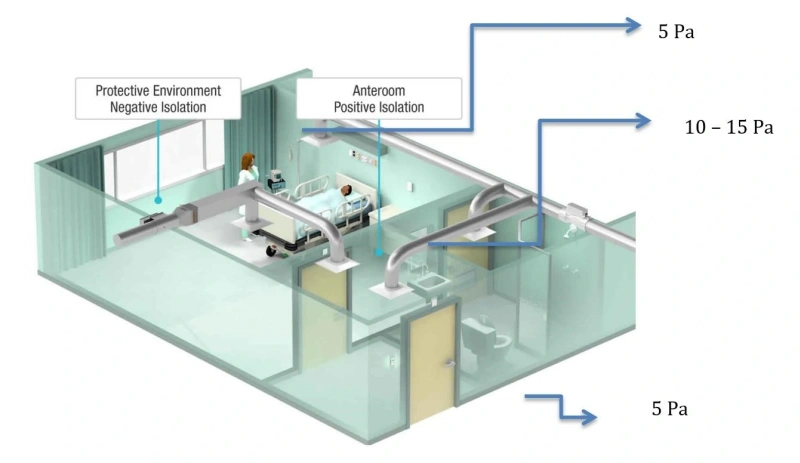
1. Determine the room pressure difference relationship before equipment selection
The first step in designing the HVAC system of the negative pressure isolation ward is to determine the pressure relationship between the isolation room and the surrounding area.
Typical air flow direction is:
Corridor → Front room → Negative pressure isolation ward → Exhaust system
The internal pressure of the isolation ward should be lower than that of the adjacent area, so that air will preferentially flow from the relatively clean area to the isolation room when the door is opened or other openings exist.
For airborne infection isolation wards (AII), CDC data recommends maintaining a negative pressure difference of at least 2.5 Pa relative to the surrounding area; for newly built or renovated related rooms, it is recommended to achieve at least 12 ACH (times/h). Actual projects should still determine final parameters based on the country and region's standards for medical buildings, HVAC, and infection control.
Parameters that need to be confirmed in engineering design
| Parameters | Engineering considerations |
|---|---|
| Room pressure | Maintain negative pressure relative to adjacent areas |
| Pressure difference | Determine according to project specifications, AII often refers to ≥2.5 Pa |
| Air exchange rate | New/renovated AII rooms often refer to ≥12 ACH |
| Air flow direction | Clean area → Isolation ward → Exhaust ventilation |
| Room airtightness | Minimize uncontrollable leakage |
| Pressure differential monitoring | Pressure differential sensor and on-site display |
| Door | Adopt self-closing and sealing design according to project requirements |
It should be noted that the pressure difference cannot be designed separately from the air volume. The final exhaust air volume is also affected by factors such as room volume, envelope leakage, door opening and pressure control methods.
2. Calculate room air volume and exhaust capacity
Air volume is one of the core parameters in the design of HVAC systems in negative pressure isolation wards.
Basic air change calculation formula:
Q = V × ACH
Where:
Q = required air volume, m³/h
V = Room volume, m³
ACH = air changes per hour
For example, the volume of an isolation ward is 50 m³ and the design air changes are 12 ACH:
Q = 50 × 12 = 600 m³/h
600 m³/h can be used as the basic value for ventilation volume design.
The final air supply volume and exhaust volume need to be combined:
Pressure difference requirements
Room leakage
Heating and cooling load
Fresh air volume
Duct resistance
Filter resistance
Local medical building codes
Comprehensive determination.
The exhaust system must have sufficient capacity to maintain the required negative pressure under normal operating conditions. At the same time, fan selection cannot only be calculated based on the initial state, but also needs to consider the increase in resistance during use of the filter.
3. Reasonably control the air supply and exhaust volume
The establishment of a negative pressure state is closely related to the relationship between air supply and exhaust.
Simplified understanding:
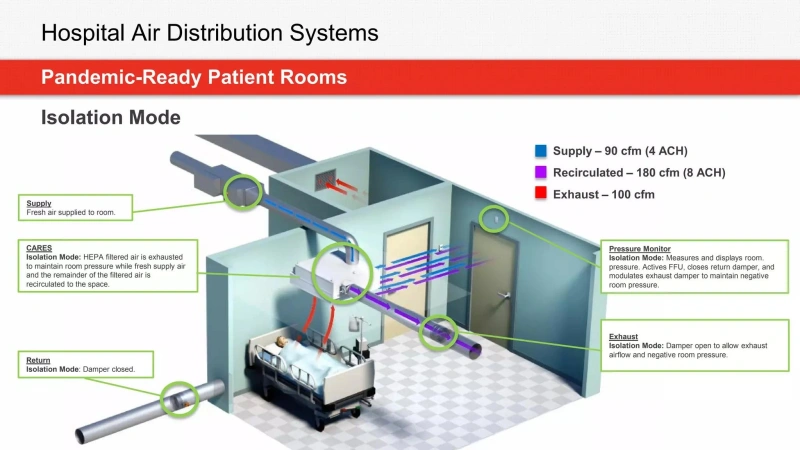
Air supply volume < exhaust volume → Negative pressure is formed in the room
But engineering design cannot simply increase the exhaust volume infinitely to obtain greater negative pressure.
If the exhaust volume is too large, it may cause:
Increased energy consumption
Difficulty in controlling room temperature and humidity
Affected air flow organization
Increased fan noise
Increased door opening resistance
Increased operating costs of HVAC systems
Therefore, comprehensive considerations should be taken when designing:
ACH required in the room
Design pressure difference
Room leakage
Air supply volume
Exhaust air volume
Fan adjustment range
Filter resistance
Door open status
For projects that require stable control, variable frequency fans, VAV control devices, air valves and differential pressure sensors can be used to form closed-loop control.
4. Establish an airflow path from the clean area to the contaminated area
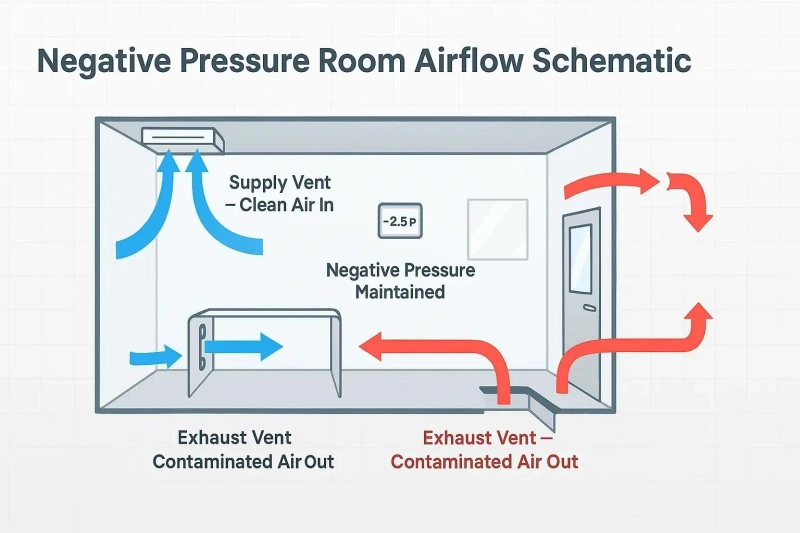
Negative pressure isolation ward should form a clear and controllable airflow path.
Typical airflow organization can be expressed as:
Corridor → Front room → Isolation ward → Air outlet → HEPA filtration/exhaust treatment → Outdoor
The positions of the air supply and exhaust outlets need to be reasonably designed to avoid air flow short circuits.
Engineers need to consider:
Bed location
Air supply vent location
Air exhaust vent location
Door location Placement
Location of medical equipment
Partitions and walls
Potential airflow dead spots
The location of the exhaust vents should be conducive to capturing indoor air in a timely manner to prevent contaminated air from being retained around patients or other key areas.
During the project debugging phase, the actual airflow direction can be verified through smoke testing or airflow visualization testing.
5. Select air filtration system based on risk and air volume
The negative pressure isolation system can adopt different filtration solutions according to the project risk level, HVAC structure and exhaust mode.
The common fresh air filter structure is:
Fresh air → Primary filter → Medium-efficiency filter → Air conditioning treatment → Indoor air supply
Primary-efficiency and medium-efficiency filters are mainly used to reduce the load of particulate matter entering the air-conditioning system, while protecting back-end equipment and high-efficiency filters.
The exhaust side needs to be designed separately based on the project risk assessment and exhaust method.
If the exhaust air cannot be safely discharged directly to the outdoors and needs to be recirculated, HEPA high-efficiency filtration needs to be considered according to relevant specifications. For exhaust systems where there is a risk of contamination, the filter sealing, installation structure, and subsequent replacement methods should also be considered.
HEPA filter selection needs to be confirmed
When purchasing a HEPA filter, it is not recommended to only look at the "H13/H14" parameter. You also need to confirm at the same time:
Filtration efficiency
Rated air volume
Initial resistance
Final resistance
Filter size
Frame material
Sealing method
Gasket or liquid tank sealing requirements
Installation direction
Pressure differential monitoring method
Filter replacement method
HEPA filters should be selected based on actual air volume and resistance, not just filtration efficiency.
6. Select the exhaust fan based on the total system resistance
The exhaust fan selection must conduct a complete system resistance calculation.
The static pressure required by the fan usually needs to be considered:
Filter resistance + air duct resistance + damper resistance + exhaust outlet resistance + other system losses
As the HEPA filter continues to accumulate dust, its resistance will gradually increase.
Therefore, the fan needs to have a sufficient adjustment range to ensure that the design exhaust volume and negative pressure requirements can be maintained throughout the entire service life of the filter from the new installation state to the near-replacement state.
For important medical isolation projects, also consider:
Continuous operation capability
Frequency adjustment
Fan redundancy
Fault alarm
Operation strategy after power outage
Equipment maintenance space
If the fan is selected only according to the "new filter status", the system may not be able to maintain the designed air volume after the filter resistance increases.
7. Pressure differential monitoring and automatic control
Pressure differential monitoring is an important part of the negative pressure isolation ward control system.
Typical control logic is:
Pressure differential sensor → controller → Fan/VAV/air valve → Air volume adjustment
The system can monitor:
The pressure difference between the room and the corridor
The pressure difference between the room and the front room
Air supply volume
Exhaust air volume
Filter pressure difference
Temperature
Relative humidity
Fan operating status
When the room pressure exceeds the set range, the control system can automatically adjust the exhaust fan speed or air volume control device and generate an alarm.
For important medical projects, a clear on-site pressure difference display should also be set up so that medical staff can quickly determine whether the room is in a normal negative pressure state.
8. HVAC equipment selection checklist
Before inquiring from the equipment manufacturer, the engineer or project contractor should prepare the following parameters as much as possible:
| Project | Information to be provided |
|---|---|
| Room Dimensions | Length × Width × High |
| Room volume | m³ |
| Air changes | ACH |
| Air supply volume | m³/h |
| Air volume | m³/h |
| Design pressure difference | Pa |
| Filtration efficiency | Required grade |
| Filter size | W × H × D |
| Fan air volume | m³/h |
| Fan static pressure | Pa |
| Air duct interface | Size and type |
| Air valve/control valve | Type and specification |
| Monitoring parameters | Pressure difference/air volume/temperature and humidity |
| Installation method | Ceiling/wall/air duct installation |
| Quantity | Quantity of equipment |
| Project location | Country and site conditions |
After providing this information, manufacturers can match products based on actual engineering conditions, instead of just recommending products based on the application name of "negative pressure ward".
9. What technical requirements need to be clarified when making a purchase inquiry?
For purchasers, the HVAC RFQ (request for quotation document) should clarify both performance parameters and structural parameters.
Filter requirements
It is recommended to be clear:
Filter level
Rated air volume
Dimensions
Initial resistance
Final resistance
Frame material
Sealing method
Testing and certification requirements
Fan requirements
Clear recommendations:
Rated air volume
External static pressure
Motor power
Whether frequency conversion is required
Daily running time
Noise requirements
Whether a backup fan is required
Air valve and air control components
Clear recommendations:
Air valve/control valve type
Tightness level requirements
Control signal
Pressure differential control range
Material
Interface size
Supplier technical information
It is recommended that suppliers provide:
Product data sheet
Performance curves
Filter test data
Product size chart
Installation instructions
Maintenance instructions
Replacement recommendations
This way the purchasing team can compare different suppliers under the same technical conditions instead of simply comparing product unit prices.
10. Common design issues in negative pressure isolation wards
Problem 1: Insufficient exhaust air volume
The room cannot maintain the designed negative pressure.
Solution: Recalculate the air supply and exhaust volume and the total resistance of the entire system.
Problem 2: The exhaust volume is too large
It is difficult to control the room temperature and humidity, and it also increases energy consumption.
Solution: Use variable frequency control to adjust the exhaust volume according to the actual pressure difference demand.
Problem 3: Ignore HEPA filter resistance
The system runs normally during initial debugging, but the air volume decreases after the filter has been used for a period of time.
Solution: Consider both the initial resistance and the final resistance of the HEPA filter when selecting the fan.
Problem 4: Insufficient room airtightness
A large amount of uncontrollable air leakage leads to unstable negative pressure.
Solution: Check the sealing of the door, wall, ceiling, pipe penetration position and air duct connection.
Problem 5: The position of the air outlet is unreasonable
The exhausted air may re-enter the new air outlet or the area where people move.
Solution: Simultaneously consider the positional relationship between the exhaust vents, fresh air vents and personnel activity areas during the architectural design stage.
11. Boyang air filtration and HVAC supporting capabilities
The HVAC system of negative pressure isolation ward does not require a separate selection of a fan or a filter, but requires an overall matching of filtration, air supply, exhaust, air control and monitoring systems.
Jiangsu Yueboyang Purification Equipment Co., Ltd. provides factory-direct air filtration and clean air products, including:
Primary effect air filter
Medium effect air filter
HEPA high efficiency filter
FFU fan filter unit
Air diffuser
HVAC damper and air control products
For hospitals, medical clean rooms and negative pressure isolation projects, product matching can be carried out according to the following engineering parameters:
Design air volume
Filtration efficiency
Filter size
Filter resistance
Installation method
Air control requirements
Project technical specifications
For engineering contractors and procurement teams, providing information such as project air volume, pressure difference, filter specifications, sizes and quantities can help manufacturers make more accurate product recommendations and quotations.
12. Final checklist for HVAC system in negative pressure isolation ward
The room design pressure difference has been determined
The required number of air changes has been calculated
The air supply volume has been determined
The exhaust air volume has been determined
The room tightness has been assessed
The locations of the air supply and exhaust outlets have been confirmed
HEPA filtration requirements have been determined
The filter resistance has been taken into consideration when selecting the fan
The position of the exhaust outlet has been confirmed
Pressure differential monitoring has been configured
Air The machine has sufficient adjustment range
Filter replacement and maintenance space have been considered
Local medical building and HVAC regulations have been checked
Conclusion
The core of the HVAC system in the negative pressure isolation ward is not to simply install a large air volume exhaust fan, but to coordinate the overall pressure difference, air volume, number of air changes, air filtration, exhaust treatment, room tightness, equipment resistance and automatic control.
For engineers and contractors, these engineering parameters should be clarified before equipment selection; for procurement personnel, relevant parameters should be written into the RFQ inquiry document to ensure that different suppliers are compared under the same technical conditions.
Only by clarifying the project requirements first and then selecting filters, fans, dampers and other HVAC equipment can we reduce the risk of procurement errors and improve the operational stability of the negative pressure isolation system.


