
After long-term operation of central air-conditioning systems in large buildings, the air filters will gradually accumulate dust and increase resistance, causing the fans to consume more electricity to maintain the designed air volume. Through reasonable energy-saving modification of filters, system operation energy consumption can be reduced while ensuring air quality, and the overall operating efficiency of central air conditioning can be improved.
1. Why is it necessary to carry out energy-saving transformation of filters?
After the air filter is used for a period of time, dust will gradually accumulate and the filter resistance will increase. If it is not replaced for a long time or the selection is unreasonable, it will cause the air volume to decrease, the fan load to increase, and the energy consumption of the air conditioning system to increase.
In addition, the filters used in some buildings have high initial resistance. Even new filters may increase the energy consumption of fan operation. Therefore, energy-saving renovation cannot only focus on the price of the filter, but also needs to pay attention to the operating costs of the entire life cycle.
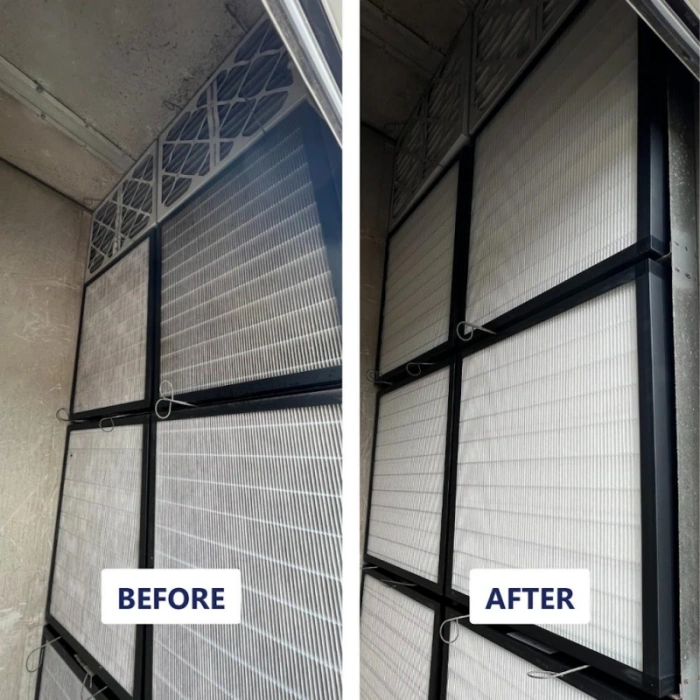
2. System assessment before transformation
Basic data measurements of the central air conditioning system should be carried out before transformation, including:
Original filter type and size
Design air volume and actual air volume
New filter initial resistance
Current operating resistance
Fan operating parameters
< /li>
Filter replacement cycle
Air conditioning system operating time
Current filter purchase and maintenance costs
Through these data, it can be determined whether the main energy consumption problem of the current system comes from filter resistance, fan operating status or unreasonable filter selection.
3. Choose low-resistance, high-performance filters
One of the cores of energy-saving transformation is to reduce filter resistance while meeting filtration efficiency requirements.
For primary and medium-efficiency filtration, products with larger filtration area and reasonable structure can be selected based on actual air quality to improve dust holding capacity and extend the replacement cycle.
For high-efficiency filters, the initial resistance and rated air volume of different products should be compared while meeting the target filtration efficiency to avoid simply pursuing a higher filtration level.
IV. Optimizing filter configuration
Central air conditioners in large buildings usually use multi-stage filtration. Reasonable configuration of primary, medium and high-efficiency filter layers can reduce the entry of large particle pollutants into the rear-stage filter, thereby extending the service life of the rear-stage filter.
For ordinary commercial buildings, it is not necessarily necessary to configure high-level filters. A reasonable filtration combination should be determined based on indoor air quality, personnel density and system requirements to avoid additional resistance caused by excessive filtration.
5. Improve the level of filter replacement management
The later the filter is replaced, the more energy-saving it will be.
When the filter resistance continues to increase, the fan energy consumption will also increase. Therefore, the replacement cycle should be developed based on the actual resistance and operating status of the filter, rather than completely replacing it at a fixed time.
Large buildings can record the operating status of the filter through differential pressure monitoring, and perform timely maintenance after reaching the set final resistance or replacement conditions.
6. Comprehensive calculation of energy-saving effect
Filter energy-saving renovation should compare the purchase cost and operating cost at the same time.
For example, although a filter has a higher purchase price, if it has lower initial resistance, longer service life and higher dust holding capacity, the long-term operating cost may be lower than that of a lower-priced product with faster resistance growth.
Therefore, it is recommended to use the initial purchase cost + fan energy consumption + replacement and maintenance cost for life cycle cost analysis.
7. Operation verification after modification
After replacing the energy-saving filter, the system air volume, filter resistance, fan operating parameters and indoor air quality should be re-tested.
If the system air volume is improved and the filter resistance is reduced, the fan operating parameters can be further optimized to achieve more obvious energy saving effects.
At the same time, changes in filter pressure difference should be continuously recorded to provide data basis for filter selection and maintenance in the next cycle.
Conclusion
The energy-saving renovation of central air-conditioning filters in large buildings is not a simple replacement of "low-resistance filters", but requires comprehensive consideration of filtration efficiency, initial resistance, dust holding capacity, service life, fan operating status and maintenance costs. Through system evaluation, reasonable selection and pressure difference management, long-term operation energy consumption of central air conditioners can be reduced while ensuring air quality.
For projects that require central air conditioning filter selection, energy-saving transformation and bulk purchase, Jiangsu Yueboyang Purification Equipment Co., Ltd. can match products according to the design air volume, filtration level, equipment size and operating conditions of the building HVAC system, and provide initial, medium, high and HEPA filters and other products provide filter energy-saving transformation and product supporting support for large buildings, commercial buildings and industrial HVAC systems.


