
With the continuous improvement of infection control and air cleanliness requirements in modern hospitals, operating room air purification systems have become an important part of ensuring medical safety. Among them, High Efficiency Air Filter (HEPA Filter) is the core equipment of the air purification system. Its selection and performance directly affect the quality of the surgical environment and the risk of postoperative infection for patients.
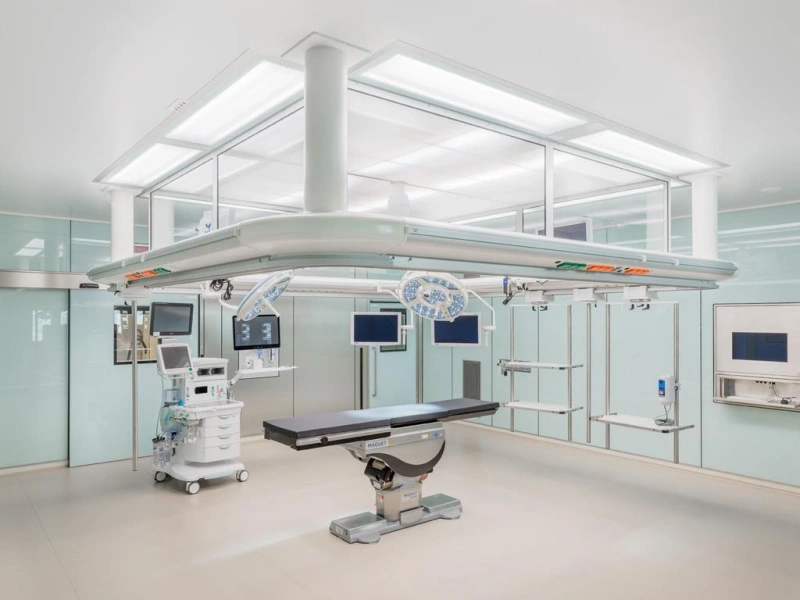
The importance of operating room air filters
During surgery, bacteria, viruses, dust particles and other suspended pollutants in the air may become sources of infection. According to the hospital's clean operating department construction standards, the operating room needs to continuously maintain the specified cleanliness level and achieve air purification through a reasonable air supply system and high-efficiency filtration system.
The air filter not only undertakes the task of filtering particulate matter, but also maintains an indoor positive pressure environment to prevent external polluted air from entering the surgical area. Therefore, choosing an air filter that meets standards is crucial to ensuring surgical safety.
Common configurations of operating room filters
A complete operating room air purification system usually adopts a three-stage filtration structure:
Primary filtration (Primary filter)
Primary filter is mainly used to intercept larger dust particles, hair and fiber impurities, and the filtration efficiency is generally G3-G4 level. Its main function is to protect the back-end filter and extend the overall service life of the system.
Secondary filtration (Medium-efficiency filter)
Medium-efficiency filters usually use F7-F9 grade filter materials, which can effectively filter particles above 1 μm and further reduce the concentration of suspended pollutants in the air.
Three-stage filtration (High-efficiency filter)
The high-efficiency filter is the most critical part of the entire system. The medical industry often uses H13 or H14 rated HEPA filters.
The filtration efficiency can reach:
H13: ≥99.95% (MPPS)
H14: ≥99.995% (MPPS)
It can effectively capture bacteria, virus vector particles and sub-micron pollutants to ensure that the surgical area meets cleanliness requirements.
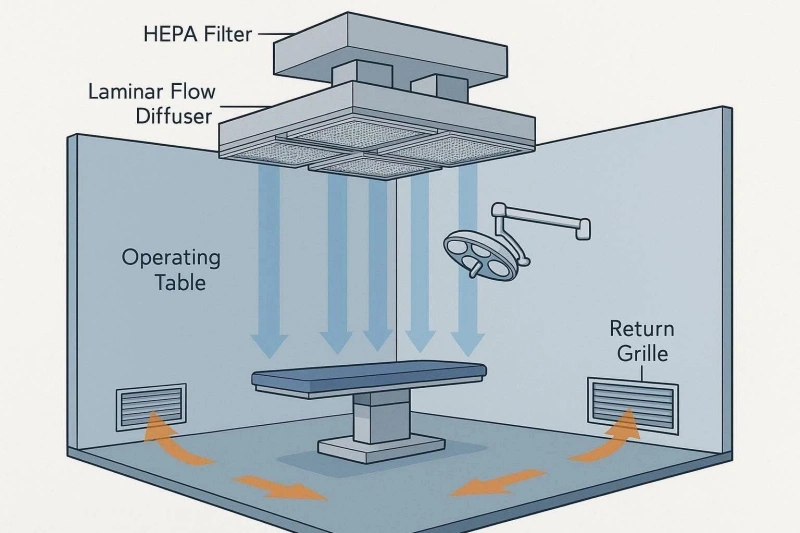
Analysis of high-efficiency filter layer technology
The core of the high-efficiency filter lies in the filter media. At present, mainstream products use ultra-fine glass fiber filter paper as the filter layer material.
Ultra-fine glass fiber technology
The diameter of glass fiber is usually controlled between 0.5μm and 2μm. It forms a complex fiber network structure through random arrangement, so that particulate matter is captured through the following mechanism:
Inertial collision
Interception effect
Brownian diffusion
Electrostatic adsorption
This multiple filtration mechanism can achieve efficient removal of particles of different sizes.
Partitionless structure technology
In recent years, partitionless high-efficiency filters have gradually become the mainstream choice for hospital projects.
Compared with traditional aluminum partition structure, it has the following advantages:
Lower wind resistance
More even air volume distribution
Lighter weight
Better sealing performance
More obvious energy saving effect
Especially suitable for high-level clean environments such as laminar flow operating rooms, clean wards and biological laboratories.
Key points for operating room filter selection
When selecting operating room air filters, the following factors should be considered:
Filtration efficiency level
Select H13 or H14 high-efficiency filters according to the operating room cleanliness level requirements.
Air volume and resistance
The rated air volume of the filter should match the designed air volume of the air conditioning system, and at the same time, try to choose low-resistance products to reduce operating energy consumption.
Sealing performance
It is recommended to use polyurethane sealant or gel sealing structure to ensure no bypass leakage.
Moisture resistance and corrosion resistance
The hospital environment has high requirements for the long-term stable operation of the filter, so moisture-resistant, mildew-proof, and anti-corrosion materials should be selected.
Testing and Certification
Priority is given to products that have passed the testing and certification of international standards such as EN1822 and ISO 29463.
Conclusion
With the continuous improvement of hospital clean engineering standards, the role of high-efficiency air filters in operating room air purification systems has become increasingly important. Scientific and reasonable selection of filtration levels, structural forms and filter materials can not only improve air cleanliness, but also effectively reduce infection risks and system operating costs. For hospital construction units, clean engineering contractors and medical equipment purchasers, choosing a professional and reliable air filter manufacturer is an important guarantee for ensuring long-term and stable operation of the project.


