
With the continuous upgrading of modern hospital cleanliness projects, medical purification air conditioning systems not only require stable air cleanliness, but also require precise air volume adjustment capabilities and reliable automatic control performance. As an important part of the heating, ventilation and air conditioning (HVAC) system, the purge air valve actuator directly affects the control accuracy, energy consumption and pressure difference stability of the clean area of the air supply and exhaust system. Properly selecting air valve actuator and realizing linkage with building automation (BAS) or clean room control system are important measures to ensure the safe operation of the hospital's clean environment.
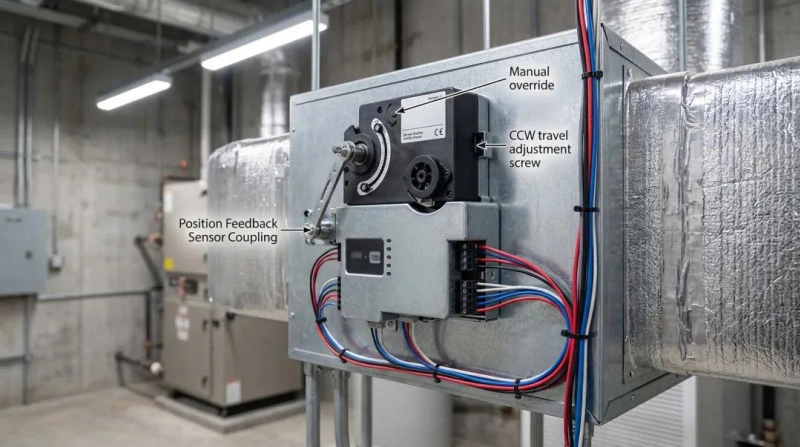
The function of medical purification damper actuator
The damper actuator is mainly used to drive the regulating damper, fire damper, smoke exhaust valve and sealing valve to realize the opening, closing or continuous adjustment of the damper. In clean areas such as hospital operating rooms, ICUs, negative pressure wards, pharmaceutical production workshops, and laboratories, actuators need to adjust the air valve opening in real time based on parameters such as pressure difference, temperature and humidity, CO₂ concentration, and air volume to ensure that the air flow direction meets cleanliness control requirements.
Compared with ordinary commercial buildings, medical cleanliness projects place higher requirements on actuators’ response speed, positioning accuracy, operational stability and long-term reliability.
Principles for selecting air valve actuators
When selecting a medical purification air valve actuator, the following factors should be considered:
1. Matching of air valve size and torque
The actuator output torque must meet the opening and closing requirements of the air valve under the maximum static pressure. Generally speaking, actuators with higher torque should be selected for large-size dampers or high air pressure systems to ensure long-term stable operation.
2. Control method
According to the system control requirements, you can choose:
Switch type (On/Off)
Three-position floating point control (Floating)
Proportional adjustment type (0-10V, 2-10V, 4-20mA)
For hospital clean air conditioning systems, proportional adjustment actuators can achieve more precise air volume control, so they are more widely used.
3. Power supply type
Common power supplies include 24VAC/DC and 220VAC. Among them, 24V low-voltage power supply is safer and is also the mainstream choice for hospital automatic control systems.
4. Feedback signal
Actuators with opening feedback or position feedback functions can transmit the damper status to the BAS system in real time, improving system monitoring capabilities and fault diagnosis efficiency.
The development of linkage control technology
Modern hospitals are increasingly adopting intelligent linkage control technology to work together with air valve actuators and the following equipment:
Differential pressure controller
Temperature and humidity sensor
Air volume sensor
FFU control system
VAV variable airflow Volume system
Fresh air unit and exhaust system
Fire alarm system
For example, in a negative pressure isolation ward, when the room pressure difference is lower than the set value, the control system can automatically adjust the opening of the air supply and exhaust dampers to maintain a stable negative pressure environment. When the fire protection system alarms, the fire damper actuator can quickly close the relevant air duct, effectively preventing the spread of smoke.
At present, most actuators support Modbus RTU, BACnet, KNX and other communication protocols, and can be easily connected to the hospital building automation management platform to achieve remote monitoring, fault alarm and data recording.
Energy saving and intelligence trends
As the demand for energy saving in hospitals continues to increase, low-power actuators, electronic limit technology, brushless motors and intelligent diagnostic functions have gradually become the development direction of the industry. Intelligent actuators can not only reduce system operation energy consumption, but also reduce maintenance costs through self-test and status feedback, and improve the reliability of the entire clean air conditioning system.
Conclusion
The medical purification damper actuator is not only an important execution device of the HVAC system, but also an important part of the automatic control of the clean environment. Reasonable matching of actuator torque, control mode and communication protocol, combined with intelligent linkage control technology, can effectively improve the air quality, system stability and energy efficiency of hospital clean rooms.


