
Semiconductor manufacturing has extremely high requirements for air cleanliness, and micron or even nanoscale particles may affect chip yield. Therefore, scientifically designing the air filtration system is an important part of building a clean semiconductor factory. A complete filtration system can not only control particle pollution, but also needs to take into account temperature and humidity, air flow organization, energy consumption and subsequent maintenance costs.
1. Composition of air filtration system
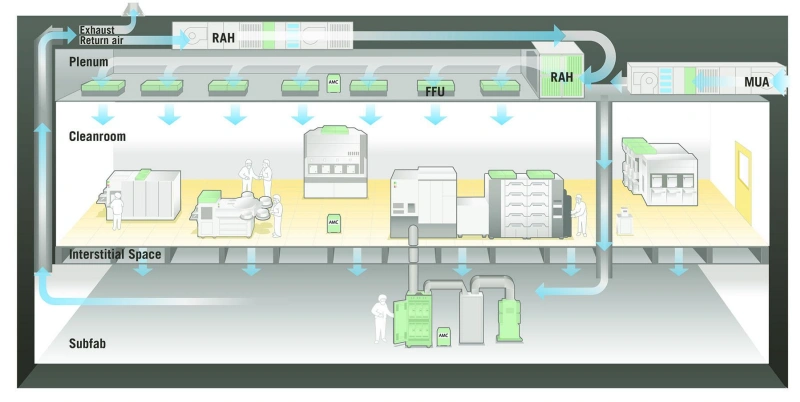
Semiconductor clean plants usually adopt a three-stage filtration structure:
Primary filter: Installed at the fresh air inlet of the air conditioning unit to filter large particles of dust and protect subsequent equipment.
Medium efficiency filter: further intercepts fine particles and extends the service life of the high-efficiency filter.
HEPA/ULPA high-efficiency filter: Installed at the air supply end of the clean room, it can filter particles of 0.3μm or even smaller, ensuring that the cleanliness level meets the requirements of ISO 14644 standards.
2. Air flow organization design
Semiconductor production areas usually adopt a vertical unidirectional flow (Laminar Flow) design. The top FFU or high-efficiency air supply vents continuously supply air downwards. The polluted air returns to the air conditioning system through the floor return vents, forming a stable clean air flow to reduce particle retention and cross-contamination.
3. Air volume and pressure difference control
The air filtration system must not only ensure sufficient air changes, but also maintain the pressure difference between different clean areas. It is generally required that the clean area maintains positive pressure to prevent external contaminated air from entering; special process areas can be designed with negative pressure control according to needs.
IV. Energy-saving design
As the scale of semiconductor factories continues to expand, the energy consumption of filtration systems accounts for a high proportion of HVAC systems. It is recommended to use:
Low resistance HEPA filter;
EC fan FFU system;
Variable frequency fan control (VFD);
Pressure differential monitoring and intelligent control system.
These measures can reduce operating costs while ensuring cleanliness.
5. Maintenance and replacement
A filter pressure difference monitoring system should be established to regularly detect filtration efficiency and air leakage. When the pressure difference reaches the design upper limit or the filtration efficiency decreases, the filter should be replaced in time and the integrity test should be performed to ensure the continuous and stable operation of the clean room.
Conclusion
The air filtration system of semiconductor clean factory is a systematic project, involving many aspects such as filter selection, air flow organization, air volume control, pressure difference management and intelligent operation and maintenance. Reasonable system design can not only meet high-cleanliness production requirements, but also reduce operating energy consumption and improve equipment stability and product yield.


