
Chip manufacturing requires extremely high environmental stability in clean rooms. In addition to controlling particles and pollutants in the air, temperature and humidity also affect wafer processing, photolithography, deposition and precision equipment operations. A reasonable temperature and humidity control system can reduce environmental fluctuations and provide reliable guarantee for stable production and product yield.
1. Why does the chip clean room need constant temperature and humidity?
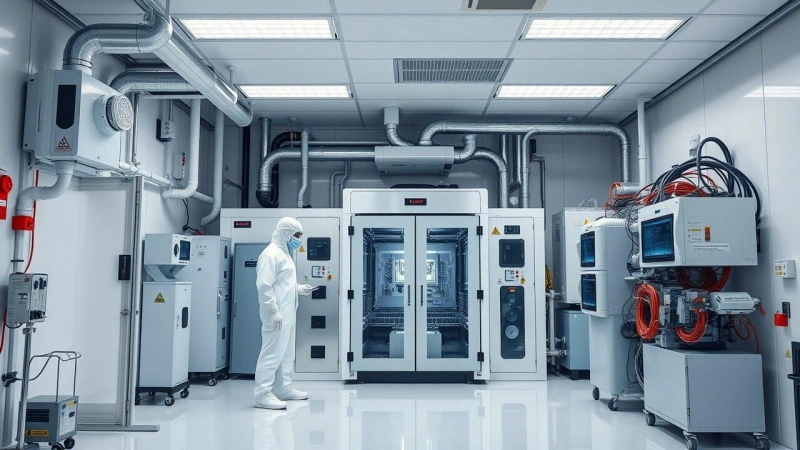
Chip manufacturing involves precise processes such as photolithography, etching, deposition, and cleaning. Temperature changes may cause dimensional changes in wafers, masks and related materials, affecting processing accuracy; too high humidity may increase the risk of condensation and contamination, and too low humidity may increase static electricity accumulation and ESD risks.
Therefore, clean room temperature and humidity control should be set according to specific process requirements and maintain a small fluctuation range, rather than simply pursuing constant temperature and humidity values.
2. Basic components of temperature and humidity control system
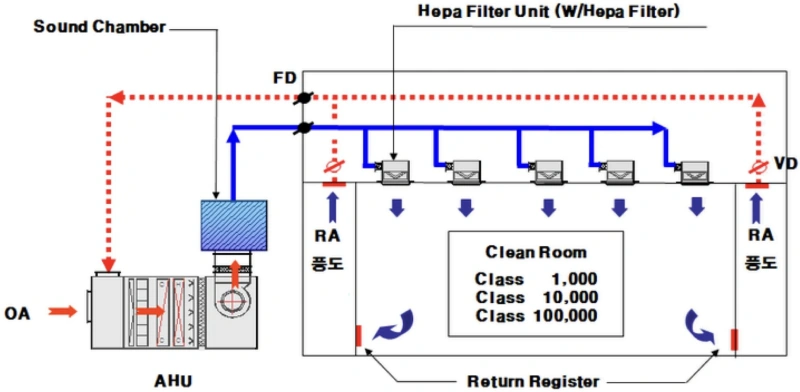
A typical chip clean room air treatment system can use:
Fresh air treatment → Primary filter → Medium efficiency filtration → Cooling and dehumidification → Heating/reheating → Humidification → HEPA/ULPA filtration → FFU clean air supply
The fresh air treatment system is mainly responsible for the temperature and humidity treatment and pollutant filtration of outdoor air; the AHU or precision air treatment equipment is responsible for the main cooling, heating and dehumidification; the humidification equipment is used to compensate for the humidity loss in low-humidity environments; the terminal HEPA or ULPA filter is responsible for further reducing fine particles in the air.
3. Key technologies for temperature control
1. Divide temperature control areas by process
Different chip production processes have different requirements for temperature stability. Therefore, it is recommended to carry out partition control based on photolithography, wafer processing, inspection and auxiliary areas.
Through independent temperature sensors, controllers and terminal equipment, the interaction between different areas can be reduced and the temperature control accuracy can be improved.
2. Reduce temperature fluctuations
Equipments in the clean room will continue to generate heat. If the cooling capacity is insufficient or the control response speed is slow, local high temperatures may easily occur.
Therefore, the cooling coil, reheating equipment and automatic control system should be reasonably configured according to the heat dissipation of the equipment, personnel load and fresh air volume.
IV. Key Humidity Control Technologies
1. Dehumidification
Outdoor fresh air may bring in a large amount of moisture. Basic dehumidification can be achieved by lowering the air dew point through cooling coils. For chip production areas with high requirements for low humidity, focus should also be placed on controlling the dew point of fresh air to reduce the impact of humid air on the humidity of the clean room.
2. Humidification
In winter or low-humidity operating environments, humidification needs to be carried out according to actual process requirements. The humidification system should choose equipment suitable for clean environments, and the humidification amount should be reasonably controlled to avoid excessive humidity.
3. Prevent condensation
Temperature and humidity need to be jointly controlled. Pay attention to the air dew point and surface temperature of equipment, pipes, etc. to avoid condensation caused by excessive humidification or temperature changes.
5. Collaborative control of temperature, humidity and cleanliness
The chip clean room is not a simple constant temperature and humidity space. Air filtration, airflow organization, pressure difference and temperature and humidity require collaborative design.
HEPA/ULPA filters are used to control fine particles, FFU provides stable clean air supply, and the HVAC system is responsible for handling the cooling, heating and humidity loads. The filter and installation frame should also be well sealed to avoid bypass leakage that affects cleanliness.
6. How to reduce energy consumption in temperature and humidity control?
Chip clean rooms usually have a large air handling capacity, so system operating efficiency can be improved in the following ways:
Set independent control areas according to different processes;
Reasonably control the fresh air volume and return air ratio;
Adopt dew point control to optimize dehumidification;
Adjust cooling, heating and humidification equipment according to actual load;
Use variable frequency fans and automatic control systems;
Regularly monitor temperature, humidity, pressure difference and filter resistance.
7. Clean air product supporting capabilities
Jiangsu Yueboyang Purification Equipment Co., Ltd. focuses on the field of clean air and purification equipment, and can provide primary, medium, high-efficiency and ultra-high-efficiency filters, FFU fan filter units, high-efficiency air outlets and other products for electronic manufacturing, semiconductor and other industries.
The company can select and customize products according to the clean room grade, design air volume, installation size and specific process requirements, and provide supporting support for air filtration and terminal clean air supply systems in chip manufacturing clean rooms.
8. Summary
Clean room temperature and humidity control in chip manufacturing is a systematic project that requires the combination of air treatment, temperature control, humidity control, HEPA/ULPA filtration, FFU air supply and automatic control.
Through reasonable system design and continuous monitoring, temperature and humidity fluctuations can be reduced, the clean room environment can be stabilized, and system operating efficiency and energy costs can be considered while meeting chip manufacturing process requirements.


