
Semiconductor manufacturing is currently one of the industries with the highest requirements for air cleanliness. From wafer manufacturing, photolithography, etching to packaging and testing, every process may be affected by particulate pollution in the air. As chip manufacturing processes continue to develop to smaller nanoscale, the importance of air filtration systems has become increasingly prominent.
HEPA filters and ULPA filters are commonly used terminal filtration equipment in semiconductor clean rooms. Many people think that the higher the filtration efficiency, the better, so they tend to choose ULPA filters directly. However, in actual projects, not all areas require the use of ULPA filters. Reasonable selection is not only related to clean room performance, but also directly affects HVAC system energy consumption and operating costs.
This article will introduce in detail the difference between HEPA filters and ULPA filters, and how to scientifically select filters in the semiconductor industry.
What are HEPA filters and ULPA filters?
HEPA (High Efficiency Particulate Air) filter is a high-efficiency air filter, usually used in the end air supply system of clean rooms, which can effectively remove tiny particles in the air.
ULPA (Ultra Low Penetration Air) filter is a higher-grade product based on HEPA. It adopts a finer filter material structure and has higher filtration efficiency for ultra-fine particles.
Both use the principles of interception, inertial collision, and diffusion to capture particulate matter, but the ULPA filter material is denser and therefore can filter pollutants with smaller particle sizes.
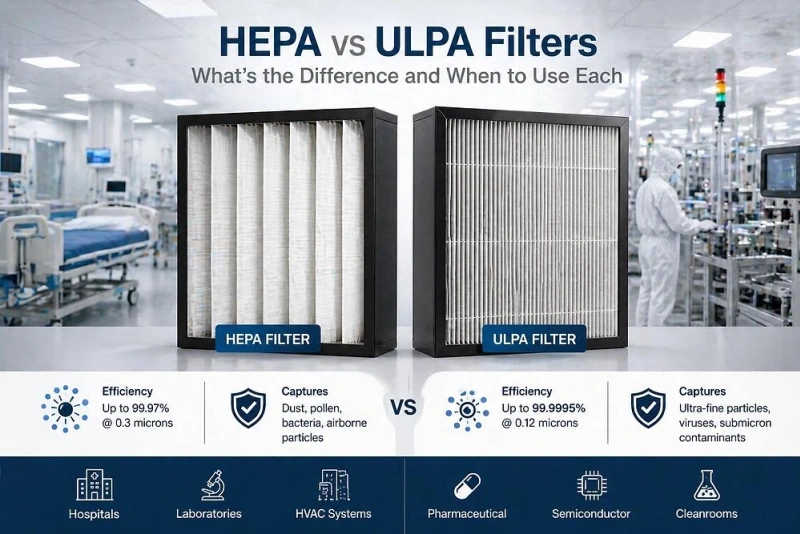
The main difference between HEPA filters and ULPA filters
1. Different filtration efficiency
HEPA filters can usually reach H13 or H14 levels, have extremely high filtration efficiency for 0.3μm particles, and can meet the air cleanliness requirements of most semiconductor clean rooms.
ULPA filters have higher filtration efficiency and can effectively capture particles with smaller particle sizes, making them suitable for ultra-high cleanliness production environments.
For key processes such as advanced chip manufacturing and photolithography, ULPA filters can provide more stringent particle control capabilities.
2. Applicable to different cleanliness levels
HEPA filters are widely used in ISO Class 5 and above clean rooms.
ULPA filters are mainly used in ultra-high clean areas such as ISO Class 3 and ISO Class 4, as well as in core production processes that require extremely high air quality.
Therefore, not the entire semiconductor factory needs to be equipped with ULPA filters, but hierarchical configuration according to different areas.
3. System resistance is different
Because the filter material of ULPA filter is denser, its initial resistance is usually higher than that of HEPA filter.
Increased filtering resistance means:
Fans need to provide greater static pressure
HVAC system energy consumption increases
Fan operation load is higher
System operating costs increase
Therefore, when designing an air purification system, it is necessary to consider the balance between filtration efficiency and energy consumption.
4. Cost differences
Compared with HEPA filters, ULPA filters usually have:
Higher product procurement costs
Higher fan energy consumption
Higher installation accuracy requirements
Higher replacement costs later
If the actual cleanliness level requirements of the clean room are not high, blindly choosing ULPA filters will not only fail to bring significant benefits, but may also increase the overall operating costs.
5. Different application scenarios
HEPA filters are usually used in:
Semiconductor general clean production area
Chip packaging workshop
Electronic component production workshop
Equipment auxiliary area
FFU air supply system
High-efficiency air supply outlet
ULPA filters are usually used in:
Wafer manufacturing workshop
Lithography process area
EUV exposure equipment area
Wafer inspection area
Nano-scale chip manufacturing process
Ultra-high cleanliness level production area
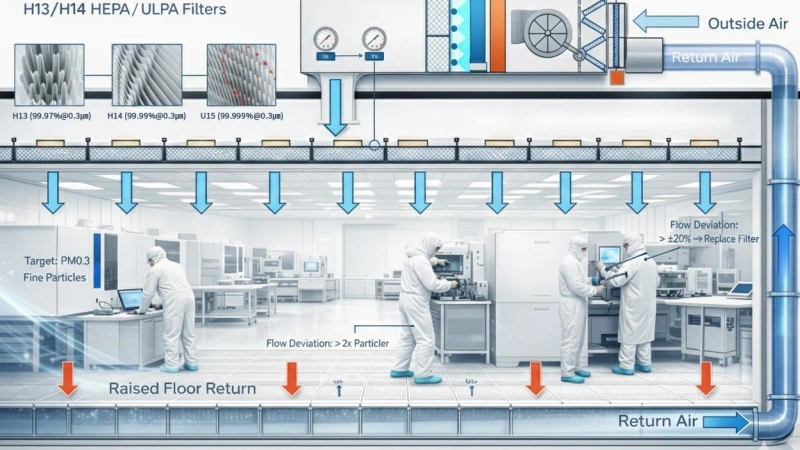
How to choose HEPA or ULPA filters in the semiconductor industry?
Filter selection should be based on process requirements rather than simply pursuing the highest filtration efficiency. The following factors usually need to be considered:
Clean room ISO grade requirements
Chip process node
Process requirements for particle control
HVAC system air supply volume
Fan static pressure capacity
System operating energy consumption
Project budget
Post-maintenance costs
For most semiconductor projects, the air filtration system usually adopts a multi-stage filtration design, including primary effect filter, medium effect filter and HEPA or ULPA final filter to achieve the best balance between filtration efficiency, system energy consumption and operating cost.
Recommended filter configuration scheme
Currently, most semiconductor factories will adopt a regional configuration strategy instead of uniformly using ULPA filters throughout the factory.
For example:
HEPA filters are used in general production areas to meet air cleanliness requirements while reducing operating costs.
ULPA filters are used in key process areas such as photolithography, wafer manufacturing, and inspection to ensure an ultra-high cleanliness environment.
With FFU, high-efficiency air supply vents and laminar air supply system, precise air control in areas with different cleanliness levels can be achieved.
This configuration method can not only ensure product quality, but also effectively control the long-term operating costs of the HVAC system.


