
As the demand for air filtration products continues to increase in HVAC, clean room, pharmaceutical, semiconductor, hospital, food processing and other industries, more and more brands, dealers, engineering companies and equipment manufacturers choose OEM customized air filters to meet the personalized needs of different projects and markets.
This article will introduce in detail the complete process of air filter OEM customization, helping purchasers understand every key link from demand communication to product delivery.
1. Submit project requirements
The first step in OEM customization is to clarify project requirements. The more complete the information provided by the customer, the more suitable the solution designed by the manufacturer will be for practical applications.
Usually you need to confirm the following:
Product application fields, such as HVAC systems, clean rooms, hospitals, pharmaceuticals, electronic factories, etc.
Filter type
Product size
Rated air volume
Filtration efficiency level
Using ambient temperature and humidity
Installation method
Service life requirements
Estimated purchase quantity
Whether OEM brand customization is required
Complete project information can help engineers quickly formulate reasonable product plans.
2. Technical evaluation and solution design
After receiving customer requirements, the manufacturer's technical team will design the product according to the application environment and provide professional advice.
Program design usually includes:
Filter structure design
Filter material selection
Outer frame material recommendation
Sealant and sealing Pad selection
Wind resistance calculation
Air volume optimization
Service life evaluation
Product implementation standards, such as EN1822, ISO 16890, etc.
Experienced manufacturers will also optimize product design according to project needs to ensure filtration effects while reducing system operation energy consumption.
3. Sample production and confirmation
After the technical solution is confirmed, the manufacturer will arrange sample production for customers to test and confirm.
Sample confirmation content generally includes:
Product size confirmation
Material confirmation
Appearance inspection
Air volume test
Resistance test
Installation suitability test
After the customer confirms that the sample meets the requirements, and then enters the mass production stage, the project risk can be effectively reduced.
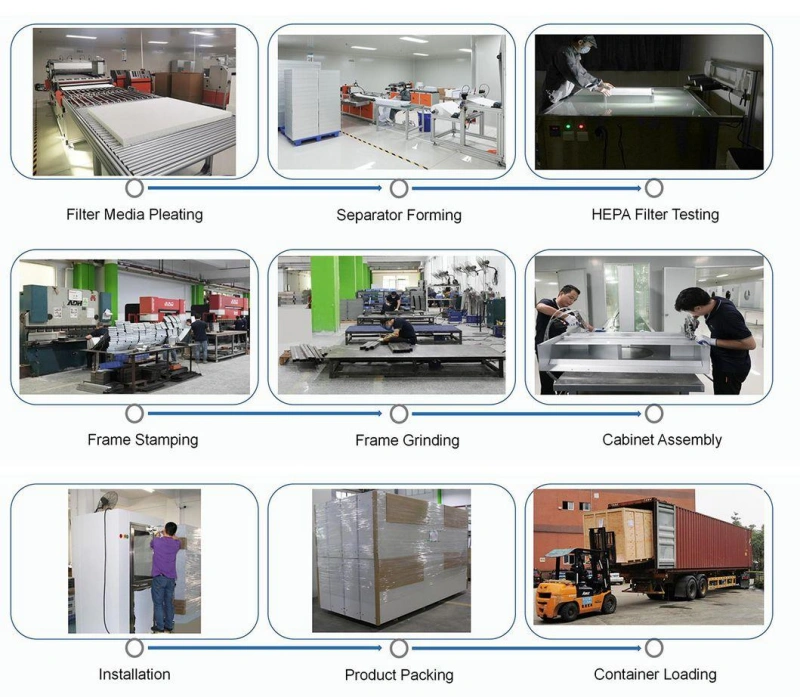
4. Mass production
After the sample is confirmed to be correct, the manufacturer will organize formal production according to the technical parameters confirmed by both parties.
Professional filter manufacturers usually strictly control the following production links:
Raw material inspection
Filter material folding and forming
Outer frame assembly
Sealing process
Product labeling
Performance testing
Finished product quality inspection
A complete production management system can ensure that each batch of products maintains stable and consistent quality.
5. Product testing and quality control
Quality control is one of the most important links in the OEM production process and an important basis for ensuring product performance.
Common testing items include:
Product size inspection
Appearance quality inspection
Air leakage inspection
Filtration efficiency inspection
Resistance test
Structural strength test
Packaging inspection
For HEPA and ULPA high-efficiency filters, it is usually necessary to conduct a one-by-one scanning leak test to ensure that they meet the requirements for clean room use.
6. OEM brand customization and packaging design
Many customers want to sell products with their own brand logos, so OEM manufacturers usually provide complete brand customization services.
Common OEM customization content includes:
Product LOGO printing
Private brand label
Customized product nameplate
Outer box packaging printing
Barcode label
Customized instruction manual
Packaging design
Professional OEM packaging can not only enhance the brand image, but also help improve the competitiveness of the product in the market.
7. Shipping, transportation and after-sales service
After the product is tested, it will be packaged in accordance with export transportation requirements and arranged for shipment.
Manufacturers usually provide the following information and services:
Export packaging
Packing list and invoice
Product test report
Product certificate
Installation instructions
Technical support
Product warranty service
Complete after-sales service can help customers quickly solve problems encountered during installation and use, and establish long-term and stable cooperative relationships.
8. How to choose a reliable air filter OEM manufacturer
Choosing a professional OEM manufacturer is an important prerequisite for ensuring product quality and smooth project implementation.
It is recommended to focus on the following aspects:
Factory production experience
Manufacturing capabilities
Quality management system
International certification status
Technical R&D capabilities
OEM/ ODM customization capabilities
Delivery cycle
Export experience
After-sales service capabilities
Manufacturers with rich export experience and mature production systems can provide more stable product quality and more professional technical support, creating greater commercial value for customers.
Conclusion
Air filter OEM customization is by no means a simple processing and production of supplied materials, but a one-stop full-process complete solution covering technical consultation, working condition scheme design, sample verification and confirmation, large-scale mass production, factory quality inspection and verification, OEM brand customization and after-sales operation and maintenance guarantee.
Boyang Purification has been deeply engaged in air filtration OEM customization for many years. It has a mature R&D and production system and a complete service chain, and can create exclusive filtration products to meet the personalized needs of various cleaning projects and HVAC projects.


