
The spray workshop has high requirements for air cleanliness, air flow stability and filtration system operating costs. Reasonably choose primary filter and Bag filter can not only reduce dust, fibers and particles in the air from entering the spraying area, but also reduce the load of subsequent filters and maintain stable air supply and exhaust effects. When actually selecting a model, a comprehensive judgment should be made based on the spraying process, pollutant concentration, air volume, filtration efficiency and replacement cycle.
1. Why does the spray workshop need to reasonably configure air filters?
During the spraying process, dust, fibers, metal particles and paint mist in the air may affect the quality of the coating. Particles entering the spraying area may cause defects such as particles and pitting on the surface of the paint film. Therefore, the air inlet filtration system needs to maintain stable filtration performance.
At the same time, the paint mist in the exhaust system will gradually adhere to the filter material and air duct. If the filter resistance continues to increase, it will lead to a decrease in air volume, changes in the air flow organization of the workshop, and increase the fan operating load. Spraying equipment usually needs to be equipped with corresponding filter sections according to the air inlet and exhaust positions.
2. Characteristics and applicable scenarios of primary filters
Primary filters are usually used as the front-end filtration stage of the air filtration system. They are mainly used to intercept larger dust, hair, fibers and particulate matter and reduce the dust accumulation speed of subsequent filters.
The main advantages include:
The initial resistance is low, suitable for larger air volume systems;
The cost of filter materials is relatively low;
It is easy to replace and maintain;
It can effectively protect subsequent filters such as medium-efficiency and bag filters.
In the spray workshop, the primary filter is suitable for use at the fresh air inlet, the front end of the air conditioning unit, and the filter section that has relatively general requirements for air cleanliness. In actual spray booth systems, pre-filtration is often used to intercept large particle pollutants entering the equipment, thereby protecting the subsequent filtration system.
3. Characteristics and advantages of bag filters
Bag filters use multiple filter bags to form a larger effective filtration area. Compared with ordinary flat filters, they have a larger dust-holding space, so they are more suitable for HVAC systems with larger air volumes and higher dust loads.
Main features include:
Large filtration area;
High dust holding capacity;
Usually longer service life;
Has good filtration ability for medium-sized particles;
Able to maintain a relatively stable operating air volume under reasonable selection.
In spraying equipment, bag filters can be used for both inlet air pre-filtration and exhaust air filtration depending on the equipment structure. The deep bag structure increases the dust holding capacity by increasing the expansion area of the filter material, and helps the filter maintain a relatively stable airflow after dust accumulation.
5. How to choose a spraying workshop?
1. Ordinary spraying workshop
If the dust concentration in the workshop environment is not high and the cleanliness requirements of the coating surface are average, the primary filter can be used as the main pre-filtration equipment, and subsequent filtration levels can be added according to the actual cleanliness requirements.
2. Automobile and high-quality painting workshops
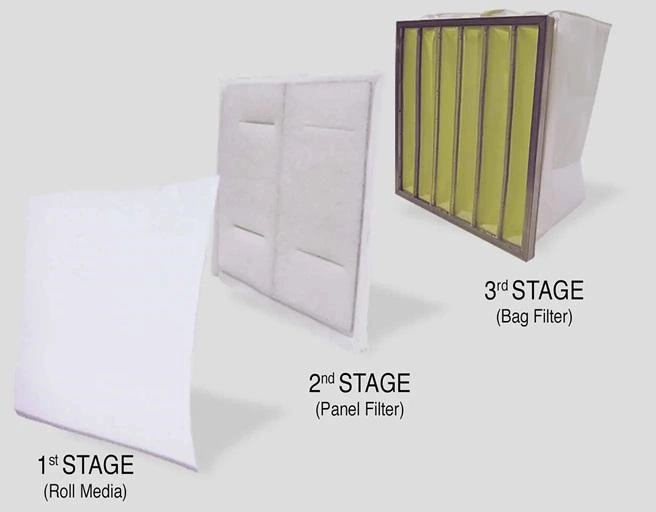
Automotive spraying and high-quality industrial painting are more sensitive to particulate matter in the air. It is recommended to use a multi-stage filtration structure such as "primary filter + bag filter" to improve the cleanliness and stability of the air sent to the spraying area.
3. High dust, high air volume environment
When the fresh air volume in the workshop is large or the air pollution load is high, bag filters usually have more advantages. Its large filtration area and dust holding capacity can reduce the impact of frequent filter replacement on production.
4. Exhaust air and paint mist filtration
The purposes of exhaust air filtration and supply air filtration are different. The focus of exhaust is to control the entry of paint mist and pollutants into the air duct and the external environment. Special paint mist filter materials or bag exhaust filters should be selected based on the spraying materials, paint mist concentration and equipment structure, instead of simply applying ordinary HVAC filters.
6. What parameters should you pay attention to when selecting?
The selection of filters in the spray workshop should not only look at the filtration efficiency, but also comprehensively consider:
Rated air volume: ensure that the filter can meet the system design air volume.
Filtration efficiency: determined according to the spraying process and air cleanliness requirements.
Initial resistance and final resistance: Too high resistance will affect the fan air volume and system energy consumption.
Dust holding capacity: When the dust load is high, priority should be given to filter structures with larger dust holding capacity.
Filter size: must match existing filter frame and installation space.
Filter material performance: There may be moisture, paint mist and other pollutants in the spraying environment, so filter materials suitable for the working conditions should be selected.
Replacement cycle: should be determined based on pressure difference changes and actual operating conditions, rather than just replacement at a fixed time.
In particular, it is important to note that clogged filters will increase system resistance and affect spray airflow, so differential pressure monitoring and regular maintenance mechanisms should be established.
7. Conclusion
The primary filter and bag filter in the spray workshop each have their own advantages. The primary filter is more suitable as an economical front-end filtration, focusing on the interception of large particle pollutants; the bag filter has a larger filtration area and higher dust holding capacity, and is more suitable for spray air treatment systems with large air volume and high pollution load.
For industrial projects that require higher painting quality, it is recommended to adopt a multi-stage filtration solution based on actual air volume and pollutant load, rather than simply pursuing higher filtration efficiency. By properly configuring primary-effect, bag-type and other necessary filtration stages, a better balance can be achieved between air cleanliness, spray quality, air volume stability and operating costs.


