
Purchasing air filters seems to only require confirmation of size and filtration level, but actually involves multiple parameters such as air volume, resistance, filter material, sealing method and installation structure. If the technical parameters are incomplete, problems such as the product being unable to be installed, insufficient air volume, excessive resistance, or unsatisfactory filtration performance may easily occur. Therefore, a complete technical parameter sheet should be established before purchasing.
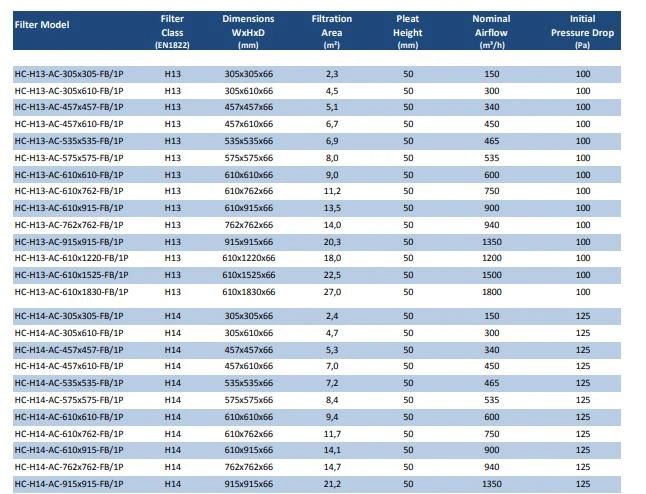
1. Product size and installation parameters
First, you need to provide the basic dimensions of the filter, including length, width and thickness. At the same time, the actual installation space, flange size, connection method and installation direction should be confirmed.
If you are replacing the original filter, it is recommended to provide the original product model, product photos or on-site installation drawings to avoid providing only one external dimension, resulting in a mismatch in the installation structure.
2. Filtration level and filtration efficiency
The required filtration level should be clearly defined, such as primary efficiency, medium efficiency, high efficiency or HEPA, as well as specific filtration efficiency requirements.
For high-efficiency filters such as H13 and H14, the test standards, test methods and testing requirements should also be clearly defined to avoid deviations in parameter understanding between different standards.
3. Rated air volume and resistance
Rated air volume is an important parameter for air filter selection and should be provided based on the design air volume of the HVAC system or equipment.
At the same time, the initial resistance and final resistance need to be confirmed. If the filter resistance is too high, it may lead to a decrease in air volume, an increase in fan energy consumption, and an abnormal system pressure difference.
Therefore, it is recommended that the purchasing parameters include at least:
Design air volume + rated air volume + initial resistance + final resistance.
IV. Filter materials and frame materials
The type of filter material should be clearly specified when purchasing, such as synthetic fiber, glass fiber, activated carbon, PP or other special filter materials.
Also confirm the frame material, such as galvanized steel plate, aluminum profile, stainless steel, etc.
If the application environment contains high humidity, high temperature or corrosive gases, the corresponding ambient temperature, humidity and corrosion conditions should also be provided.
5. Sealing method
Different equipment has different requirements for the filter sealing structure. It should be clear which sealing method is used, such as gasket seal, sealing strip or liquid tank seal.
For applications such as clean rooms and high-grade HEPA filters, it is also necessary to confirm the sealing material, sealing position and installation structure to avoid bypass leakage after installation.
6. Usage environment and pollutant types
The actual usage environment of the air filter should be stated when purchasing, for example:
General HVAC systems
Clean rooms
Hospitals and operating rooms
Pharmaceutical workshops
Food Product processing workshop
Electronic manufacturing workshop
Industrial dust removal environment
Also indicate whether the main pollutants are dust, particulate matter, oil mist, odor or gaseous pollutants, so that suppliers can reasonably choose filter materials and product structures.
7. Testing and acceptance requirements
For B-end projects, the testing requirements should be clearly stated in the procurement technical specifications in advance, including filtration efficiency, resistance, dimensional deviation, appearance quality and whether leak detection is required on a unit-by-unit basis.
For HEPA filters, the supplier can also be required to provide a factory test report and clarify the test standards and acceptance methods.
8. It is recommended to establish a complete parameter table
When actually purchasing, the technical parameters can be organized according to the following items:
Product type, size, filtration level, filtration efficiency, rated air volume, initial resistance, final resistance, filter material, frame material, sealing method, installation method, use environment, test standards and test reports.
For products with non-standard sizes or special working conditions, equipment drawings or site photos should also be provided.
Conclusion
Air filter procurement cannot only provide the two parameters of "size + filtration level". Only by providing complete information such as size, air volume, resistance, efficiency, filter material, frame, sealing and usage environment to the supplier can selection errors and on-site installation problems be reduced.
For projects that require air filter selection, customization and bulk purchase, Jiangsu Yueboyang Purification Equipment Co., Ltd. can assist in product selection and technical parameter confirmation based on the equipment parameters, installation dimensions, design air volume and usage environment provided by the customer, and provide primary-efficiency, medium-efficiency, high-efficiency, HEPA and activated carbon filters and other products. At the same time, it can be equipped with FFU fan filter unit, high-efficiency air supply outlet and other clean air equipment to provide product supporting support for clean rooms and HVAC air purification systems.


