
HVAC air supply vent is an important component at the end of the air conditioning and ventilation system. It is mainly responsible for sending the processed air evenly into the room. The type, size, installation location and air flow organization of the air supply outlets will directly affect the indoor temperature uniformity, comfort, noise level and the operation effect of the entire HVAC system.
In engineering projects, the air supply outlet is not "the bigger the air volume, the better", but needs to be comprehensively selected based on the design air volume, projection distance, installation height, noise requirements and building structure.
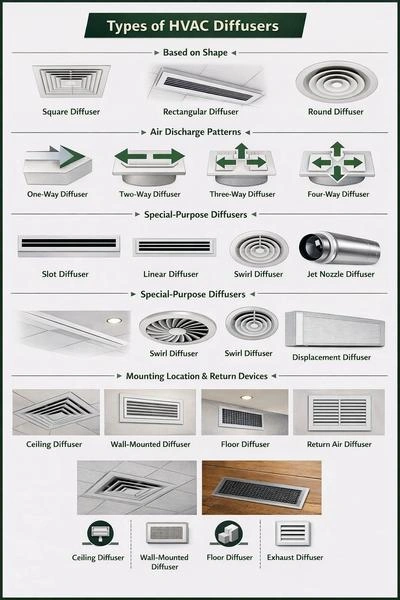
1. What are the common types of air supply vents for HVAC?
1. Single-layer louver air vents
Single-layer louver air vents usually use adjustable horizontal or vertical blades to change the air supply direction by adjusting the blade angle.
It has a simple structure and low cost, and is suitable for ordinary air conditioning and ventilation systems, especially for side wall air supply.
Typical applications:
Office
Corridor
Commercial building
General industrial factory building
If the project has certain adjustment requirements for the air supply direction, and the air volume and range are at medium to low levels, single-layer louver air outlets are usually an economical choice.
2. Double-layer louver air outlet
Double-layer louver air outlet has two sets of mutually perpendicular adjustable blades, which can adjust the horizontal and vertical air supply directions respectively, so it has more flexible airflow adjustment capabilities than single-layer louvers.
It is suitable for medium air volume and short-to-medium distance air supply. It is a common air supply form in commercial buildings and office spaces.
Applicable scenarios:
Office
Conference room
Shopping mall
Hotel
Hospital
Industrial building
If the project requires adjusting the air supply direction according to the room layout, double-layer louvers are usually more suitable than fixed air vents.
3. Square diffuser
Square diffusers are usually installed on the suspended ceiling and diffuse the air in multiple directions, allowing the supply airflow to quickly mix with the indoor air.
Compared with side wall louver air outlets, square diffusers are more suitable for ceiling air supply and comfort air conditioning.
Typical applications:
Office buildings
Hotels
Commercial spaces
Hospitals
Meeting rooms
Square diffusers are a common choice for general air-conditioned spaces that require more even airflow distribution and lower noise.
4. Four-sided diffuser
Four-sided diffuser can diffuse air in multiple directions and is suitable for the center of the room or regular ceiling areas.
When the height of the space is low and the comfort level in the personnel activity area is high, the discomfort caused by the direct impact of the air supply airflow on personnel can be reduced by rationally selecting the air volume and air outlet size.
5. Cyclone diffuser
The cyclone diffuser creates a strong induction effect through rotating airflow, so that the incoming air can quickly mix with the indoor air.
It is suitable for larger air volumes and higher spaces, and can also be used in HVAC systems that require higher air mixing capabilities.
Common applications:
Industrial plants
Commercial buildings
Lobbies
Warehouses
Tall spaces
6. Nozzles and spherical nozzles
The nozzles have high air supply speed and long projection distance, and are suitable for large spaces or high-level installation scenarios.
When ordinary diffusers cannot meet the long-distance air supply requirements, the nozzle can send air to a farther location through a higher initial jet velocity.
Typical applications:
Large factories
Stadiums
Airports
Exhibition halls
Large warehouses
When selecting this type of air outlet, focus should be placed on projection distance, terminal speed, air volume and noise.
7. Linear air vents and micro-slit air vents
Linear air vents usually have a long continuous structure and can be combined with suspended ceilings, walls and architectural decorations.
The main advantages are not only air supply performance, but also architectural aesthetics and flexible airflow organization.
It is suitable for hotels, high-end office spaces, commercial buildings and other projects that require high architectural decoration effects.
8. Clean room high-efficiency air supply outlet
Clean room air supply outlet is usually used in conjunction with HEPA or other high-efficiency filters to efficiently filter the air while supplying air.
Compared with ordinary HVAC air supply vents, clean room air supply vents pay more attention to filtration efficiency, sealing performance, air flow uniformity and clean room grade requirements.
Applicable to:
Pharmaceutical factory
Hospital
Semiconductor factory
Electronic manufacturing
Medical device production
Laboratory
ISO 5. Different clean environments such as ISO 7 and ISO 8 should be designed according to the requirements of cleanliness level, number of air changes, air supply volume and air flow organization.
2. How to select HVAC air supply outlets based on project parameters?
The air outlet selection should not just look at the product size. Engineers usually need to consider the following parameters comprehensively.
1. Select based on air volume
Air volume is the most basic parameter for air outlet selection.
If the air volume borne by a single air outlet is small, you can consider single-layer louvers, double-layer louvers or small diffusers.
For comfort air conditioning systems with medium air volume, square diffusers, double-layer louvers, etc. usually have better adaptability.
If a single air outlet needs to handle a large air volume, you can consider a large diffuser, swirling air outlet or nozzle.
It should be noted that the size of the air outlet cannot be judged based on the air volume alone. It also needs to be calibrated based on the face wind speed, neck wind speed, static pressure and noise.
2. Select according to the projection distance
The projection distance is an important factor in determining the type of air supply outlet.
For rooms with smaller areas and lower floor heights, generally there is no need for a particularly long air supply range, and diffusers and louvered air outlets can meet the requirements.
If the space is larger, or the air supply vent is installed at a higher position, a longer projection distance is required.
At this time, you can consider nozzles, spherical nozzles or swirling air outlets with strong jet capabilities.
Simple judgment:
| Engineering conditions | Recommended air outlets |
|---|---|
| Short-distance air supply | Square diffuser, louvered air outlets |
| Medium projection distance | Double-layer louvers, swirl diffuser |
| Long-distance air supply | Nozzle, spherical nozzle |
| Tall space | Nozzle, swirl air outlet |
3. Select according to noise requirements
The noise generated by the air outlet is mainly related to wind speed, pressure loss and air outlet structure.
Office buildings, hotels, hospitals and conference rooms are usually more sensitive to noise, so the air outlet speed cannot be simply increased in order to increase the air volume.
For low-noise environments, priority should be given to air vents with better air diffusion performance, and the face wind speed should be reduced by increasing the size of the air vents.
When selecting the project, you can check it based on the noise data or NC level provided by the equipment manufacturer.
General principle: When the air volume is constant, appropriately increasing the size of the air outlet is usually beneficial to reducing wind speed, pressure drop and noise.
4. Select according to the installation method
Building structure and air duct layout will also affect the selection of air outlets.
Ceiling installation:
Priority is given to square diffusers, circular diffusers, four-sided diffusers and linear air outlets.
Side wall installation:
Priority should be given to single-layer louvers, double-layer louvers and other directional air supply outlets.
High installation:
If you need to send air to distant personnel activity areas, you can consider nozzles or spherical nozzles.
Floor installation:
For the raised floor air supply system, you can choose an air supply outlet suitable for floor installation, focusing on load-bearing capacity and noise.
5. Select according to indoor use
Different building uses have different requirements for airflow organization and noise.
| Application scenarios | Recommended types | Main considerations |
|---|---|---|
| Office | Square diffuser, double-layer louvers | Low noise, comfort |
| Meeting room | Diffuser, linear air outlet | Noise, air flow uniformity |
| Shopping mall | Diffuser, swirl air outlet | Air volume, coverage |
| Industrial plant | Nozzle, swirl Air outlet | Large air volume, range |
| Large hall | Nozzle, swirling air outlet | Height, projection distance |
| Hotel | Diffuser, linear air outlet | Noise, beautiful |
| Clean room | High efficiency filtration air outlet | Filtration efficiency, sealing, air flow uniformity |
| Hospital | Clean air outlet, diffuser | Cleanliness, noise, air flow organization |
3. HVAC air supply outlet project selection table
In actual projects, quick judgments can be made according to "air volume + projection distance + noise + installation method".
| Engineering conditions | Recommended air outlet | Main features |
|---|---|---|
| Low air volume , short distance | Single-layer louver | Economical, simple structure |
| Medium air volume, medium and short distance | Double-layer louver | The air supply direction is adjustable< /td> |
| Medium air volume, ceiling installation | Square diffuser | Four-way diffusion, uniform air flow |
| Low noise requirements | Conducive to reducing local wind speed | |
| Large air volume | Cyclone air outlets and large diffusers | Suitable for larger air supply volumes |
| Long projection distance | Nozzle, spherical nozzle | Longer range |
| Tall space | Nozzle, swirling air outlet | Suitable for air supply in high positions and large spaces |
| Side wall installation | Single/double-layer louvers | Facilitated for directional air supply |
| Suspended ceiling Installation | Square diffuser, linear air outlet | Combined with suspended ceiling |
| Clean room | HEPA high-efficiency air supply outlet | Taking into account both filtration and Air supply |
| High cleanliness environment | High-efficiency filter air supply port | Emphasis on sealing and air flow uniformity |
4. How should the size of the air supply outlet be determined?
When determining the size of the air outlet, it is not recommended to directly apply a fixed size based on the air volume alone.
A complete project selection usually needs to consider:
Design air volume → Number of air outlets → Air outlet size → Surface wind speed → Static pressure loss → Noise → Jet distance → Terminal wind speed
For example, if a room requires a larger total air supply volume, the air speed of each air outlet can be reduced by increasing the number of air outlets or appropriately increasing the size of a single air outlet.
If a single air outlet is allowed to bear too much air volume in order to reduce the number of air outlets, it may lead to excessive wind speed, increased pressure drop, increased noise, and an enhanced sense of wind blowing to personnel.
Therefore, the final dimensions should be checked based on the performance data and project design conditions provided by the tuyere manufacturer.
5. Several issues that engineers easily overlook when selecting models
Don't just look at the air volume
Under the same air volume, air outlets with different structures may produce completely different jet flows, pressure drops and noises.
Don't just look at the air outlet size
The air outlet size is only a geometric parameter, and the actual performance is also affected by the neck size, blade structure, static pressure and installation conditions.
Don't ignore the installation height
When the same type of air outlet is installed at a height of 2.5 m and 8m, the requirements for range and airflow organization are completely different.
Don't ignore indoor use
Although offices and industrial plants both need air supply, they have different requirements for noise, comfort and range, so the exact same selection criteria cannot be used.
Clean rooms cannot be directly selected according to ordinary air outlets
Clean room projects need to consider filtration efficiency, leakage rate, air flow uniformity, cleanliness level and maintenance methods at the same time.
6. Core principles of HVAC air supply outlet selection
For most engineering projects, preliminary screening can be carried out according to the following logic:
Small air volume + short distance → louvered air outlet
Medium air volume + ceiling installation → square/four-sided diffuser
Medium air volume + side wall installation → double-layer louver air outlet
Large air volume + large space → swirl air outlet
High installation + long throw distance → nozzle/spherical nozzle
Low noise + high comfort requirements → diffuser or linear air outlet
High cleanliness + top air supply → HEPA high-efficiency filtration air outlet
The final selection also requires performance verification based on air volume, static pressure, wind speed, range, noise, installation height and indoor heat load, rather than selecting based solely on the name or size of the air outlet.
For projects that require customized HVAC air supply vents, Jiangsu Yueboyang Purification Equipment Co., Ltd. can provide corresponding air supply outlets and air diffusion products according to the air volume, installation method, size, material, air flow organization and cleanliness requirements of the project, and assist in product selection according to specific applications.


