
The welding workshop of automobile factories will produce welding smoke, metal particles and some oil mist during the production process. If smoke and dust cannot be collected and filtered in time, it will not only affect the air quality in the workshop, but may also cause dust accumulation on equipment, risk of personnel exposure, and deterioration of the production environment. Therefore, a reasonable dust filtration system should be designed based on the welding process, pollutant characteristics and workshop layout.
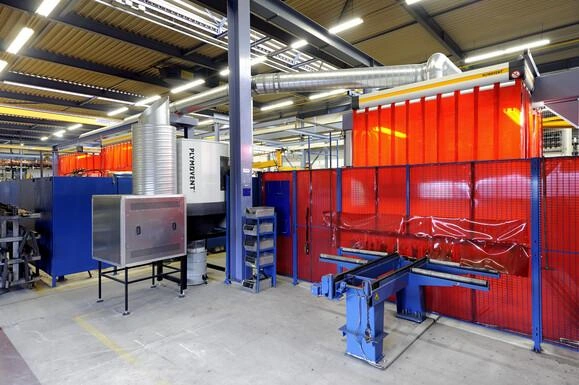
1. Analysis of the characteristics of pollutants in welding workshops
The pollutants generated in welding workshops mainly include welding smoke, fine metal particles, grinding dust, and some oil mist and gaseous pollutants.
The smoke concentration and particle characteristics generated by different welding processes are different. Therefore, before designing the filtration system, the welding method, the number of welding stations, the amount of pollutants produced, and the ventilation requirements of the workshop should be clarified.
2. Prioritize the use of local exhaust air
For welding fume, relying solely on the ventilation of the entire workshop for dilution is usually inefficient.
A more reasonable way is to set up local exhaust devices such as suction hoods and suction arms near the welding gun, welding station or pollution source to collect the pollutants before the smoke spreads and send them to the filtering equipment.
The local exhaust system should be reasonably designed based on the number of workstations, exhaust volume and pipeline resistance to avoid the problem of insufficient air suction in some workstations.
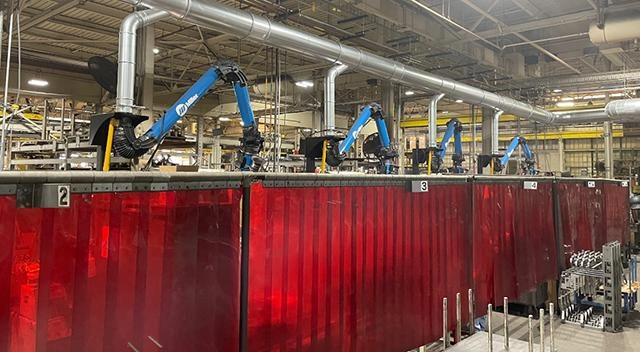
3. Configure multi-stage air filtration
The dust filtration system of the automobile welding workshop can be configured with multi-stage filtration according to the concentration of pollutants.
The pre-filter mainly intercepts larger particles and reduces the load on the back-end filtration equipment; the medium-efficiency or high-efficiency filtration equipment further processes fine particles.
For places with high welding fume concentration, filter products with higher dust holding capacity and lower operating resistance should be selected based on actual working conditions.
4. Reasonable selection of filter materials
Welding workshop filters need to select appropriate filter materials based on the nature of the dust.
If you mainly deal with ordinary metal particles, you should focus on filtration efficiency, dust holding capacity and dust cleaning performance; if there is oil mist in the air at the same time, you need to confirm the oil resistance of the filter material to avoid rapid clogging of the filter material.
For the back-end high-efficiency filter, attention should also be paid to the initial resistance and rated air volume to prevent excessive filter resistance from affecting the entire exhaust system.
5. Pay attention to air volume and system resistance
The dust filtration system needs to maintain a stable exhaust volume. As dust accumulates on the filter, the system resistance will gradually increase, which may result in a decrease in air suction volume if not maintained in time.
Therefore, the design exhaust volume, filter initial resistance, final resistance, fan residual pressure and pipeline resistance should be comprehensively considered during design to ensure that the system can still meet the design requirements after the filter reaches a certain level of dust accumulation.
6. Set up a pressure difference monitoring and maintenance system
The filter pressure difference can reflect its dust accumulation status. It is recommended to install a pressure difference monitoring device on the filtration equipment to determine whether the filter needs maintenance or replacement based on actual operating data.
For equipment that uses washable or replaceable filter materials, the maintenance cycle should be formulated based on dust concentration and operating time to avoid long-term high-resistance operation of the filter.
7. Taking into account workshop air circulation
Air purification in automobile welding workshops cannot only focus on local dust removal, but also needs to be combined with the overall ventilation system.
Fresh air, exhaust air and air circulation should be reasonably organized to prevent the treated air from bringing pollutants back to the work area again. For areas with different pollution levels, zoned exhaust and independent filtration solutions can also be used to improve system control effects.
Conclusion
Dust filtration in the automobile factory welding workshop should focus on pollution source control, local exhaust, high-efficiency filtration and pressure difference monitoring. By rationally configuring the suction device, pre-filtration and high-efficiency filtration equipment, and optimizing the air volume and system resistance, the impact of welding smoke on the workshop environment and equipment operation can be effectively reduced.
For projects requiring automotive factory welding shop air filter selection, customization and bulk purchase, Jiangsu Yueboyang Purification Equipment Co., Ltd. can make technical selections based on the welding process, dust characteristics, design air volume and equipment size, and provide products such as primary-efficiency, medium-efficiency, high-efficiency and HEPA filters. It can also be equipped with HVAC dampers, air filtration equipment and clean air supply products, providing complete product supporting support for automobile manufacturing, welding and industrial air purification systems.


