
Lithium battery production workshops have high requirements for air cleanliness, humidity, temperature and air flow organization. Especially in processes such as pole piece manufacturing, battery cell assembly and liquid injection, particulate matter and moisture in the air may affect product quality. Therefore, the design of clean air systems needs to combine different production processes and reasonably configure air filtration, temperature and humidity control and air flow organization systems.
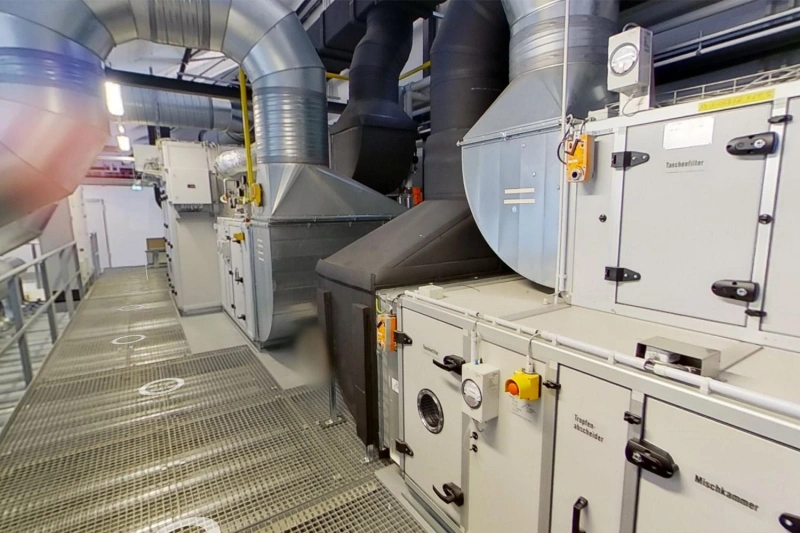
1. Divide clean areas according to the production process
Different processes in the lithium battery production workshop have different requirements for the air environment, and the clean areas should be reasonably divided according to the production process.
Areas such as pole piece manufacturing, coating, and rolling mainly focus on particle control and temperature and humidity stability; processes that are more sensitive to moisture, such as cell assembly and liquid injection, usually require a more stringent low-humidity environment.
Therefore, the cleanliness, temperature, humidity and dew point requirements of each area should be clarified before design to avoid using the exact same air treatment solution.
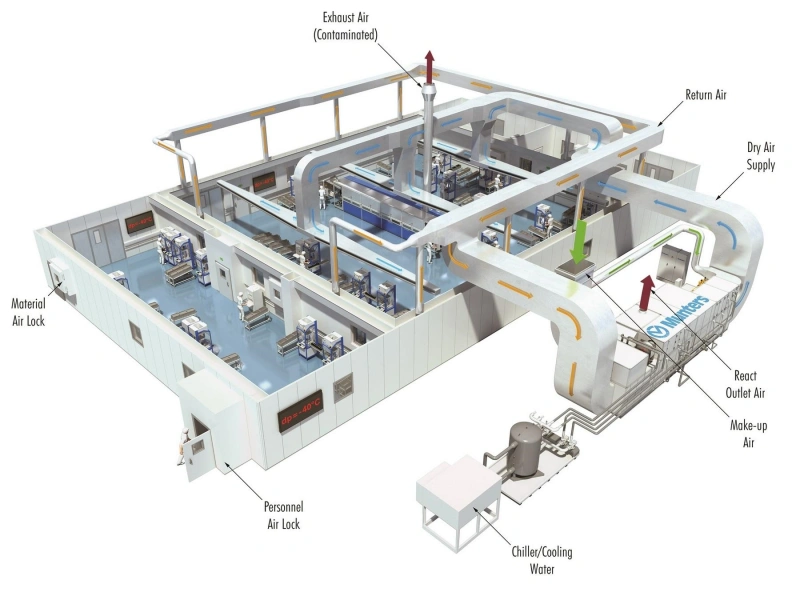
2. Establish a multi-stage air filtration system
Clean air systems usually adopt a multi-stage filtration structure.
Primary filter is used to intercept larger particles and protect air-conditioning boxes and back-end equipment; Medium-efficiency filter further reduces the particle load; for high-clean areas, a HEPA filter can be configured at the end.
Through reasonable multi-stage filtration, the load of the back-end high-efficiency filter can be reduced and its service life can be extended.
3. Reasonable selection of HEPA filters
For lithium battery production areas with high requirements for particle control, appropriate HEPA filters should be selected based on the cleanliness level and design air volume.
When purchasing, you need to confirm the filtration level, rated air volume, initial resistance, size, sealing method and testing standards.
The higher the filtration efficiency, the better. The filter resistance and fan residual pressure should also be considered comprehensively to avoid insufficient system air volume and increased energy consumption due to excessive resistance.
4. Focus on controlling humidity and dew point
Part of the lithium battery production process is very sensitive to moisture in the air. Therefore, the clean air system cannot only focus on particle filtration, but also needs to be equipped with a dehumidification system.
According to process requirements, technologies such as rotary dehumidification can be used to reduce air moisture content, and the regional environment can be monitored in real time through temperature and humidity sensors.
For low dew point workshops, special attention should be paid to the sealing performance of the building envelope, doors, windows, air ducts and equipment interfaces to reduce the infiltration of external moist air.
5. Optimize the air flow organization of the clean room
The clean air system should design a reasonable air supply and return method based on the layout of the production equipment and the personnel activity area.
For highly clean areas, airflow organization methods such as high-efficiency air supply at the top and return air at the bottom can be used to effectively cover the production area with clean air and reduce the retention of pollutants.
At the same time, the pressure difference and air flow direction between different areas should be reasonably controlled to prevent contaminated air from entering high-clean areas.
6. Strengthen air valve and pressure difference control
It is necessary to establish a reasonable pressure difference between different clean areas through air volume balance. Regulator dampers, high-tightness dampers and VAV dampers can be used to control supply, return and exhaust air volumes.
For important clean areas, air valves with good sealing performance and adjustment accuracy should be selected according to design requirements and linked with the automatic control system.
7. Strengthen filter maintenance and management
HEPA and other air filters will gradually accumulate dust during use, and the resistance will continue to increase. It is recommended to judge the operating status of the filter through pressure difference monitoring and develop a replacement cycle based on actual operating data.
At the same time, the sealing condition, frame integrity and installation status of the filter should be checked regularly to avoid affecting the clean air quality due to bypass leakage.
8. Comprehensive consideration of system energy consumption
Lithium battery clean workshops usually require a long time to operate, and the energy consumption of the air treatment system is high. Therefore, filter resistance, fan efficiency, dehumidification load and fresh air volume should be comprehensively considered during design.
Selecting low-resistance filters, optimizing airflow organization, and reasonably controlling fresh air volume can reduce long-term operating costs while meeting cleanliness and low-humidity requirements.
Conclusion
The design of clean air system in lithium battery production workshop needs to comprehensively solve problems such as particle control, temperature and humidity control, low dew point environment, air flow organization and pressure difference control. Through multi-stage filtration, HEPA terminal filtration, dehumidification system and air valve control, a stable clean air environment can be established for different production processes.
For projects that require lithium battery production workshop air filter selection, customization and system support, Jiangsu Yueboyang Purification Equipment Co., Ltd. can make technical selections based on cleanliness level, design air volume, low humidity requirements, equipment size and production process, and provide primary-efficiency, medium-efficiency, high-efficiency, HEPA and other air filtration products. At the same time, it can be equipped with FFU fan filter unit, high-efficiency air supply outlet, regulating air valve, high-sealing air valve and other clean air equipment to provide complete air purification product supporting support for lithium battery and new energy production workshops.


