
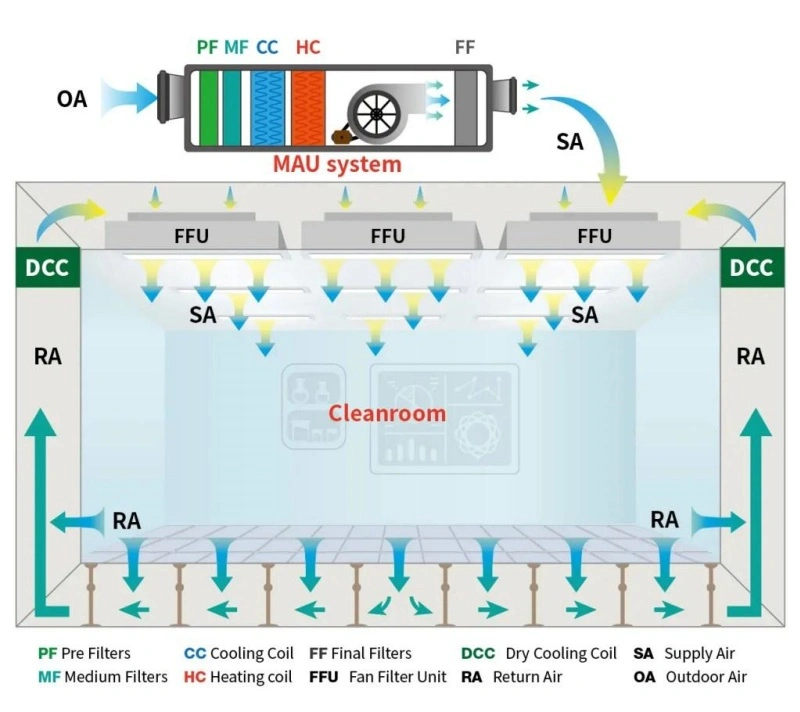
FFU (fan filter unit) integrates a fan and a high-efficiency filter and can be installed on the ceiling of a clean room to provide continuous and stable clean air indoors. FFU is widely used in clean environments such as electronics, semiconductors, pharmaceuticals, medical equipment, food and precision manufacturing.
For clean room engineers and buyers, FFU selection is not just about determining the size and air volume, but also requires comprehensive consideration of cleanliness level, filtration efficiency, static pressure, noise, energy consumption, control methods and subsequent maintenance costs.
1. Determine filtration efficiency according to cleanliness level
FFU is usually configured with HEPA or ULPA filter. When selecting, the filtration efficiency should first be determined based on the clean room grade and process requirements.
ISO 5 and higher cleanliness requirements areas: usually require high-efficiency HEPA, and some key process areas may use ULPA.
ISO 6, ISO 7 clean rooms: HEPA filters of the corresponding grade can be selected according to actual particle control requirements.
General clean areas: The filtration level should be determined based on the design cleanliness, number of air changes and pollution control requirements.
You cannot simply pursue higher filtration efficiency. An increase in filtration efficiency is usually accompanied by an increase in resistance, and both fan performance and operating energy consumption need to be considered.
2. Determine the number of FFU according to the room air volume
The number of FFU directly affects the air flow organization and cleanliness of the clean room.
When designing the project, the total air supply volume required can be calculated first based on the room area, floor height, cleanliness level, number of air changes and process load, and then the quantity can be determined based on the actual working air volume of a single FFU.
The basic calculation idea is:
Number of FFU ≈ total required air supply ÷ actual working air volume of a single FFU
In actual projects, FFU layout density, equipment dust volume, local high-clean areas and system safety margins should also be considered, rather than just determining the quantity according to theoretical formulas.
3. Focus on comparing air volume and static pressure performance
When purchasing FFU, you should not only compare the "maximum air volume".
What is more important is to confirm how much air volume the FFU can provide under the actual system static pressure.
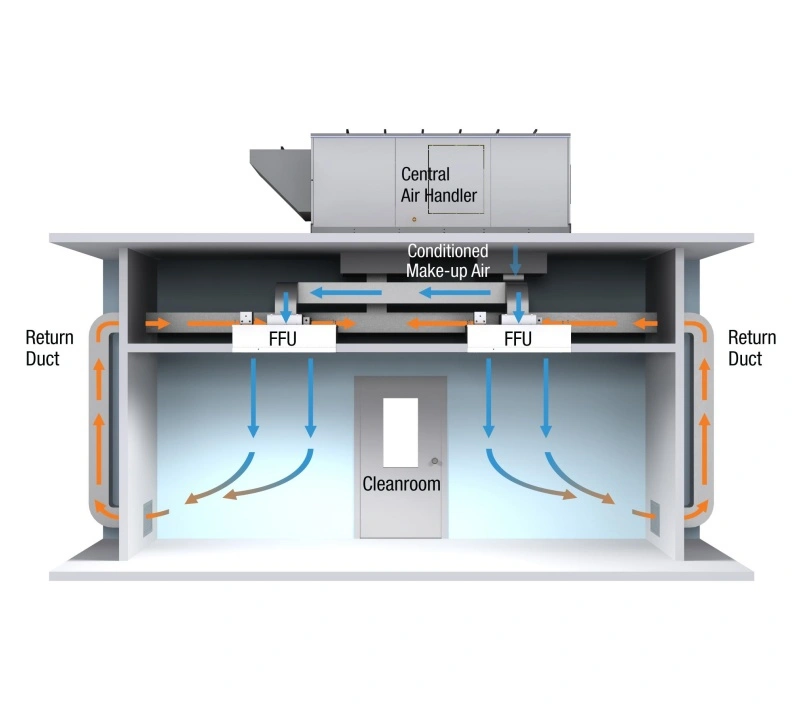
If the FFU needs to overcome the HEPA filter resistance, ceiling structure resistance and other system resistance, the actual performance of the fan under different static pressures will directly affect the clean room ventilation effect.
Therefore, it is recommended to ask suppliers to provide:
Air volume-static pressure performance curve
Rated operating point
Filter initial resistance
Fan maximum static pressure
Motor power and operating parameters
Comparison through actual operating points has more reference value than simply comparing maximum air volume.
4. How to choose between HEPA and ULPA?
The higher the level of HEPA and ULPA, the better.
If the cleanroom process can meet the requirements, using the appropriate grade of HEPA usually has a better cost and energy consumption balance. For areas such as semiconductors and precision electronics that have higher requirements for ultrafine particle control, ULPA can be considered based on process requirements.
When purchasing, you also need to pay attention to the filter size, rated air volume, resistance, sealing method and later replacement cost to ensure that the FFU and filter can match each other in the long term.
5. Don’t ignore noise and energy consumption
FFU usually needs to run continuously for a long time or even 24 hours a day, so noise and energy consumption will directly affect the operating costs of clean rooms.
Recommended key comparisons:
Motor type → Power → Actual operating air volume → Static pressure → Noise → Speed regulation method
FFU using EC motor, frequency conversion or multi-speed speed control can adjust the operating status according to actual cleaning needs and avoid long-term full load operation.
For large clean room projects, even if the power saved by a single FFU is not large, there may be a significant difference in energy costs when hundreds or even thousands of devices are running for a long time.
6. Control methods affect system management efficiency
Depending on the project scale and degree of automation, FFU can adopt independent control, partition control or centralized control.
It is recommended that large clean rooms consider centralized monitoring functions to achieve:
FFU start and stop control
Wind speed adjustment
Operating status monitoring
Fault alarm
Partition management
Energy consumption management
For large clean factories such as electronics and semiconductors, the scalability of the control system is also worth confirming during the procurement stage.
7. What parameters should be confirmed when purchasing FFU?
Before formal inquiry, it is recommended to provide the following parameters to the supplier:
FFU size, rated air volume, working static pressure, filtration efficiency, filter size, filter initial resistance, motor type, power, noise, control method, installation method, shell material and power supply requirements.
If it is a large clean room project, the clean room area, floor height, cleanliness level, designed air exchange times, FFU layout and the environment where the project is located should also be provided.
Complete technical parameters can reduce repeated confirmation by suppliers and improve the accuracy of quotations and technical solutions.
8. How to choose a suitable FFU supplier?
For engineering projects, FFU is not only the purchase of a single equipment, but also involves the matching of fans, filters, control systems and the overall air flow organization of the clean room.
Therefore, it is recommended to give priority to manufacturers that can provide technology selection, air volume and static pressure matching, filter configuration, control solutions and OEM/ODM customization services.
Jiangsu Yue Boyang Purification Equipment Co., Ltd. can provide FFU fan filter units and supporting high-efficiency filters according to different cleanliness levels and project requirements, and supports customization of parameters such as size, air volume, motor, and control methods, and provides air purification equipment for electronic, semiconductor, pharmaceutical, medical, and precision manufacturing clean room projects.
For FFU procurement projects, the final selection should be based on actual working air volume, system static pressure, filtration efficiency and long-term operating costs, rather than simply comparing equipment prices.


