
The air quality in clean rooms directly affects product yield, experimental results and production safety. HEPA high-efficiency filter is the core filtration component in the clean room air purification system. It is mainly used to remove particulate pollutants in the air and help the clean room meet the corresponding air cleanliness requirements.
But in actual projects, HEPA filters are not simply "the higher the efficiency, the better". Engineers and purchasers also need to comprehensively consider parameters such as filtration efficiency, air volume, initial resistance, final resistance, size, sealing method, installation form, and usage environment.
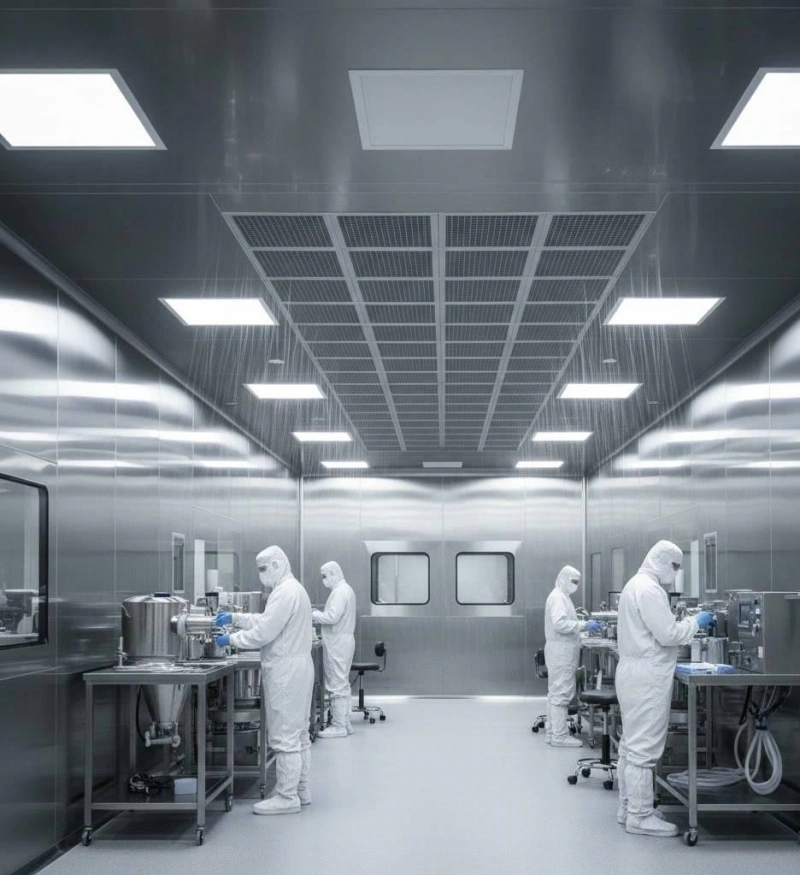
1. Why do clean rooms need HEPA filters?
Ordinary primary and medium-efficiency filters are mainly used to intercept larger dust, fibers and particles and protect back-end equipment. Clean rooms have higher requirements for the control of tiny particles in the air, so HEPA high-efficiency filters are usually used as terminal filtration.
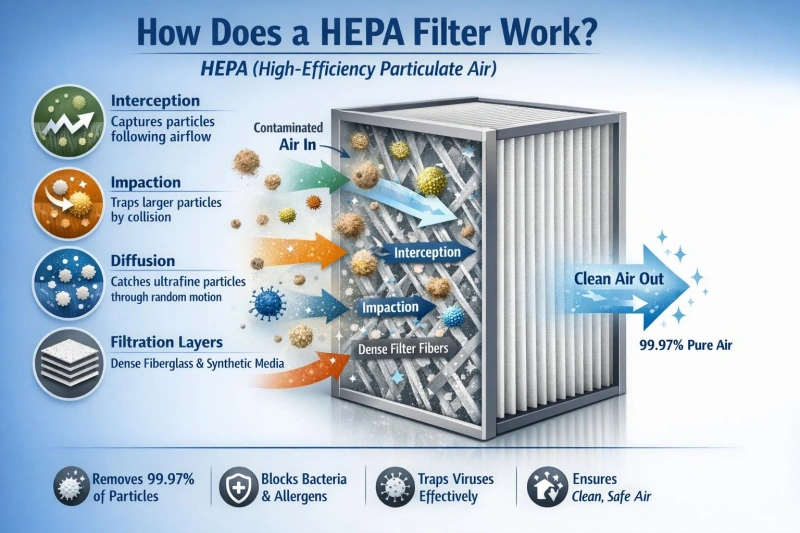
HEPA filter can effectively capture fine particles in the air, including some particulate pollutants that may affect product quality and clean environment.
In applications such as pharmaceuticals, medical devices, electronics, semiconductors, food, and laboratories, HEPA filters are usually installed at the end of the air treatment system to continuously filter the air entering the clean area to reduce the risk of particle contamination.
2. How does HEPA filter affect the cleanliness of clean room?
The final cleanliness of the clean room depends not only on HEPA filtration efficiency, but also on factors such as air supply volume, air flow organization, air change times, filter sealing and room pressure difference.
Therefore, engineering design cannot only focus on the efficiency level of HEPA filters.
For example:
Insufficient filtration efficiency may not meet the target cleanliness level;
Insufficient air volume may affect the number of air changes and pollutant dilution capabilities;
Poor sealing between the filter and the installation frame may cause bypass leakage;
Mismatching filter size or structure will increase the difficulty of installation and maintenance.
Therefore, HEPA filters should be selected as part of the entire clean room air system.
3. H13 or H14? How to choose an engineering project?
H13 and H14 are both common high-efficiency filtration grades, but it does not mean that all clean rooms must use H14.
The actual selection should be determined based on the cleanliness level, industry requirements, system design and project risks.
Generally speaking:
H13 HEPA filter
It is suitable for clean room systems that have higher requirements for particle pollution control but do not require the highest filtration level. Reasonable selection of H13 can meet the cleanliness requirements while taking into account wind resistance and operating costs.
H14 HEPA filter
It is suitable for applications with stricter requirements for air particle control, such as some high-level clean production areas, key process areas and places that are more sensitive to pollution risks.
It is important to note that higher filtration efficiency does not automatically mean better system performance. Engineers should also compare the rated air volume, initial resistance, size and operating energy consumption of the filter at the same time.
4. How to choose a HEPA filter based on air volume and resistance?
Air volume is an important parameter for HEPA filter selection.
The rated air volume of the filter must match the design air volume of the clean room air supply system, FFU or high-efficiency air supply outlet. If the actual operating air volume of the filter exceeds the reasonable range, it may lead to increased resistance, increased energy consumption, and affect the system's operational stability.
It is recommended to confirm the following parameters when purchasing:
Rated air volume;
Initial resistance;
Recommended final resistance;
Filtration efficiency;
Filter size;
Installation direction;
Sealing method.
For clean rooms using FFU, it is also necessary to confirm whether the static pressure and air volume of the HEPA filter and FFU fan match.
5. How to choose HEPA with or without partitions?
The common structures of HEPA filters include those with partitions and without partitions.
HEPA filter with partitions Usually aluminum foil or other materials are used as the separation structure. It has the characteristics of stable structure and large filtration area, and is suitable for some traditional clean rooms and air treatment systems.
Partitionless HEPA filter Using hot melt adhesive and other methods to form a folded structure of the filter material, it can obtain a larger effective filtration area under smaller thickness or space conditions. It is suitable for FFU, clean equipment and scenes with limited installation space.
The actual selection should be determined based on the equipment structure, installation space, air volume requirements and maintenance methods, rather than just based on the filter type.
6. What are the common installation methods of HEPA filters?
HEPA filters can be installed in different terminal purification equipment. Common methods include:
Suitable for clean production areas such as electronics, semiconductors, and lithium batteries. FFU integrates a fan and HEPA filter and can independently control the air supply.
High-efficiency air supply outlet
Suitable for clean room terminal air supply system. The HEPA filter is installed inside the air supply outlet and supplies air to the clean area after high-efficiency filtration.
Filter box or terminal filter unit
Suitable for air purification systems that require centralized installation or special structural requirements.
When choosing an installation method, you need to consider the air volume, space, maintenance, replacement methods, and system pressure difference at the same time.
7. What parameters need to be confirmed when purchasing HEPA filters?
For engineering projects and bulk purchases, it is recommended that purchasers provide complete technical requirements when making inquiries, not just "HEPA H13/H14 filters".
It is recommended to confirm at least:
HEPA grade;
Filter size;
Rated air volume;
Initial resistance;
Filter material type;
Structure with or without partitions;
Frame material;
Sealing method;
Installation method;
Whether inspection reports and performance test data are required.
If it is a clean room renovation project, the existing equipment model, installation size and actual operating air volume should also be provided so that the supplier can match it.
8. How to judge whether the HEPA supplier is suitable for the project?
For B2B purchases, simply comparing unit prices is often not enough.
It is recommended to focus on whether the supplier can provide:
Stable filtration efficiency;
Consistent product size and structure;
Complete testing and quality control documents;
Mass production capability;
Customized size and OEM capabilities;
The ability to match FFU, high-efficiency air supply vents and other equipment;
Pre-factory performance testing;
Stable delivery cycle.
For large clean room projects, the supplier's technical support capabilities and batch delivery capabilities are equally important.
9. Replacement and maintenance of HEPA filters
HEPA filters are not permanent filter elements. As the use time increases, the filter material gradually accumulates particulate matter, and the filter resistance will continue to rise.
The actual replacement cycle should not be simply determined according to a fixed time, but should be judged based on the filter pressure difference, operating air volume, air quality and system operating status.
When the filter resistance reaches the final resistance set by the system, or it cannot continue to meet the design air volume and cleanliness requirements, it should be checked in time and replaced.
After replacing the HEPA filter, you should also check the sealing status and perform integrity testing according to project requirements.
10. BoYang HEPA filter supporting capabilities
Jiangsu Yueboyang Purification Equipment Co., Ltd. specializes in air filtration and clean room air purification equipment. It can provide HEPA high-efficiency filters of different grades such as H13 and H14 according to project requirements, and is equipped with FFU fan filter units, high-efficiency air supply outlets and other clean room air treatment equipment.
For clean room projects in different countries and industries, we can match products according to the cleanliness level, air volume, installation size and usage environment provided by customers, and provide customized sizes, OEM and batch supply services.
For projects that require clean room construction or renovation or bulk purchase of HEPA filters, it is recommended to provide complete technical parameters during the inquiry stage in order to obtain more accurate product configurations and quotations.


