
In HVAC, clean room, hospital, laboratory and industrial ventilation systems, dampers are not only used to regulate air flow, but also perform functions such as air volume balancing, pressure control, fire isolation and air sealing.
Although different air valves have similar appearances, there are obvious differences in design purposes, sealing performance, control methods and applicable scenarios. If the selection is unreasonable, it may lead to insufficient air volume in the system, unstable pressure difference, increased air leakage, and even failure to meet fire protection or clean environment requirements.
Therefore, when engineers and purchasers choose HVAC dampers, they should make a comprehensive judgment based on system function, air volume, pressure, air leakage requirements, installation location and control method, rather than purchasing based solely on size.
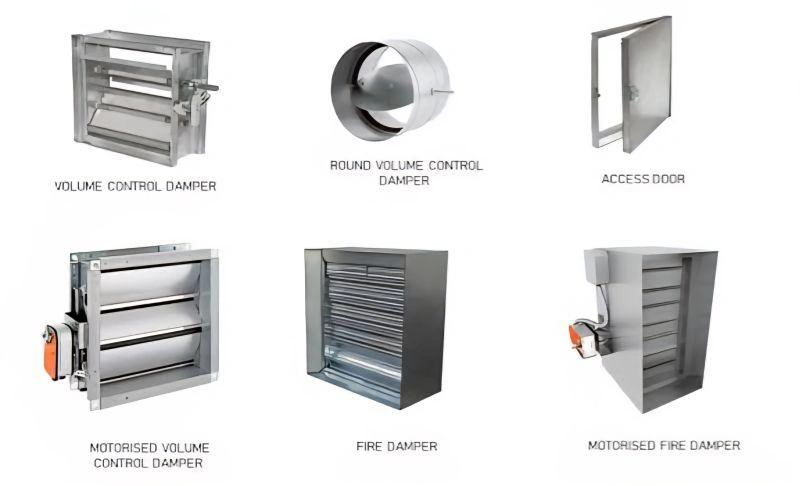
1. Common HVAC damper types
1. HVAC regulating damper
Adjusting dampers are mainly used to control the air flow in supply, return and exhaust systems and are one of the most common dampers in ordinary HVAC systems.
Common structures include single blade, multi-blade and split blade structures, which can be selected according to the duct size, air volume and adjustment accuracy.
Main features:
Used for air volume adjustment and system balancing
Can use manual or electric actuators
Relatively low resistance
Different sealing levels can be selected according to project requirements
Suitable for central air conditioning, ventilation and general industrial HVAC Systems
Typical applications include commercial buildings, factories, office buildings, shopping malls and general HVAC ventilation systems.
If the main requirement of the project is to adjust the air volume and there are no special fire protection or high air tightness requirements, the damper is usually given priority.
2. Fire damper
Fire damper is mainly used in building fire protection systems and is usually installed in air ducts that pass through fire protection zones or have fire protection requirements.
When the set conditions are reached, the fire prevention mechanism closes the air duct, thereby reducing the risk of flames and high-temperature smoke spreading to other areas through the air duct.
Main features:
With fire isolation function
Can adopt control methods such as fuse closure
Some products support linkage between electric actuators and fire protection systems
Suitable for building ventilation and fire smoke exhaust related systems
Specific temperature, fire resistance time and structural requirements should be determined in accordance with the applicable project standards
Typical applications include commercial buildings, hospitals, public buildings, industrial buildings and other buildings with fire protection zoning requirements HVAC systems.
It should be noted that the core task of the fire damper is fire isolation, not to accurately adjust the air volume. Therefore, just because the fire damper can also close the air duct, it cannot be used as an ordinary regulating damper.
3. High airtight sealing damper
Sealing damper is mainly used in systems with high air leakage rate and pressure control requirements.
Compared with ordinary regulating dampers, the focus is not simply to adjust the air volume, but to reduce air leakage in the closed state through more complete blades, sealing strips and valve body structures.
Main features:
Low air leakage design
Higher sealing performance
Can be used in positive or negative pressure systems
Can be configured with manual, electric or pneumatic actuators
Air tightness performance testing can be performed according to project requirements
Typical applications include:
Clean room
Hospital and operating room
Biosafety laboratory
Pharmaceutical production area
Semiconductor clean workshop
Industrial systems with requirements for polluted air control
For clean rooms or negative pressure isolation systems, the air leakage performance of the air valve will directly affect the room pressure difference and air flow organization, so it cannot simply be replaced by ordinary air valves.
What are the differences between the two and three types of air valves?
| Air valve type | Core functions | Typical applications | Main selection points |
|---|---|---|---|
| Adjusting air valve | Adjusting air volume, balancing system | Ordinary HVAC | Air volume, resistance, size, control method |
| Fire damper | Fire isolation | Building fire protection | Fire protection requirements, installation location, linkage method |
| Tightened air Valve | Reduce air leakage | Clean room, laboratory, hospital | Air leakage rate, pressure difference, sealing structure |
| Electric damper | Automated HVAC | Actuator, control signal, torque | Automatic control of air flow |
| Check air valve | Prevent air flow from reverse Flow | Exhaust and air supply system | Air flow direction, opening resistance |
| VAV damper | Adjust the air volume according to demand | Office, clean room, laboratory | Air volume range, control accuracy |
| Venturi valve | Quickly and accurately control air volume | Laboratory, clean environment | Air volume response, pressure difference, control accuracy |
The key principle is: these dampers cannot be substituted for each other based solely on appearance or size.
The regulating damper solves the problem of air flow control; the fire damper solves the problem of fire isolation; the sealing damper solves the problem of air leakage and pressure control.
3. Can ordinary regulating air valves replace closed air valves?
Usually it cannot be determined directly and needs to be determined based on the air leakage requirements of the system.
If it is an ordinary commercial HVAC system, there are no special requirements for air leakage in the closed state, and ordinary regulating dampers can usually meet the needs.
But if it is used in clean rooms, biosafety laboratories, hospital isolation areas, negative pressure rooms, semiconductor clean workshops or contaminated air exhaust systems, you need to focus on the sealing structure of the air valve, the allowable air leakage rate and the system pressure conditions.
In these projects, if the leakage after the damper is closed is too large, it may affect the room pressure difference control and even cause air cross-contamination.
4. Can the fire damper replace the ordinary regulating damper?
Generally not recommended.
The main design goal of the fire damper is to meet the fire isolation requirements, while the ordinary regulating damper is mainly used for air flow regulation.
If the HVAC system has both air volume control requirements and fire protection requirements, dampers with corresponding functions should be configured according to the system design, rather than simply thinking that one product can completely replace another.
Engineers also need to consider the location of the damper, air duct size, fire protection system linkage method, and applicable local building and fire protection standards when designing.
5. How to choose the appropriate HVAC damper for a project?
When selecting the actual model, you can follow the following steps to determine.
1. Determine the main function of the damper
First of all, clarify what the damper is used for:
Adjust air volume
Fire isolation
Prevent backflow
Maintain air tightness
Automatic control
This is the most important selection step.
2. Determine the size of the air duct
Provide the width, height, circular duct diameter and installation method of the air duct.
The damper size should match the air duct and on-site installation space.
3. Determine the air volume and working pressure
The engineer needs to provide:
Design air volume
Minimum/maximum air volume
Working pressure
Allowable pressure drop
These parameters are particularly important for systems such as VAV and Venturi that require precise control of air volume.
4. Determine air leakage requirements
If it is an ordinary HVAC system, it usually does not require particularly high air tightness performance.
But for clean rooms, laboratories, hospitals and negative pressure systems, it is important to confirm:
Air leakage rate when the damper is closed
Sealing structure
System working pressure
Whether a factory air tightness test is required
Don’t just write "high air tight damper", it is best to clarify the air leakage level or allowable leakage required by the project.
5. Determine the control method
Select according to the degree of automation:
Manual
Electric
Pneumatic
If an electric actuator is used, it is also necessary to confirm the control signal, supply voltage, torque and whether a feedback signal is required.
6. Determine the materials and usage environment
Different environments require the selection of different valve body and blade materials.
Ordinary HVAC systems can use conventional galvanized steel plate structures; for clean rooms, hospitals and special industrial environments, stainless steel, aluminum alloy or other corrosion-resistant materials may need to be considered.
If there are corrosive gases, humid environments or special chemical pollutants in the system, the manufacturer should be informed in advance.
6. What parameters need to be provided when purchasing HVAC dampers?
If you need to inquire from the air valve manufacturer, it is recommended to provide at least the following information:
| Parameters | Contents that need to be confirmed when purchasing |
|---|---|
| Air valve type | Adjustment, fire protection, sealing, VAV, check, etc. |
| Duct size | Length × width or circular diameter |
| Design air volume | m³/h, CFM, etc. |
| Working pressure | Pa or other pressure units |
| Air leakage requirements | Air leakage rate/air tightness level |
| Control method | Manual, electric, pneumatic Actuator |
| Actuator | Brand, model, torque, signal |
| Material | Galvanized steel, Stainless steel, aluminum alloy, etc. |
| Installation location | Air supply, return air, exhaust or fire protection partition |
| Use environment | General HVAC, clean rooms, hospitals, laboratories, etc. |
| Quantity | Project purchase quantity |
| Certification requirements | Determined according to the project and target market |
For bulk purchases, it is best to provide air duct drawings or HVAC system diagrams so that the manufacturer's engineers can confirm based on actual installation conditions instead of just quoting based on a damper size.
7. Recommendations for damper selection in different projects
A preliminary judgment can be made based on project requirements:
General building HVAC → Adjusting damper
Focus on air volume adjustment, pressure drop and size.
Fire protection zone → Fire damper
Focus on fire protection requirements, installation location and system linkage.
Clean room → Low air leakage/high air tightness damper
Focus on air leakage rate, pressure difference and sealing performance.
Hospital operating room/isolation area → High airtight air valve
Focus on air flow direction, pressure difference control and air leakage.
Laboratory → VAV / Venturi valve
If you need to quickly and accurately adjust the air volume according to the room conditions, control accuracy and response speed should be considered.
Semiconductor clean factory → Low air leakage and high-precision air valve
Focus on air tightness, pressure control, materials and long-term stable operation.
8. Before inquiring from the air valve manufacturer, it is recommended to confirm these 5 questions
① What is the core function of this air valve?
Is it to adjust the air volume, fire protection, sealing or precise control?
② How much air volume and working pressure does the system require?
This determines damper size, construction and actuator configuration.
③ Are there clear air leakage requirements?
If so, specific standards or allowable leakage volumes need to be provided to the supplier.
④ What control method is required for the actuator?
Manual, electric or pneumatic? Do you need a feedback signal?
⑤ Does the project have any special materials and certification requirements?
Especially for hospitals, laboratories, clean rooms and overseas engineering projects, relevant standards should be confirmed in advance.
9. How do BoYang air valve products support engineering projects?
For HVAC, clean room, hospital, laboratory and industrial air control systems, air valve selection should not only look at the product price, but also need to comprehensively consider air volume, pressure, air tightness, materials, actuators and the actual installation environment.
Jiangsu Yueboyang Purification Equipment Co., Ltd. can provide air control products such as regulating air valves, airtight air valves, Venturi valves, etc. based on the air duct size, air volume, pressure, control method and application environment of the project, and combine them with air filtration, air distribution and clean room systems.
For bulk procurement or engineering projects, it is recommended to provide product size, quantity, design air volume, working pressure, control method and usage scenarios when enquiring, and the engineering team will confirm the product configuration based on actual working conditions.


