
During food processing, air not only affects the cleanliness of the production environment, but may also affect product hygiene, microbial control and production stability. Properly designed air filtration systems can reduce dust, particles, microorganisms and other air pollutants from entering the production area, providing a more stable and hygienic production environment for food processing.
1. Why do food processing plants need air filtration systems?
Food processing workshops usually contain dust and particulate matter generated by personnel activities, raw material handling, equipment operation, etc. Without adequate air filtration, contaminants can enter food exposure areas and increase the risk of cross-contamination. At the same time, the temperature and humidity in the air will also affect microbial reproduction, food processing environment and equipment operation. Therefore, the air filtration system should be designed in conjunction with the HVAC system, temperature and humidity control, and workshop hygiene management, rather than considering filtration efficiency alone.
2. Basic structure of air filtration system in food processing plants
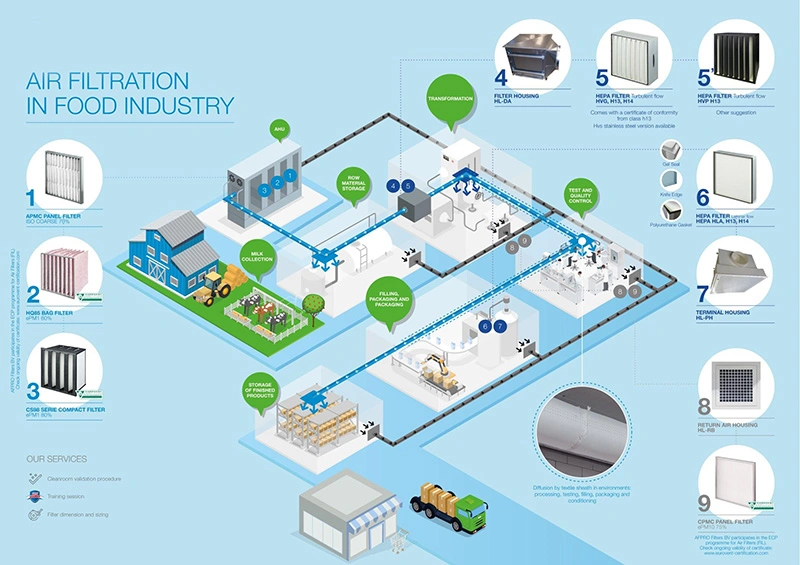
For general food processing workshops, multi-stage filtration can be used according to air cleanliness requirements:
Fresh air inlet → Primary effect filter → Medium effect/bag filter → High efficiency filter (on demand) → Air treatment equipment → Clean production area
Primary filter mainly intercepts larger dust, fibers and particles and reduces the load of subsequent filters.
Bag filter has a large filtration area and high dust holding capacity. It is suitable for air treatment systems with large air volumes and can be used as a medium-efficiency filtration stage.
For baking, dairy products, beverages, meat products and other production areas with higher requirements for air cleanliness, high-efficiency filters can be added according to risk levels to further reduce fine particles in the air.
3. Filtration design of different food areas
1. Raw material processing area
During the raw material processing process, more dust and particulate matter are usually generated. The air system should focus on the dust holding capacity and maintenance cycle of the filter. A combination of primary filter and bag filter can be used to reduce the entry of large amounts of particulate matter into the HVAC system.
2. Food processing area
Food processing areas should maintain stable air quality and airflow organization. For areas where food is directly exposed, the cleanliness of the air supply should be improved, and the direction of the air supply should be reasonably controlled to prevent contaminated air from flowing from areas with low hygiene levels to areas with high hygiene levels.
3. Packaging area
Food packaging areas usually have high requirements for air cleanliness, especially open food or ready-to-eat food. Medium-efficiency and high-efficiency filtration stages can be configured according to product risks and production processes, while maintaining a reasonable positive pressure relationship to reduce the possibility of external pollutants entering.
4. High-hygiene production areas
For food production environments with high requirements for particle and microbial control, HEPA filters can be used for terminal filtration, and combined with clean rooms, clean workbenches or FFU and other equipment to form a local high-clean environment.
4. What parameters should be paid attention to when selecting a filter?
When selecting filters in food processing plants, they should not only focus on filtration efficiency, but also consider comprehensively:
Rated air volume: ensure that the filter meets the system design air volume;
Filtration efficiency: determined according to the hygiene level of the production area;
Initial resistance and final resistance: reduce the operating energy consumption of the filtration system;
Dust holding capacity: areas with more dust should give priority to high dust holding capacity filter materials;< /p>
Filter material safety: Materials suitable for working conditions should be selected for food-related production environments;
Moisture resistance: High-humidity workshops should avoid performance degradation of filter materials when they become damp;
Size and installation method: Ensure that the filter matches existing equipment and framework;
Maintenance and replacement cycle: Establish a pressure difference monitoring and regular replacement system.
5. How to improve production efficiency through air filtration?
The air filtration system not only plays a role in pollutant control, but also affects the operating efficiency of HVAC equipment.
If the filter is clogged prematurely and the system resistance increases, the air volume will decrease and the fan energy consumption will increase; if the filtration efficiency is chosen too low, it may not be able to meet the production environment requirements.
Therefore, the filtration level should be reasonably selected based on the actual pollution load, and the filter replacement time should be judged through pressure difference monitoring. Using a reasonable multi-stage filtration structure allows different filters to take on the filtration tasks of pollutants of different particle sizes, thereby extending the service life of high-grade filters.
6. Design recommendations for air filtration systems in food processing plants
A reasonable food processing air filtration system should comprehensively consider product type, production process, regional hygiene level, number of personnel, air exchange volume, temperature and humidity, and sources of pollutants.
For ordinary production areas, primary-efficiency + medium-efficiency filtration can be used; for areas where food is directly exposed, high-efficiency filtration can be further added; for high-risk or high-cleanliness areas, the system design should be combined with clean room airflow organization, HEPA filtration and pressure difference control.
7. Summary
The core goal of the food processing plant air filtration system is to reduce the risk of air pollutants entering the production area while maintaining stable air volume, cleanliness and operating efficiency.
By rationally configuring primary-efficiency, bag-type, medium-efficiency and HEPA filters, combined with temperature and humidity control, pressure difference management and regular maintenance, a more stable food production air environment can be established to achieve a balance between food safety, hygiene control, product quality and equipment operating costs.


