
HEPA filters are widely used in clean rooms, hospital operating rooms, biological laboratories, semiconductors, pharmaceuticals, food processing and HVAC air conditioning systems. When purchasing HEPA filters, many purchasers only focus on filtration efficiency and product size, while ignoring key technical parameters such as air volume, resistance, and sealing performance, resulting in increased equipment operating energy consumption, reduced filtration effects, and even affecting the clean room grade. This article will introduce 12 key parameters that need to be confirmed when purchasing HEPA filters to help you choose products that are more suitable for your project needs.
1. Filtration efficiency level
Filtration efficiency is the most important technical indicator of HEPA filters. Currently, EN1822 and ISO 29463 standards are mainly used internationally to classify HEPA filters according to the filtration efficiency of the most penetrating particle size (MPPS).
Common levels include:
H13: Filtration efficiency ≥99.95%
H14: Filtration efficiency ≥99.995%
U15-U17 : Ultra-high-efficiency filter (ULPA)
Different application industries have different requirements for filtration levels. For example, semiconductor, pharmaceutical, and biological laboratories usually require H14 or even ULPA levels, while ordinary clean factories can choose appropriate products based on the cleanliness level.
2. Product size
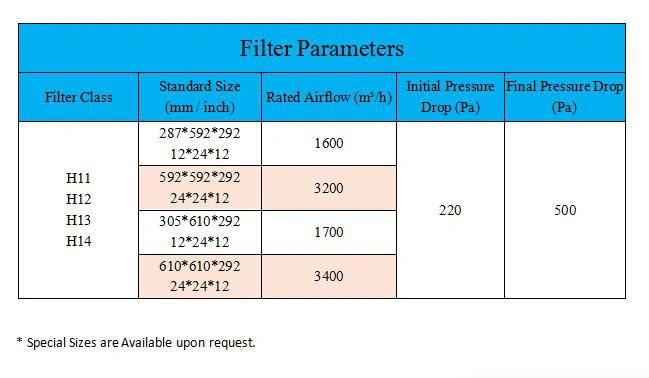
Before purchasing, you should confirm the installation dimensions of the filter, including: length, width, and thickness. Dimensional errors will cause installation difficulties or air leakage, so it is best to confirm according to the equipment drawings or original filter specifications. For non-standard equipment, customized sizes can also be selected.
3. Rated air volume
Each HEPA filter has a corresponding design air volume.
When purchasing, you need to confirm: rated air volume, maximum allowable air volume, and face wind speed. If the actual air volume exceeds the design range, it will not only increase the resistance, but also affect the filtration efficiency and shorten the service life.
4. Initial resistance (initial pressure drop)
Filter resistance directly affects the energy consumption of the air conditioning system.
Low resistance HEPA filters have the following advantages: reduce fan energy consumption, extend filter life, maintain stable air supply volume, and reduce long-term operating costs
Therefore, when the filtration efficiency is the same, products with lower initial resistance should be given priority.
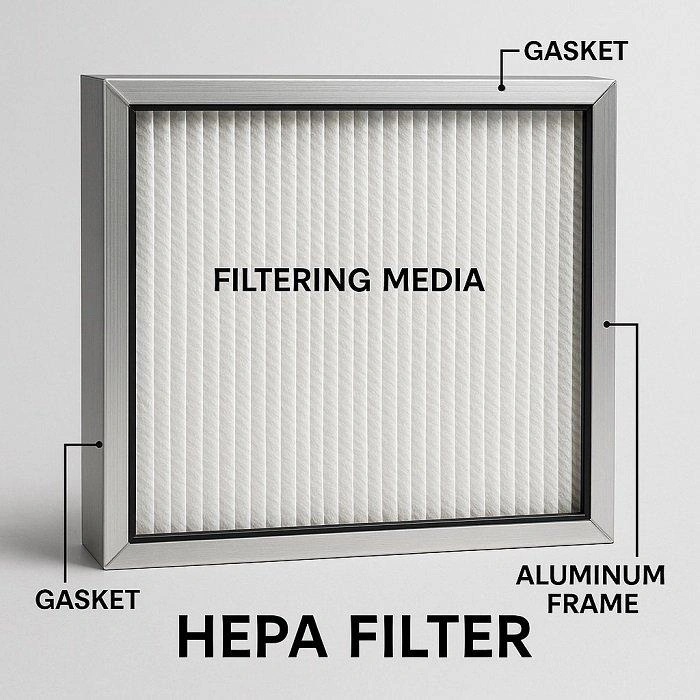
5. Filter media type and frame material
Filter media determines filtration performance and durability. Common filter materials include: ultrafine glass fiber filter paper, PTFE-coated filter material, and synthetic fiber filter material. At present, glass fiber filter paper is the most widely used, while PTFE filter material has the characteristics of low resistance, corrosion resistance, and non-hygroscopicity, and is suitable for special working conditions.
The filter frame is related to the overall strength and corrosion resistance. Common materials include: aluminum alloy, galvanized steel plate, stainless steel, medium density fiberboard (MDF), and ABS plastic. In high humidity or corrosive environments, it is often recommended to choose an aluminum alloy or stainless steel frame.
7. Sealants and gaskets
HEPA filters not only require high filter material efficiency, but also must ensure reliable sealing.
Common sealants include: polyurethane (PU) and silicone.
Common gaskets include: EPDM rubber, neoprene rubber, and silicone rubber.
At the same time, you should also confirm whether the installation position of the gasket matches the equipment to avoid bypass leakage.
8. Usage environment
Different working conditions place different requirements on HEPA filters.
Confirm before purchasing:
Operating temperature
Ambient humidity
Presence of corrosive gases
Exposure to chemicals
Whether high-temperature sterilization is required
Special environments may require high-temperature, corrosion-resistant or chemical-resistant HEPA filters.
9. Application industries
The filtration requirements of different application fields are different, for example:
Biosafety laboratory
Precision electronic manufacturing
Selecting corresponding specifications according to industry standards will help ensure long-term stable operation of the system.
10. Service life and replacement cycle
When purchasing HEPA filters, you should not just compare the unit price, but also consider the full life cycle cost.
Recommended attention:
Estimated service life
Replacement cycle
Energy cost
Maintenance cost
Later replacement cost
High-quality filters generally have a longer service life and lower operating costs, although they cost more to purchase.
11. Supplier qualifications
It is very important to choose suppliers with professional manufacturing capabilities.
Recommended key inspections:
ISO 9001 quality management system certification
Clean production workshop
Single unit leak detection capability
OEM/ODM customization capability
Stable production capacity
Technical support and after-sales service
Manufacturers with rich project experience can also provide professional product selection suggestions based on clean rooms and HVAC systems.
Summary
When purchasing HEPA filters, you should not only focus on filtration efficiency and size, but also comprehensively consider multiple factors such as air volume, initial resistance, filter material, outer frame, sealing performance, testing and certification, usage environment, and supplier strength.
Jiangsu Yueboyang Purification Equipment Co., Ltd. has been deeply involved in the field of air purification and filtration for many years. It can combine the actual working conditions of clean rooms and HVAC systems to fully match various parameter requirements for customers. Fully finalizing the above key indicators with professional manufacturers before purchasing can not only effectively improve the quality of air filtration, but also reduce system operation energy consumption, extend the service life of filters, and comprehensively ensure the long-term stable, safe and efficient operation of clean rooms and HVAC systems.


