
In a clean room environment, stable and uniform airflow distribution is a key factor in controlling air particles, ensuring product quality, and meeting cleanliness level requirements. High-efficiency filters (HEPA) are responsible for filtering pollutants from the air, while clean room air diffusers determine how clean air enters the room and affect the airflow pattern throughout the space.
The structural design, installation position and air supply method of the air diffuser will directly affect the air flow speed, air flow direction, temperature and humidity uniformity and particle removal efficiency in the clean room. If the diffuser is unreasonably selected, it may lead to problems such as local eddy currents, air flow short circuits, and accumulation of pollutants, which will reduce the operation effect of the clean room. Therefore, air diffusers are an important component in achieving efficient air control in cleanroom HVAC system design.
1. The main function of clean room air diffusers
Clean room air diffusers are usually installed on the ceiling or wall and are used to send filtered clean air evenly into the room. It not only undertakes the function of air transportation, but more importantly, controls the way the air flows.
Air diffusers mainly affect the following aspects:
Air supply direction and speed
Clean air coverage
Indoor air flow organization pattern
Pollutant dilution and removal efficiency
Temperature and humidity uniformity
In a complete clean room air treatment system, air diffusers are usually combined with HEPA High efficiency filter, FFU fan filter unit and return air system are used together to form a stable clean airflow environment.
2. How do air diffusers affect cleanroom airflow patterns?
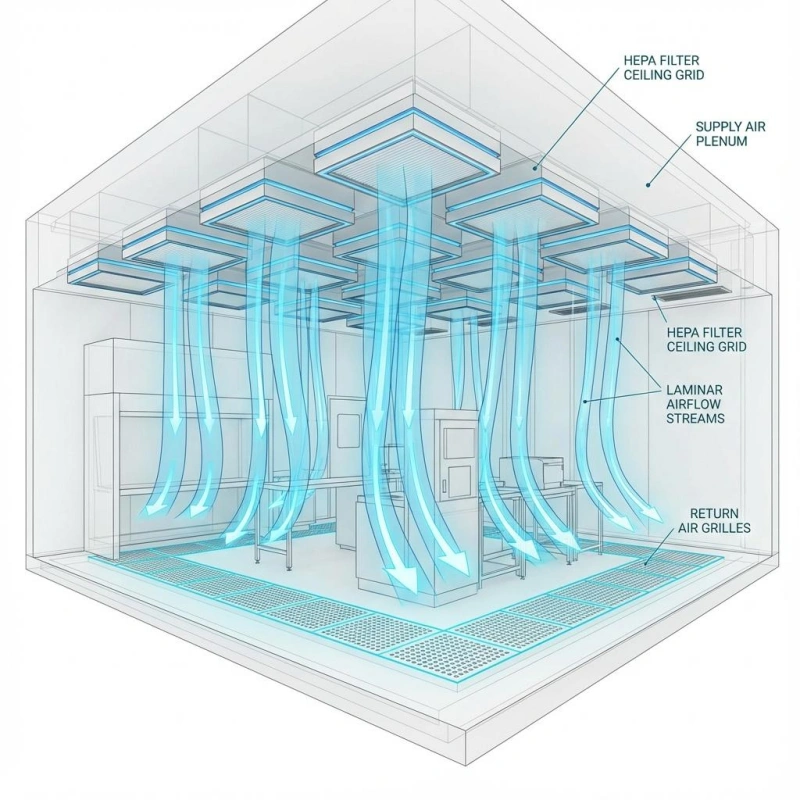
2.1 Vertical one-way flow airflow
For high cleanliness level places such as semiconductor manufacturing, biopharmaceuticals, laboratories, etc., vertical one-way flow design is usually used.
Clean air is sent vertically downward into the work area through a top-mounted air diffuser or FFU system, causing particles in the air to move downward with the airflow and be discharged through the return air outlet.
High-performance cleanroom air diffusers can help achieve:
Uniform vertical air supply
Reduce airflow turbulence
Maintain stable air speed
Reduce particle residence time
This airflow pattern is particularly suitable for ISO Class 5 and higher clean environment.
2.2 Turbulent mixed air flow
Some clean rooms adopt a non-unidirectional flow design, and clean air is sent into the room through the top air diffuser and fully mixed with the indoor air.
In this type of system, the design of the air diffuser affects:
Air mixing efficiency
Pollutant dilution speed
Indoor air circulation effect
If the air supply range of the air diffuser is insufficient, it is easy to form local air stagnation areas, preventing pollutant particles from being discharged in time, and reducing clean room performance.
3. Important design factors of clean room air diffusers
3.1 Air supply speed control
Air supply speed is a key parameter that affects the stability of clean room air flow.
If the air supply speed is too high:
It is easy to cause air flow turbulence
Increase the risk of particle diffusion
Affect the precision production process
If the air supply speed is too low:
May reduce pollutant removal efficiency
Cause local pollution accumulation
Therefore, clean room air diffusers need to be designed according to the following factors:
Cleanliness level requirements
Room height
Equipment layout
Process environment requirements
HVAC system air volume
3.2 Diffuser structure and air supply direction
Air diffusers with different structures will produce different airflow effects.
Common types include:
HEPA filter integrated air supply diffuser
Usually used in high-clean areas, delivering filtered air directly to the clean room through high-efficiency filtration at the end.
Used in areas where uniform unidirectional airflow is required to reduce air turbulence.
Perforated air diffuser
Through the uniform opening design, low turbulence air supply is achieved.
Cyclone air diffuser
It is mainly used in clean environments that require air mixing to improve air exchange efficiency.
The air outlet structure, internal flow guide design and installation method of the air diffuser will all affect the final airflow distribution effect.
4. The relationship between air diffusers and clean room pollution control
One of the biggest risks in a clean room is particle pollution in the air. Although HEPA filters can remove particulate matter from the air, only proper airflow organization can effectively remove pollutants.
A quality clean room air diffuser can:
Deliver clean air evenly
Shorten the residence time of particles
Reduce the air stagnation area
Maintain a positive pressure environment in the clean room
For the following industries, air diffuser performance is particularly important:
Semiconductor manufacturing industry
Pharmaceutical production industry
Medical device industry
Food processing industry
Biology laboratory
A stable airflow environment can improve product quality and reduce the risk of contamination.
Conclusion
Clean room air diffuser is a key device that affects air flow distribution, pollution control and environmental stability. The HEPA filter is responsible for filtering pollution particles in the air, while the air diffuser determines whether the clean air can cover the entire clean area evenly and efficiently. By rationally selecting the type of air diffuser, optimizing the installation location, and combining it with the design requirements of the clean room HVAC system, the air flow efficiency can be effectively improved, the risk of contamination can be reduced, and the energy efficiency can be improved at the same time.


