
HVAC system is an important infrastructure for industrial plants, commercial buildings, hospitals, clean rooms and laboratories. Its stable operation directly affects indoor air quality, temperature and humidity control and energy consumption. However, during long-term operation, the system often encounters problems such as insufficient air volume, stuck air valves, and blocked air outlets. This not only reduces the efficiency of the air conditioning system, but may also lead to reduced cleanliness, increased energy consumption, and equipment failure.
Timely discovery of fault causes and taking scientific maintenance measures can effectively restore system performance, extend equipment service life, and reduce operating costs. This article will introduce the common fault causes and corresponding solutions of HVAC systems to help users quickly diagnose and optimize system operation.
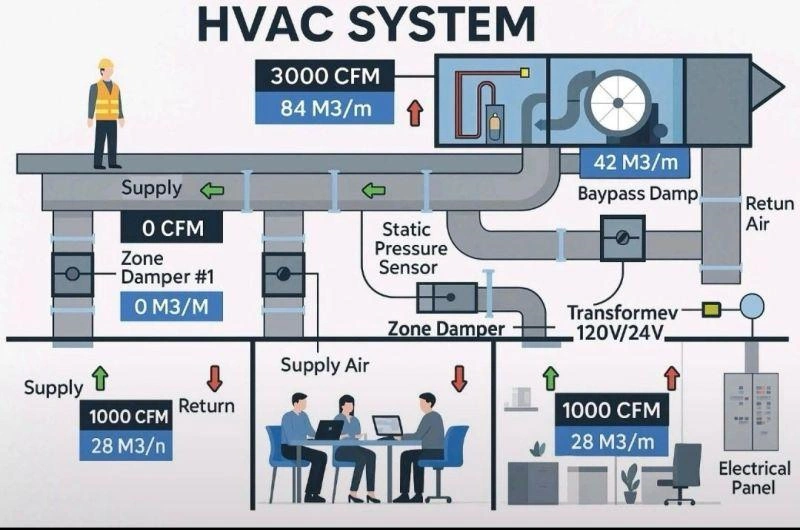
Common reasons for insufficient HVAC air volume
Insufficient air volume is one of the most common problems in HVAC systems. Its manifestations include decreased air supply volume, failure of indoor temperature to reach the set value, uneven heating and cooling in local areas, etc.
Common causes include:
The air filter is clogged and the system resistance increases.
The fan impeller is dusty or worn, causing the fan efficiency to decrease.
The fan belt is loose or damaged.
The air valve opening angle is insufficient.
The air duct is leaking.
The air duct design is unreasonable and the local resistance is too large.
The fan motor fails or the speed drops.
VAV system control abnormality.
Solution
For insufficient air volume, the following measures can be taken:
Regularly replace primary-efficiency, medium-efficiency and HEPA filters.
Clean the fan impeller to restore fan efficiency.
Check the belt tension and replace the aging belt in time.
Check whether each air valve is fully open and readjust the air volume.
Check whether there is air leakage at the air duct connection and seal it.
Conduct air volume balance debugging (TAB) on the system.
Check the operating status of the motor, power supply and inverter.
Calibrate VAV control system and air volume sensor.
Causes and solutions to damper stuckness
The damper is responsible for regulating the air volume, pressure difference and air flow direction of the system. Once stuck, it will directly affect the normal operation of the HVAC system.
Common causes include:
Long-term lack of lubrication of the valve shaft.
Dust or debris enters the valve body.
The actuator is damaged.
The linkage mechanism is loose or deformed.
Long-term inactivity causes corrosion.
The control signal of the electric actuator is abnormal.
Solution
It is recommended to take the following measures:
Clean the inside of the damper regularly.
Add lubricant to the valve shaft and transmission parts.
Check whether the actuator operates normally.
Replace damaged connecting rods or bearings.
Check the control circuit and feedback signal.
Regularly test the air valve switch to prevent it from getting stuck due to long-term deactivation.
For hospitals, clean rooms and biosafety laboratories, the sealing performance of high-tightness air valves should be tested regularly to ensure the safety and reliability of the system.
Causes and treatment methods of blocked air vents
The air supply and return vents are responsible for even distribution of air. If clogged, it will affect the air supply effect of the entire HVAC system.
Common causes of blockage include:
Long-term accumulation of dust.
The filter was not cleaned in time.
Decorative materials block the air vents.
Insects or foreign objects enter the air duct.
A large amount of dust is generated during clean room maintenance.
Blocked air vents usually lead to:
Insufficient local air volume.
The room temperature is uneven.
Noise increases.
Energy consumption increases.
The pressure difference in the clean room is abnormal.
Solution
It is recommended to regularly:
Clean the air supply and return vents.
Clean or replace the air inlet filter.
Keep the area around the air outlet clear.
Check whether there are foreign objects inside the air duct.
Comprehensively clean the clean room air supply system.
How to prevent HVAC system failure?
Compared with fault repair, it is more important to establish a complete preventive maintenance system.
The following maintenance schedule is recommended:
Monthly inspection
Check the filter pressure differential.
Check the operating status of the fan.
Check whether the air valve operates normally.
Clean the air supply and return vents.
Quarterly inspection
Check the fan belt and bearings.
Measure air volume and wind pressure.
Calibrate the air volume sensor.
Check the actuator and control system.
Annual maintenance
Replace the air filter that has reached the end of its life.
Conduct air volume balance testing (TAB) on HVAC systems.
Detect air leakage in air ducts.
Check the sealing performance of the high-tightness air valve.
Perform comprehensive maintenance on the AHU.
Establishing a standardized maintenance system can effectively reduce sudden failures and improve system operation stability.
Conclusion
Hospitals, clean workshops, pharmaceutical factories, biological laboratories, food processing and other places have strict standards for air quality. Only by selecting high-quality air filters, dampers, and diffuse air supply equipment, coupled with standardized and professional HVAC system operation and maintenance management, can we build a safe, stable, and efficient air treatment system.
Boyang Purification is deeply involved in the field of purification HVAC supporting equipment. It can tailor a full range of filtration, dampers, and air supply end products for high-clean scenes such as medical, pharmaceutical, food, and laboratories, and provide suitable system supporting suggestions. Complete hardware selection and systematic operation and maintenance services can build a strong clean air defense line for enterprises in an all-round way and create a safe, stable, long-term and efficient overall air treatment solution.


