
As semiconductor manufacturing processes continue to develop towards higher precision, clean room air control systems have become an important part of ensuring product yield. From wafer processing, photolithography, etching to packaging testing, each process requires a stable clean environment, and air volume control and air sealing performance directly affect the temperature, humidity, pressure difference and air cleanliness level of the clean room. Against this background, closed air volume dampers have been widely used in semiconductor factories, new energy electronic workshops, biological laboratories and high-level clean projects due to their excellent low air leakage performance and precise air volume adjustment capabilities.
Traditional air valves usually use ordinary metal valve plates with mechanical opening methods. During long-term operation, air leakage is prone to occur due to factors such as insufficient processing accuracy, aging sealing strips, and increased valve shaft clearance. When the air valve is closed, air will still leak through the edges of the valve plate, valve shaft connections and structural gaps. This not only increases the energy consumption of the air conditioning system, but also affects the pressure difference control of the clean room, and even leads to air cross-contamination between different clean areas. For ISO Class 5 and above semiconductor clean workshops, any tiny air leakage may affect the stability of the production environment.
The core design of the low air leakage sealed air volume damper is first reflected in the valve body structure. High-quality products are usually integrally processed and formed from high-strength galvanized steel plates, stainless steel or aluminum alloys. Through CNC laser cutting and high-precision bending processes, the dimensional accuracy of the valve body is improved, structural errors are reduced, and the valve plate and valve frame are evenly fitted, thereby reducing the air leakage rate from the source.
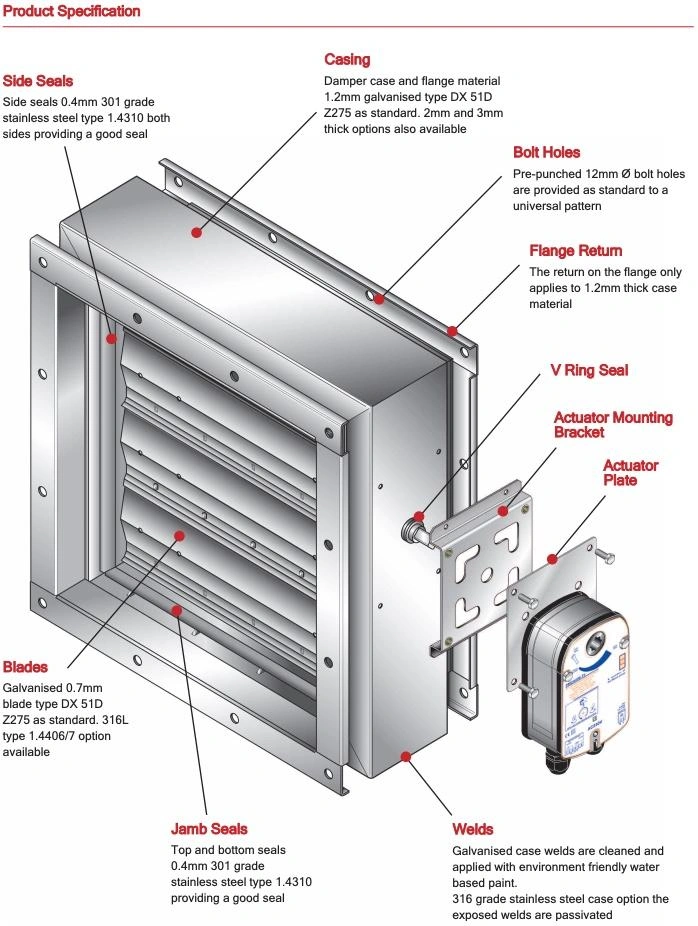
Secondly, the sealing system is an important factor in determining the performance of the air valve. At present, high-level clean systems generally use EPDM rubber, silica gel or other aging-resistant sealing materials. A continuous sealing structure is designed around the valve plate, and a multi-point compression mechanism is used to form a stable and uniform sealing pressure when the air valve is closed. Compared with ordinary dampers, this structure can effectively reduce edge leakage, maintain good sealing performance after frequent opening and closing for a long time, and reduce maintenance costs.
Valve shaft seal is also an important part of low air leakage design. Most of the air leakage of traditional air valves occurs at the valve shaft position, while high-performance closed air valves usually use double-layer bearing seals, wear-resistant sealing rings and precision-machined bushings to effectively reduce axial clearance and reduce air leakage. At the same time, the high-quality actuator can ensure accurate opening and closing positioning of the valve plate and avoid sealing failure due to deviation.
For modern intelligent clean factories, closed air volume dampers can usually be linked with building automation systems (BAS), clean room monitoring systems and PLC control systems to achieve air volume adjustment, pressure difference control, temperature and humidity adjustment and equipment operating status monitoring. Some products also support analog control, Modbus, BACnet and other communication protocols, and can automatically adjust the opening according to feedback from the pressure difference sensor and air volume sensor, improving the automation level and energy efficiency of the entire HVAC system.
In addition, during the product manufacturing process, high-quality air valves usually need to undergo air leakage tests, air tightness tests, opening and closing life tests and actuator linkage tests to ensure that the products meet the long-term continuous operation requirements of clean rooms. For industries such as semiconductors, chip manufacturing, biopharmaceuticals, and laboratory engineering, choosing low-leak airtight air volume dampers that have undergone strict quality testing can not only improve the stability of the clean environment, but also effectively reduce the energy consumption of the air conditioning system and extend the service life of the equipment.
As the semiconductor industry continues to upgrade, high-grade clean rooms have increasingly stringent requirements for air control equipment. In the future, Low air leakage sealed air volume damper will continue to develop towards higher sealing performance, smarter control, lower energy consumption and longer service life, providing safer, more stable and efficient air control solutions for clean projects.


