


Low initial resistance, no progressive pressure loss
Reduce HVAC system operating costs
Simple loading and unloading steps
Improve and enhance indoor air quality Can be matched with different types of filter media
The filter media has a large filling capacity and a long service life
A chemical filter that can be used to improve air quality.
It has a wide range of applications and can be used with different filter materials to provide effective gaseous chemical filtration.
The following is an introduction to some application fields:
Semiconductor - front-end process (AMC control)
Semiconductor - back-end packaging and testing and other processes (corrosion, pollution and AMC control)
Commercial buildings - office buildings and public buildings (corrosion control and air quality control) Industrial production processes, etc. (corrosion and pollution control)
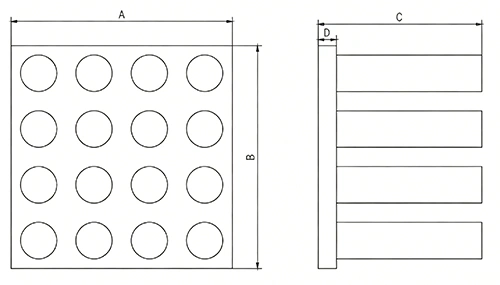
Model | Frame length (A) | Frame width (B) | Carbon cylinder depth (C) | Rated air volume (CMH) | Resistance (Pa) | Filter bed depth D (mm) | Number of carbon cartridges |
CT16-450 | 610 | 610 | 450 | 3400 | <15 0@2.5m/s | 26 | 16 |
CT8-450 | 305 | 610 | 450 | 1700 | <150@2.5m/s | 26 | 8 |
CT4-450 | 305 | 305 | 450 | 850 | <150@2.5m/s | 26 | 4 |
CT16-600 | 610 | 610 | 60 0 | 3400 | <150@2.5m/s | 26 | 16 |
CT8-600 | 305 | 610 | 600 | 1700 | <150@2.5m/s | 2 6 | 8 |
CT4-600 | 305 | 305 | 600 | 850 | <150@2.5m/s | 26 | 4 |
In industrial production and indoor air treatment, gaseous pollutants often cannot be effectively removed by conventional particulate filters. Cylindrical activated carbon filters use physical adsorption to provide thorough treatment of gaseous pollutants, significantly improving air quality, protecting personnel health, and maintaining a stable production environment.
Compared with conventional flat-panel or bag-type activated carbon filters, the cylindrical structure offers lower airflow resistance, higher adsorption efficiency, and a longer service life.
Select granular, honeycomb, or modified activated carbon according to the target pollutants. Confirm media suitability based on gas composition, inlet concentration, and treatment requirements.
The cylindrical structure allows multiple cartridges to be installed within a filter housing. Check airflow direction, carbon bed thickness, and cartridge quantity to ensure proper airflow distribution.
Adsorbs VOCs and odors compatible with the selected carbon media. Actual performance depends on pollutant concentration, temperature, humidity, contact time, and remaining adsorption capacity.
Determine cartridge quantity according to the airflow capacity of each cartridge and total system airflow. Check pressure drop at actual operating airflow to avoid exceeding the fan’s available pressure.
Cartridges can be individually removed and replaced, simplifying maintenance and spare parts management. Confirm mounting connections, removal procedures, and maintenance access before purchasing.
Support and retention structures reduce media movement and particle escape. For humid conditions, also check housing corrosion resistance and the carbon media’s operating requirements.
Different activated carbon performance grades can be selected according to operating conditions. Indicators such as iodine value support comparison, but selection should also consider adsorption data for the target gas.
Used in the gas filtration stage of fresh air or return air systems to treat specific odors and gaseous pollutants. Check unit airflow, filter housing dimensions, and allowable pressure drop.
Suitable for ventilation systems requiring gaseous pollutant control. Specify the chemicals and their concentrations, and combine the filter with the particulate filtration and exhaust measures required by the project.
Used for gas filtration and odor control after confirming suitability for the operating conditions. Determine the installation location according to cleanliness requirements, pollutant sources, and maintenance conditions.
Used in air treatment systems requiring control of airborne molecular contaminants. Specify target substances, required outlet concentrations, and carbon media cleanliness requirements.
Can serve as an adsorption stage in odor collection systems. Select media according to actual pollutants, such as hydrogen sulfide and ammonia, and assess humidity and pretreatment requirements.
Used for odor control in ventilation systems serving office buildings, shopping malls, and underground spaces. Specify odor sources, operating hours, airflow, and available installation space.
Can serve as an adsorption unit following an assessment of operating conditions. Calculate capacity based on gas composition, concentration, temperature, and humidity, and confirm pretreatment requirements for dust, oil mist, and other contaminants.
Cartridge diameter, length, and mounting connections can be customized to fit the equipment space. For replacement projects, provide photos and drawings of the existing cartridge to verify sealing and fixing methods.
Select granular, honeycomb, or modified activated carbon according to the target gas. Provide pollutant names, concentrations, temperature, and humidity to help confirm suitable media.
Carbon specifications such as iodine value and CTC can be confirmed according to project requirements. Use target gas adsorption data to assess filling quantity and the expected replacement interval.
Options include galvanized sheet steel, stainless steel, and aluminum alloy. Confirm the configuration according to environmental corrosiveness, operating temperature, weight limits, and cleaning requirements.
Determine cartridge quantity according to total system airflow, individual cartridge capacity, and allowable pressure drop. Also check carbon bed thickness, contact time, and available installation space.
Structure, mounting connections, packaging, and brand markings can be customized. Provide technical drawings, purchase quantity, and delivery requirements when requesting a quotation to help confirm the production plan.
Years of experience in air filtration and purification
Standardized production system with consistent, reliable quality
Support for small trial orders and bulk supply
Strict pre-shipment inspection and performance testing
Prompt response to customization requests and technical support needs
Global export experience and adaptation to different market standards
For detailed specifications, selection recommendations, or pricing for cylindrical activated carbon filters, please provide:
Airflow requirements
Installation dimensions or equipment model
Operating environment (industrial / commercial / cleanroom, etc.)
Specific filtration requirements, such as VOC types
We will provide a professional selection proposal and our best quotation.
Looking for a reliable manufacturer of air filtration, air distribution, and cleanroom equipment? We provide high-quality products, competitive factory pricing, and flexible OEM/ODM customization services for global customers, meeting the diverse needs of industrial, medical, cleanroom, and HVAC projects.
We can arrange third-party inspection and issue this attestation for each shipment, supporting customs clearance and L/C presentation.
Address: No. 458 Jiangping Road, Jingjiang City, Jiangsu Province, China
Payment Terms: L/C, T/T, D/P
International Trade Terms: FOB, CFR, CIF, DAP, EXW
Average Lead Time: Peak season: one month; off season: within 15 working days
Nearest Port: Shanghai
Looking for a reliable supplier of air filtration, air distribution, or cleanroom system products? We provide factory-direct pricing, customized OEM/ODM services, and complete engineering project solution support.
Submit your requirements, and our engineering team will provide a dedicated solution and quotation within 12 hours, including detailed product specifications and delivery lead time.


