

Save installation space
Reduce operating costs of HVAC systems Simple loading and unloading steps
Improve and improve indoor air quality Low dust generation
Applicable surface wind speed:<25m/s
Can target different types of gaseous molecular pollutants (AMC), Use the corresponding filter material formula
Plate activated carbon (non-woven fabric) is a chemical filter that can be used to improve air quality. It has a wide range of applications and can be used with different HVAC systems to provide effective gaseous chemical filtration.
It can be installed in ventilation and air conditioning systems with tight space.
The following is a brief introduction to some application fields:
Commercial and civil buildings such as airports, high-end hotels, office buildings, large shopping malls, etc.
Optimize the filtration function of the existing comfort air conditioning system.
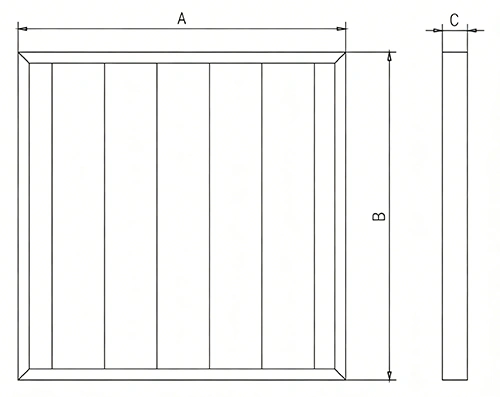
Product parameters | PP-PCN | PP-PAA | PP-GAC | PP-PHD |
Standard nominal size | 592x592x45 | 592x592x45 | 592x5 92x45 | 592x592x45 |
Rated air volume (CMH) | 3400 | 3400 | 3400 | 3400 |
Resistance (Pa) | <160@2.54m/s | <160@2.54m/s | <160@2.54m/s | <160@2.54m/ |
Filter Timber area (m²) | 2.48 | 2.48 | 2.48 | 2.48 |
Number of pleats | 53 | 53 | 53 | 53 |
Filter box material | Plated Zinc plate, aluminum, plastic | Galvanized plate, aluminum, plastic | Galvanized plate, aluminum, plastic | Galvanized plate , aluminum, plastic |
Target gaseous molecular pollutants |
| Alkaline gaseous molecules (NH3) | Condensable gaseous molecules (VOC) |
|
For air treatment systems with limited space and strict cost requirements, activated carbon panel filters offer a cost-effective solution. Compared with honeycomb or cylindrical designs, this product features a thinner, lighter structure and more flexible installation, making it suitable for standardized equipment and retrofit projects.
The nonwoven composite structure improves the uniformity of activated carbon distribution, providing more consistent adsorption performance while reducing the risk of carbon dust release.
Suitable for installation in air handling units, filter housings, and equipment modules. Check frame dimensions, thickness, fastening methods, and sealing requirements for new installations or replacements.
Activated carbon is combined with nonwoven fabric to form a thin adsorption layer. Confirm the composite construction, carbon retention method, and requirements for carbon dust shedding.
Adsorbs VOCs and odors compatible with the selected carbon media. Specify gas composition, concentration, and treatment targets, and assess suitability based on temperature and humidity.
Suitable for fresh air equipment and air purification modules with limited installation depth. Check media thickness, carbon content, and treatment requirements rather than selecting by dimensions alone.
Select filtration area and media configuration according to equipment airflow. Verify the initial pressure drop at the actual operating airflow against the fan’s available static pressure.
Carbon media can be selected according to the target gas. Review gas adsorption data and carbon content; iodine number alone cannot determine the product’s treatment capability.
Specifications can be matched to air openings, filter housings, or air handling units. For replacements, provide existing filter dimensions, photos, and operating airflow to verify installation compatibility.
Can be used in the gas filtration stage of fresh air or return air systems. Confirm target odors, operating airflow, and allowable pressure drop, and configure upstream filtration according to dust loading.
Treats specific odors in fresh air systems for offices, hotels, and shopping centers. Specify odor sources, operating hours, and available installation space within the unit.
Used for ventilation odor control in support areas after operating conditions have been assessed. Specify gas types and concentrations, and provide particulate filtration and exhaust measures according to project requirements.
Suitable for air treatment equipment requiring odor control. Check pollutant sources, recirculation airflow, and maintenance conditions to determine media configuration and replacement schedules.
Can be used for ventilation odor treatment in auxiliary areas. Specify odor sources, oil mist, and humidity conditions to determine whether pretreatment or specialized carbon media is required.
Can be used for low-load gas adsorption applications following an assessment. Calculate capacity based on pollutant concentration, airflow, and operating hours to confirm the suitability of a thin composite layer.
Suitable for equipment integration and retrofit projects with limited space. Check installation interfaces, airflow direction, sealing methods, and replacement access to facilitate module integration.
Determine length, width, and thickness according to equipment openings, guide rails, and installation depth. For replacements, provide photos or drawings to verify dimensional tolerances and sealing structures.
Assess carbon type and content based on target gases, concentrations, and operating hours. When increasing carbon loading, also check pressure drop, media thickness, and equipment space.
Determine fabric basis weight and composite construction according to support strength, carbon retention, and pressure drop requirements. Provide dust shedding limits and operating temperature and humidity conditions.
Galvanized steel, aluminum alloy, and plastic frames are available. Select materials according to environmental corrosivity, operating temperature, weight limits, and installation methods.
Configure the media according to target pollutants, treatment airflow, and allowable pressure drop. Gas adsorption performance must be verified separately and cannot be evaluated using particulate filtration efficiency.
Custom dimensions, frames, packaging, and brand identification are available. Provide technical drawings, purchase quantities, and delivery requirements when requesting a quotation to confirm production and supply arrangements.
Extensive experience in manufacturing air filtration products
Standardized production with consistent, reliable quality
Batch production in multiple specifications
Established activated carbon composite manufacturing processes
Prompt response to customization requirements
Extensive export experience to meet international project requirements
For selection assistance or a quotation for activated carbon panel filters (nonwoven), please provide:
Required airflow
Installation dimensions or equipment model
Operating environment, such as commercial, industrial, or clean air systems
Specific gas or odor control requirements
We will provide professional selection recommendations and the best quotation for your requirements.
Looking for a reliable manufacturer of air filtration, air distribution, and cleanroom equipment? We provide high-quality products, competitive factory pricing, and flexible OEM/ODM customization services for global customers, meeting the diverse needs of industrial, medical, cleanroom, and HVAC projects.
We can arrange third-party inspection and issue this attestation for each shipment, supporting customs clearance and L/C presentation.
Address: No. 458 Jiangping Road, Jingjiang City, Jiangsu Province, China
Payment Terms: L/C, T/T, D/P
International Trade Terms: FOB, CFR, CIF, DAP, EXW
Average Lead Time: Peak season: one month; off season: within 15 working days
Nearest Port: Shanghai
Looking for a reliable supplier of air filtration, air distribution, or cleanroom system products? We provide factory-direct pricing, customized OEM/ODM services, and complete engineering project solution support.
Submit your requirements, and our engineering team will provide a dedicated solution and quotation within 12 hours, including detailed product specifications and delivery lead time.


